
From getting men to the moon to iconic symbols of liberty used by Civil Rights leaders, America’s historical landmarks have all contributed to the country’s national identity and values.
These iconic landmarks each tell a story of the country’s rich history. Learn about the bloody battles that took place during the Texan Revolution, visit the homes of former US presidents, and get up close to great engineering feats.
Walk through the graves of fallen soldiers, visit remote high-security prisons, or stand at the site of Martin Luther King’s ‘I have a dream’ speech. Each of these landmarks showcases how diverse and complex US history is.
33. Monticello, Charlottesville

When you visit Monticello, you get a glimpse into Thomas Jefferson’s life and ideas. His house sits on a hilltop just outside Charlottesville, Virginia.
Walking through the house, you’ll notice clever designs like hidden beds and unique gadgets. The rooms show what life was like in the 18th and 19th centuries.
Outside, you can stroll the gardens and take in views of the Blue Ridge Mountains. The grounds are peaceful, and there’s a lot to see, including the vegetable garden and burial site.
Monticello is also a place to reflect on Jefferson’s role in history, including the lives of the enslaved people who lived and worked there. Guided tours share important stories about all who were part of this landmark.
32. Ellis Island, New York

When you visit Ellis Island, you step into a place where millions of immigrants first entered the United States. From 1892 to 1954, over 12 million people passed through the Great Hall, hoping for a new start.
Today, the restored Great Hall looks much as it did a century ago. Walking through the halls, you can see old photos, personal stories, and artifacts that tell the story of American immigration.
You can get to Ellis Island by ferry from Battery Park in New York City. The trip includes both Ellis Island and the nearby Statue of Liberty if you want to visit both sites.
Exploring the museum, you’ll learn how people from all over the world made America their home. The exhibits are easy to follow and great for visitors of any age.
31. Mission San Juan Capistrano, California

You’ll find Mission San Juan Capistrano in Southern California, founded back in 1776. This mission is one of the oldest buildings in California and has a mix of Spanish and early Californian history.
Walking around, you’ll see beautiful gardens, old stone ruins, and the famous Serra Chapel, where Mass still happens after more than 200 years. Don’t skip the bell wall, where you can listen to daily bell ringing.
Every March, the mission gets thousands of visitors hoping to spot the swallows returning. The atmosphere is peaceful, and there are plenty of exhibits showing artifacts and paintings. If you want to learn about California’s past, this spot makes it easy and interesting.
30. Taos Pueblo, New Mexico

When you walk into Taos Pueblo, you step into a community that’s been lived in for over 1,000 years. The adobe buildings look much like they did centuries ago, with their earthy tones and thick walls.
Taos Pueblo isn’t just old—it’s also the only Native American community in the U.S. that’s both a UNESCO World Heritage Site and a National Historic Landmark. About 150 people still live here full-time, keeping their traditions alive.
You’ll notice the main area is small and surrounded by lands owned by the Pueblo. A fee is charged for visitors, but it helps support this unique village. The setting, under the Sangre de Cristo Mountains, feels peaceful and far from city life.
29. Faneuil Hall, Boston

You’ll find Faneuil Hall right in downtown Boston, close to the city’s historic waterfront. It’s been here since 1742 and was a meeting place for some of the earliest protests that led up to the American Revolution.
When you visit, you can check out the National Park Service Visitor Center on the first floor. They have maps, exhibits, and helpful staff who can answer your questions.
Outside, you’ll see street performers and vendors. It feels lively and upbeat almost every day. Faneuil Hall is also right along the Freedom Trail, so it’s easy to fit in with other historic sites.
Whether you’re interested in history, food, or just exploring, there’s plenty to see nearby, like the Old State House and Paul Revere House. Each place adds another layer to Boston’s story.
28. The Greenbrier Historic Resort Hotel, West Virginia

You’ll find The Greenbrier in the mountains of West Virginia, surrounded by trees and natural springs. This resort has been welcoming guests since 1778, making it one of the oldest in the United States.
You can stroll across its 11,000-acre grounds or check out the grand main hotel, opened in 1913. The property is full of history and interesting stories.
During the Cold War, a secret bunker for Congress was hidden under the hotel. It stayed hidden for about 30 years before people found out. Today, you can tour this bunker and get a look at a unique part of U.S. history.
You might also spot a few famous names on guest lists here, including many presidents. The Greenbrier isn’t just fancy—it’s a true historic landmark.
27. Mount Rushmore, South Dakota

When you visit Mount Rushmore, you’ll see huge faces of four U.S. presidents carved into a granite mountain. The site is in the Black Hills, a high area over 5,700 feet above sea level in South Dakota.
George Washington, Thomas Jefferson, Theodore Roosevelt, and Abraham Lincoln are the presidents honored here. The carving took about 14 years, from 1927 to 1941, and required a lot of hard work and planning.
A trip here is more than just looking at the sculptures. You can walk along trails and stop by the visitor center to learn about how the monument was built. The views of the Black Hills from the memorial are also pretty interesting.
Remember to bring a camera—the sculptures are even bigger than you expect up close. It’s an experience you won’t easily forget.
26. Mackinac Island, Michigan

You won’t find cars on Mackinac Island, so you get around by walking, biking, or riding in horse-drawn carriages. This island in Lake Huron feels like you’ve stepped back in time.
Fort Mackinac stands as the island’s main historic site. Built by the British in the late 1700s during the American Revolution, it’s full of stories from the past. You can explore its old stone buildings and watch historic reenactments.
There’s more than just the fort. You’ll find some of Michigan’s oldest homes and churches scattered around the island. Even the downtown has buildings dating back over a century.
Historians and sightseers alike love the state park, which covers most of the island. You’ll spot unique landmarks, natural rock formations like Arch Rock, and beautiful lake views at every turn.
25. Fort Sumter, Charleston

When you visit Fort Sumter in Charleston Harbor, you’ll step onto the site where the first shots of the Civil War were fired in 1861. You can only get there by ferry, which leaves from downtown Charleston or Patriots Point.
There’s no entrance fee for the fort, but you do have to buy a ticket for the ferry. The ride to the fort takes you through the harbor with great views along the way. Most visits, including the ferry trip and your time at the fort, last about 2-3 hours.
Fort Sumter has a visitor education center where you can learn more about the fort’s history before you ride out. The site is accessible, including a lift at the fort, so everyone can explore. You’ll find exhibits, cannons, and plenty of stories about this key moment in U.S. history.
24. John A. Roebling Suspension Bridge, Ohio/Kentucky

You can find the John A. Roebling Suspension Bridge connecting Cincinnati, Ohio to Covington, Kentucky. This bridge opened in 1866 and was the longest suspension bridge in the world at that time.
When you walk across, you’ll spot views of the Ohio River and both city skylines. The bridge’s design came from John A. Roebling, the same engineer who later designed the Brooklyn Bridge.
Locals and visitors cross it on foot, by bike, or by car. During special events and game days, you’ll see crowds heading over to stadiums and downtown areas. The structure itself is a symbol of engineering progress from the 1800s.
If you visit, you’ll be standing on a piece of American history over 150 years old. Plus, it’s a great spot for photos, especially at sunset.
23. Mesa Verde, Colorado

When you visit Mesa Verde, you get a real sense of how people lived hundreds of years ago. The cliff dwellings built by the Ancestral Puebloans are carved right into the rock faces.
Cliff Palace stands out as the largest and most well-known site. You can see towers, rooms, and kivas that were once filled with families.
Long House is another impressive spot. It’s pretty big, with over 20 kivas and enough space for more than a hundred people. Walking through these sites, you’ll notice stone walls and old storage rooms.
The park is in southwest Colorado, surrounded by canyons and mesas. Guided tours let you get up close to the ruins and learn more about the history. If you go in June, you’ll find pleasant weather for exploring.
22. Statue of Liberty, New York

You’ll find the Statue of Liberty standing tall on Liberty Island in New York Harbor. It was a gift from France in 1886 and quickly became a symbol of hope, freedom, and welcome for newcomers to America.
If you visit, you can walk around the base or take a ferry ride for incredible views. The torch and crown are famous, though climbing up can be tough since there are a lot of stairs.
The statue was once the tallest structure in New York when it was put together in 1885. Today, it still brings people from all over the world who want to see what it stands for—liberty and a fresh start.
21. Great Serpent Mound, Ohio

If you ever drive through southern Ohio, you’ll find the Great Serpent Mound waiting for you in Adams County. This giant earthwork looks like a snake winding across the land and measures over 1,300 feet long. You don’t see something like this every day.
No one knows for sure who built it, but many think it was created by ancient Native American cultures like the Adena or Fort Ancient people. Archaeologists still debate about its true age and exact purpose.
Some believe the mound lines up with the sun and moon at certain times of the year, like during the summer solstice. You can walk along the trails around the mound for a closer look. There’s also a visitor center where you can learn more about the site and its history.
20. Mount Vernon, Virginia

Mount Vernon was the home of George Washington, the first President of the United States. You can walk through the historic mansion and see where Washington lived and worked.
The estate sits on the banks of the Potomac River in Virginia. There are guided tours of the mansion, gardens, and the slave quarters. The museum and education center have artifacts and exhibits about Washington’s life.
You can also visit the working distillery and gristmill which are not far from the main house. The grounds are large, so you might want to plan plenty of time for your visit. There’s even a restaurant and a big gift shop for visitors.
Mount Vernon is located at 3200 Mount Vernon Memorial Highway in Mount Vernon, Virginia.
19. Saint Michael’s Cathedral, Alaska

When you visit Sitka, you’ll spot Saint Michael’s Cathedral right in the heart of downtown. It’s hard to miss with its green dome and Russian-style architecture.
Built between 1844 and 1848, this church is one of the most important reminders of Russian influence in Alaska. For over three decades, it served as the main center for the Russian Orthodox Church in North America.
Step inside and you can see beautiful icons and woodwork. Some items today date back to the 1800s. The building was rebuilt in 1976 after a fire but still matches the original look.
Saint Michael’s Cathedral is still active and welcomes visitors. If you’re interested in history, this spot connects you to a time when Alaska was very different from the rest of America. You can experience a real mix of cultures just by walking through the doors.
18. Little Rock Central High School, Arkansas

You’ll find Little Rock Central High School right in Little Rock, Arkansas. It looks like a regular school from the outside, but it played a huge role in the Civil Rights Movement.
In 1957, nine Black students, known as the Little Rock Nine, entered this school for the first time. Their courageous steps helped end school segregation in the United States.
The school is still open and used by students today. You can visit the National Historic Site across the street, which shares stories from that intense time.
If you want to take a guided tour of the school building itself, you’ll need to make a reservation ahead of time. Being there feels different than reading about it—history comes alive right in front of you.
17. Fort Union Trading Post, Montana

You’ll find Fort Union Trading Post right on the border between Montana and North Dakota. It sits near the spot where the Missouri and Yellowstone rivers meet. From 1828 to 1867, this spot was huge for the fur trade in the Upper Missouri region.
You can walk along the white walls and see the bright red roofs that many travelers recognized years ago. Inside, traders from different Native American tribes met with people from around the world. They swapped buffalo robes and furs for things like beads, guns, blankets, and cloth.
When you visit, you’ll learn about the Assiniboine, Sioux, Blackfeet, and other tribes who traded here. The reconstructed fort shares their stories and how they worked together in this busy outpost. The peaceful exchanges at Fort Union show a different side of history on the frontier.
16. Fallingwater, Pennsylvania

You’ll find Fallingwater tucked away in the woods of southwestern Pennsylvania. This unique house was designed by Frank Lloyd Wright in 1935 for the Kaufmann family.
What makes Fallingwater special is that it sits right over a waterfall. You can hear the water beneath your feet as you tour the home. The design blends the house into the landscape, making it feel like part of the forest.
Fallingwater is now a National Historic Landmark and a UNESCO World Heritage Site. You can visit most days of the week, except Wednesdays, and walk through the rooms and across the famous terraces.
It’s one of those places where modern architecture meets natural beauty. Even if you’re not an architecture fan, the setting and the story behind it are worth the trip.
15. The Breakers, Rhode Island

If you’re in Newport, The Breakers is a must-see spot for history fans. This mansion was built for Cornelius Vanderbilt II between 1893 and 1895 and shows off just how grand the Gilded Age could get.
You’ll find more than 70 rooms inside, spread across five floors. The details, from the high ceilings to the ornate decorations, make it feel more like a palace than a regular house.
Located on Ochre Point Avenue, the mansion looks out over the Atlantic Ocean. Walking through, you get a sense of what life was like for one of America’s wealthiest families.
Audio tours are available, and they help bring the stories of the house—and the people who lived here—to life. It’s a great way to step back in time without leaving Rhode Island.
14. Shelburne Farms, Vermont

When you visit Shelburne Farms in Vermont, you step onto a 1,400-acre property on the shore of Lake Champlain. This place started in 1886 as a model agricultural estate and is now a national historic landmark.
The landscape mixes rolling hills, old buildings, and working farmland. You can walk scenic trails, explore gardens, and meet animals at the children’s farmyard.
Shelburne Farms isn’t just beautiful—it’s also an educational nonprofit. You’ll find lots of chances to learn about farming, sustainability, and local history while you’re here.
The grand historic buildings and formal gardens give a glimpse into the estate’s past. If you love history, nature, or just want a peaceful place to visit, you’ll enjoy Shelburne Farms.
13. Paradise Inn, Washington

When you visit Mount Rainier National Park, Paradise Inn stands out. The hotel has been there since 1916, sitting at 5,400 feet on the mountain’s south slope.
You can walk through its historic lobby, check out the original architecture, or grab a bite in the dining room. Many visitors just relax and look out the windows at the view.
If you stay overnight, there are 121 rooms to choose from. The area is also home to the Henry M. Jackson Visitor Center and a historic guide house.
Paradise Inn usually opens from late May to September. Whether you stay or only stop in, you get a close-up look at national park history.
12. Biltmore Estate, North Carolina

When you visit the Biltmore Estate in Asheville, North Carolina, you step into a piece of American history. The main house was built for George Washington Vanderbilt II between 1889 and 1895.
This mansion has over 175,000 square feet, making it the largest privately owned home in the United States. Every room shows off impressive design, from grand staircases to detailed woodwork.
Outside, you can walk through huge gardens landscaped by Frederick Law Olmsted. There’s also a winery, several restaurants, and trails for exploring the grounds.
The estate is still owned by the Vanderbilt family’s descendants. Tours of the house show off how people lived over a hundred years ago, and you’ll also see art and antiques from around the world.
You don’t have to love history to enjoy the Biltmore. It’s a spot that mixes rich culture, beautiful scenery, and a peek into America’s past.
11. Gateway Arch, St. Louis

When you visit St. Louis, you can’t miss the Gateway Arch. Standing 630 feet tall, it’s the tallest arch in the world and the tallest accessible structure in Missouri. The shiny, curved design is hard to forget once you see it.
The Arch sits right on the Mississippi River and marks the spot where the westward expansion of the United States is celebrated. You can take a tram ride all the way to the top and look out over downtown St. Louis.
Underneath the Arch, there’s a museum where you can learn more about American history and the city’s role in opening up the West. The area around the Arch is great for walking, relaxing, or taking riverboat cruises.
If you visit in September, you might catch the Taste of St. Louis, a free food event held nearby.
10. White House, Washington D.C.
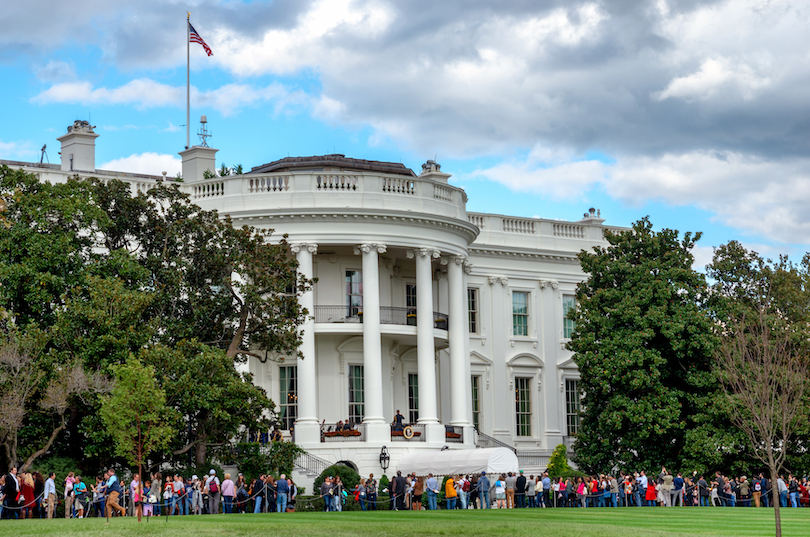
This iconic building has become one of the most notable landmarks in US history. Its construction began in 1792 according to designs by James Hoban. Did you know it was George Washington himself who chose the design of the White House?
The building was even burnt down once, during the War of 1812, by British forces. Nothing but the skeleton of the White House was left, but it was quickly rebuilt and maintained much of the original design.
The house has been the home of many legendary US presidents, like Barack Obama. If you want to go into the White House you can book an official tour!
9. Kennedy Space Center, Florida

The Kennedy Space Center is one of the most important space centers in the world. Incredibly, both the Apollo and Space Shuttle programs were operated here.
In 1969, the space center completed its first successful moon landing! Neil Armstrong’s famous words ‘One small step for a man, one giant leap for mankind’ still ring true today.
At the center there’s a large visitor complex, where you can experience space for yourself through immersive exhibits and interactive displays! You’ll even be able to see real spacecrafts like the Apollo Command Module and the Atlantis space shuttle.
Next, head to the Heroes and Legends Hall where you can learn about the most important space pioneers.
8. Fenway Park, Massachusetts

This legendary ballpark in Massachusetts is the home stadium of the Red Sox. The stadium was opened in 1912, making it one of the oldest Major League Baseball stadiums in the US.
It’s not super big compared to other stadiums, and has a seating capacity of 37,755 fans. But what it lacks in size, Fenway Park makes up for in atmosphere. The roaring crowds can be heard throughout the city whenever a home game is on.
In 2000, the Red Sox biggest win at Fenway shook the city, with a victory of 23-3 against the Detroit Tigers!
7. Hoover Dam, Nevada

The Hoover Dam was built between 1931 and 1936. It’s incredible that one of the country’s most impressive engineering feats took just five years to complete!
It disrupts the Colorado River that snaked through the Nevada landscape, and has led to the slow formation of Lake Mead. Incredibly, the lake is the largest reservoir in the US by volume, with a staggering capacity of 28.9 million acre-feet of water!
Visitors can learn more about the dam at the Visitor Center that has interactive displays and panoramic views of Lake Mead.
If you want to do something a little different you can also go on a Powerplant Tour!
6. Gettysburg Battlefield, Pennsylvania

This historical battlefield was where the bloody Battle of Gettysburg took place in 1863. To this day it’s considered one of the most important battles of the Civil War. It’s thought that some 8,000 soldiers were killed and a further 46,000 were wounded in this savage battle.
In the end, the Union soldiers won and chased out the Confederates. There are more than 1,300 memorials that commemorate the lives lost at the site, and the Gettysburg National Cemetery is the final resting place of many Union soldiers.
Visitors can walk around the cemetery, see the Cyclorama painting, and learn more about the battle at the Visitor Center.
5. Liberty Bell, Pennsylvania

The timeless message inscribed into the Liberty Bell has made it a symbol of the fight for liberation. It says ‘Proclaim liberty throughout all the land unto all the inhabitant thereof’. This inspiring quote has been adopted by abolitionists, women’s rights suffragettes, and Civil Rights leaders.
It used to be the bell that rang in the Pennsylvania State House, now called the Independence Hall. It was made in 1571, and was used to call lawmakers and the local town residents to hear the reading of the news.
If you go to see the bell you’ll immediately spot the big crack down one side, which is thought to have appeared in the 1840s after 90 years of use!
4. Arlington National Cemetery, Virginia

Possibly the most recognizable cemetery in the world. The Arlington National Cemetery is found in the old Arlington estate, which belonged to Confederate General Robert Lee.
Originally, the cemetery was the resting place of Union soldiers, but now US military personnel who have fallen in various wars are buried there.
It’s estimated that some 30 funerals take place here each weekday, and up till now there are some 400,000 graves stretched across the 624 acres of the estate.
If you go to the Tomb of the Unknown Soldier on the hour you’ll witness the elaborate guard changing ceremony!
3. Lincoln Memorial, Washington D.C.

This iconic historical landmark commemorates President Abraham Lincoln. Designed by Henry Bacon, the monument’s construction began in 1914 but wasn’t completed until 1922.
At the time of the president’s death in 1865, there were 36 states in the US, hence why there are 36 columns at the memorial.
Inside the memorial there is a large sculpture of the president sitting on a chair. If you wander up to the statue of Lincoln you’ll also find inscriptions of some of his most famous speeches etched into the white marble.
Lincoln was an important figure in the abolition of slavery in the US, which is why Martin Luther king delivered his timeless ‘I have a dream’ speech here in 1963.
2. Alcatraz Island, California

Just over a mile off the coast of San Francisco you’ll find Alcatraz Island. It sits in the San Francisco Bay and became famous as it was the former location of a high-security prison.
The prison opened in 1934 and closed less than 30 years later in 1963. Some of the country’s most dangerous prisoners were incarcerated here, like the notorious gangster Al Capone and Robert Stroud who was nicknamed the Birdman of Alcatraz.
You can visit the island by taking a ferry from Pier 33. Once you’re there you can wander through the old prison and learn about the country’s most dangerous criminals.
1. The Alamo, Texas

The Alamo in San Antonio Texas is a UNESCO World Heritage site, which includes a further four Spanish colonial missions. Built in 1718 by Spanish settlers it became famous because of the role it played in the Texas Revolution.
In 1836, American Texian defender soldiers fought against a group of Mexican soldiers in the Battle of the Alamo. After 13 days of horrific fighting the Texian defenders were defeated, and the battle became immortalized in the Texas Revolution with the chant ‘Remember the Alamo!’.
Nowadays you can visit the charming Alamo Chapel where you’ll learn about the history of the old mission and see exhibits of artifacts used in the Texas Revolution.