
Architecture is a funny thing. At one point in time, we couldn’t get enough of towering Gothic cathedrals. Then came a love of sleek glass skyscrapers. And sometimes, architects throw out all the rules, designing buildings so unusual that you’d think they weren’t buildings at all.
And these aren’t your average square or rectangular building; some seem to defy gravity entirely. Creativity is a huge part of architecture, and these unusual buildings are designed to make you feel something. In that way, they’re just like a piece of art, there to invite curiosity and, sometimes, to cause a bit of confusion.
22. Torre Helea (San Andrés Cholula, Mexico)

In San Andrés Cholula, one of Mexico’s most eye-catching towers spirals into the sky. Torre Helea looks like a giant corkscrew made from glass and steel. This 34-story tower stands 143 meters tall. Each floor turns 15 degrees as it rises, so the whole building spirals up like a helix.
You can spot this wild design from miles away. The tower holds 93 luxury apartments, and each one gets incredible 360-degree views thanks to the rotating structure.
Architects used a special steel cantilever system, letting every floor hang out over the one below. When you look at Torre Helea, it almost seems to defy gravity. The apartments look like they’re floating. This twisting shape makes it pop out in Puebla’s skyline.
21. Nakagin Capsule Tower (Tokyo, Japan)

In Tokyo’s fancy Ginza district, you will find the Nakagin Capsule Tower—a building that could’ve come straight out of a sci-fi flick. Architect Kisho Kurokawa built this odd tower between 1970 and 1972. It had 140 tiny living pods, each looking like a washing machine stacked on top of the next.
Each capsule fit just one person. Workers built them in a factory and then attached them to two concrete towers like building blocks. People lived and worked in these little pods. The whole thing was part of Japan’s Metabolism movement, which imagined buildings as living things that could grow and change.
The tower’s gone now, but you can check out a restored capsule at New York’s MoMA through July 2026. The exhibit gives you a peek at what life was like in these unusual pods.
20. Drina River House (Milanovac, Serbia)

Right in the middle of the Drina River, you’ll find one of the world’s most unusual homes perched on a rock. This tiny wooden cabin looks like it shouldn’t even exist. The house sits near Bajina Bašta in western Serbia. It’s been there since 1968, after a group of swimmers decided to build a shelter on the rock.
You can see the little house from the riverbank. It’s survived floods and wild weather for over 50 years. National Geographic featured it in 2012, and now tourists from all over come to see this odd sight.
Locals rebuild the cabin whenever floods sweep it away. You’re looking at the sixth version of this stubborn little house.
19. Upside Down House (Szymbark, Poland)

In the small village of Szymbark, there’s a wooden house that stands on its roof. Everything’s flipped upside down. Daniel Czapiewski built this odd attraction in 2007. He wanted to make a statement about Poland’s confusing communist history.
You enter through a window instead of a door, and inside, your head spins as furniture hangs from what should be the floor. The house sits in northern Poland’s Kashubian region. It took 114 days to finish—way longer than the usual 21 days.
Walking through the rooms might make you dizzy. The upside-down interior really messes with your sense of balance. This isn’t just a tourist trap. Czapiewski designed it to remind people of tough times in history.
You can visit the house as part of Szymbark Park, which also celebrates Kashubian culture and history.
18. Waldspirale (Darmstadt, Germany)

In Darmstadt, you’ll come across one of Germany’s wildest buildings. The Waldspirale, or “Forest Spiral,” doesn’t look like anything else out there. This colorful apartment building twists upward. Austrian artist Friedensreich Hundertwasser designed it in the 1990s. He hated straight lines and wanted buildings to feel more natural.
There are over 1,000 different windows—none exactly the same. The sand-colored walls curve and bend in strange ways. The roof’s a real showstopper. Hundreds of trees—beech, maple, lime—grow on top, so it’s almost like a floating forest above the apartments.
The building rises from two stories up to twelve. Construction wrapped up in 2000, and you can spot it easily in Darmstadt’s Buergerpark area.
17. Petersen Automotive Museum (L.A., USA)

On Wilshire Boulevard in L.A., you can’t miss the Petersen Automotive Museum. It looks like it’s wrapped in wild, flowing red metal ribbons. The chrome and crimson exterior makes it pop against everything else around. This isn’t your standard, boxy museum.
The building started as a Japanese department store in 1962. Years later, it turned into a car museum in 1994. The real transformation came after a $100 million renovation. Architects draped sweeping metal panels that curve and twist around the old structure.
Inside, you’ll find rare cars and motorcycles on several floors. There’s even a secret underground vault hiding some of the world’s most valuable vehicles.
16. Makedonium (Kruševo, North Macedonia)

On a hilltop in North Macedonia, the Makedonium sits like a giant white UFO—or maybe a heart valve—with ten huge stained-glass windows. This strange monument opened in 1974 to honor the Ilinden Uprising of 1903. Jordan and Iskra Grabuloska created this futuristic structure overlooking Kruševo.
The circular white building stands at the highest point of Gumenja Hill. It’s a sight you won’t forget. In 2018, an Australian magazine named it one of the top ten most unique buildings on Earth.
You can visit this socialist-era monument, now a symbol of North Macedonia. Its space-age look really sets it apart from typical memorials.
15. National Library of Belarus (Minsk, Belarus)

In Minsk, the National Library of Belarus stands out as one of the world’s weirdest libraries. It looks nothing like the libraries you’re used to. The building has a diamond shape called a rhombicuboctahedron—basically, 8 triangles and 18 squares. Most folks just call it “the diamond of knowledge.”
Architects Mihail Vinogradov and Viktor Kramarenko dreamed up this unique structure. It opened in January 2006 after years of planning. The library stands 72 meters tall and has 22 floors. You can see it from a long way off because of its unusual shape and size.
Inside, there’s room for 2,000 readers and a conference hall for 500. The building holds millions of books and documents. This library keeps making lists of the world’s most unusual buildings. It even beat out famous spots like Beijing’s National Stadium and some flashy Las Vegas hotels.
14. Guggenheim Museum (Bilbao, Spain)

In Spain’s Basque country, the Guggenheim Museum Bilbao looks like it landed from another planet. Frank Gehry designed this mind-bending structure, which opened in 1997. The building twists and curves in ways that don’t seem possible, with shiny titanium walls that change color as you move around it.
Before the museum, Bilbao was a struggling industrial city. The arrival of this wild building changed everything, bringing in millions of visitors just to gawk at the architecture. The place has no straight lines or normal shapes. It bends and flows like liquid metal caught mid-motion. Some parts jut out at odd angles, while others curve in.
You never know what you’ll see from one angle to the next. The building looks different every time you move. Honestly, it makes you wonder—can architecture really save a city? Maybe so.
13. Bolwoningen (‘s-Hertogenbosch, Netherlands)

In the Dutch city of ‘s-Hertogenbosch, you’ll stumble on one of the world’s oddest neighborhoods. The Bolwoningen are 50 round houses that look like giant balls. These sphere-shaped homes cluster together near a canal in the Maaspoort area. Architect Dries Kreijkamp designed them in the 1980s as an experimental housing project.
The Dutch government funded this wild experiment to create low-cost homes. Each ball house has about 44 square meters of living space with two rooms. People still live in these ball houses today, almost 40 years later. You can even rent one if you’re in the mood for a truly unique home.
Kreijkamp wanted them to be lightweight and moveable, though they’ve stayed put since they were built.
12. Guangzhou Circle (Guangzhou, China)

Along the Pearl River in China, the Guangzhou Circle stands out like a giant coin—or maybe a donut—propped upright. This 33-story building reaches 138 meters high and holds the record as the world’s tallest circular building.
The most striking part is the huge hole right through its center. That empty space measures 59 meters across, making it the only skyscraper with such a feature. Italian architect Joseph di Pasquale designed this odd structure, finishing it in 2013 as headquarters for several companies.
The public plaza in front is open to visitors. The circular shape stands out starkly against all the ordinary rectangular towers nearby. Some people say it looks like a coin—a symbol of wealth. Others just see a giant donut. Either way, you won’t mistake it for anything else.
11. Keret House (Warsaw, Poland)

If you wander Warsaw’s busy streets, you might spot the world’s narrowest house wedged between two buildings. The Keret House hides in a slim gap at 22 Chłodna Street and 74 Żelazna Street. This place? It measures just 60 inches wide at its fattest point. The narrowest bit—well, you’d have to squeeze through, since it’s only 36 inches across.
Polish architect Jakub Szczęsny dreamed up this odd little building in 2012. He’d floated the idea as an art concept back in 2009 during a Warsaw festival. Kind of gutsy, honestly. The house gets its name from Israeli writer Etgar Keret. His parents survived the Holocaust in Poland, so the building stands as a subtle memorial to his family.
Look closely and you’ll see how the building stitches together two eras—one wall presses against a pre-war house, the other leans into a modern apartment. The Keret House isn’t just for show. It doubles as an art installation and a real (if tiny) living space. Every so often, artists from around the world crash here for special programs.
10. Longaberger Basket Building, Newark, Ohio
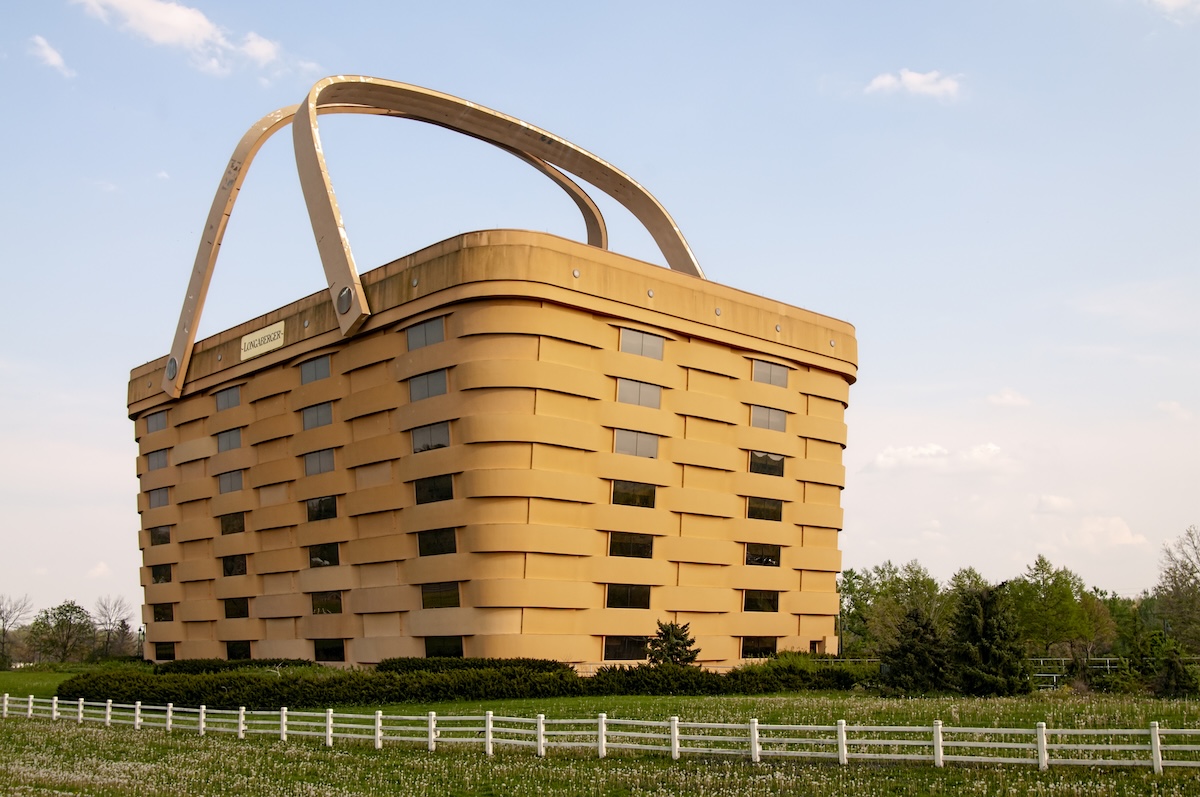
Close your eyes and picture a woven picnic basket. Now, imagine that picnic basket was seven stories high. The Longaberger Basket Building was the brainchild of Dave Longaberger, who founded an American basket manufacturing business called the Longaberger Company.
Clearly, he is passionate about baskets, and wanted the building to resemble exactly what the company is so famous for. Inside, the building was initially used as Longaberger’s corporate headquarters, with meeting rooms and offices arranged in a unique floor plan. The center of the building has a spacious glass atrium with plenty of natural light.
It’s one of those unique buildings that really turns heads if you’re walking through Newark, Ohio. And I guess that subliminal marketing was precisely what Longaberger intended with its design.
9. Azerbaijan National Carpet Museum, Baku, Azerbaijan

Baku is known for its sprawling metropolis of modern steel and glass high-rises. But one of its most identifiable buildings is, in fact, a museum dedicated to all things carpets. The marvel was designed by Austrian architect Franz Janz and completed in 2014. Expectedly unexpectedly, the museum resembles a rolled-up Azerbaijani rug rolled into a spiral.
The flick of the rug’s edge is connected with the ground by large floor-to-ceiling windows, letting plenty of natural light into the main atrium. Inside the building, you’ll find a treasure trove of carpets, along with exhibitions explaining the carpet weaving process and its artisanal history.
In fact, there are ten thousand carpets in the museum, each representing centuries of Azerbaijani weaving traditions.
8. Casa Batllo, Bercelona, Spain

Not only is the Casa Batllo one of the most unusual buildings in the world, but it’s also one of the most famous. Tourists from across the globe flock to the Spanish Capital of Barcelona to catch a glimpse of this exquisite Antonio Gaudi masterpiece.
The building was completed in 1906 and was commissioned by a wealthy businessman who gave Gaudi permission to let his imagination run wild. And what a good idea that was. The result is a building with no right angles and enough whimsical features to make it look like it could belong to a family of mermaids.
Originally a residential building, it is now a museum where visitors can bathe in the soft light of Gaudi’s famous stained-glass windows.
7. Crooked House, Sopot, Poland

The Crooked House, or Krzywy Domek in Polish, is the architectural equivalent of a funhouse mirror. Built in 2004, the building’s wavy and distorted lines were inspired by the works of Jan Marcin Szancer, a Polish children’s book illustrator, and Swedish artist Per Dahlberg. One look at their work, and it will all make sense.
It almost looks as if it’s been warped or melted by the hot sun. And it’s not just a wacky facade. The inside is a buzzing dining and shopping center that will make you feel like you’re in an alternate reality.
The Crooked House is one of those playful buildings you can’t help but love to look at. And for the architecture fans among us, it’s enough to bring the inner kid out of you.
6. Bubble Palace, Cannes, France

When you think of Cannes, your mind might jump to regal apartments and seaside estates. But the designer of this private residence in Theoule-sur-Mer had other plans for the architectural integrity of the town.
It’s one of the most unusual buildings in the world, mainly because it is used as a private holiday home. It extends across the hilly coastline and comprises a panoramic living room, a 500-seater open-air amphitheater, ten bedrooms, and three swimming pools.
This home looks a bit like what you might expect the first homes on Mars to look like — granted, we get there. The architect disliked straight lines, and with these separate bubble rooms conjoined as one mass, it’s not hard to believe.
5. National Fisheries Development Board, Hyderabad, India

Ever felt like a building was staring back at you? The National Fisheries Development Board in Hyderabad certainly has that effect. It’s another great example of mimicry architecture, where the building itself looks just like the business that operates inside it. And in this case, it’s a fish.
Designed to promote fisheries, one of the region’s major industries, the building was inspired by Frank Gehry’s quirky fish sculpture.
Inside the building are offices — because who wouldn’t want to work inside a giant fish? While it’s mostly off-limits to the public, it does entice a fun photo opportunity for anyone walking past. I suggest visiting at sunset when its ‘scales’ shimmer in the golden light.
4. Kunsthaus Graz, Graz, Austria

The Kunsthaus Graz is locally known as the ‘friendly alien’ or the ‘blue blob’, and it’s not hard to see why. It was built in 2003 by architects Peter Cook and Colin Fournier and designed like a bulbous organic space creature. As you can imagine, it sticks out like a sore thumb in a sea of otherwise traditional Austrian buildings with gabled houses and red-tiled roofs.
Appropriately, the building houses a contemporary art museum, of which the building itself is the main attraction. But the most unusual thing about it is its surface, which is covered by lights that screen signals or even written messages that can only be seen at night.
3. Kansas City Library, Kansas City, Missouri

In an unexpected yet somehow perfectly fitting twist, the parking garage of the Kansas City Library is designed to resemble a stack of books. Each “book” stands approximately 25 feet tall and 9 feet wide, showcasing classic titles such as To Kill a Mockingbird, The Lord of the Rings, and Fahrenheit 451, chosen by local residents.
And since no one expects to walk past a row of buildings that look like books, it’s these ordinary objects made big that really gets people’s attention. If you’re a book lover, this building alone will make your day (let alone the impressive collection of volumes inside the library itself).
It’s a playful tribute to the literary treasures of the Kansas City Library.
2. Hang Nga Guesthouse, Dalat, Vietnam
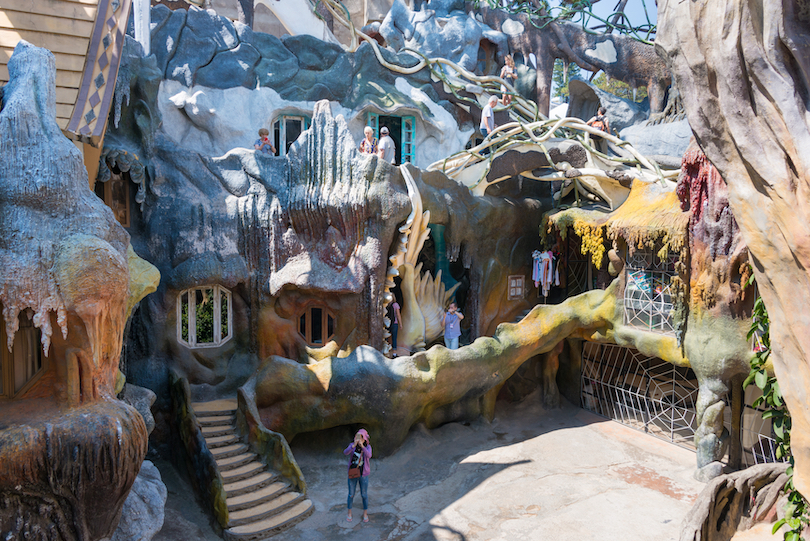
Locally known as the Crazy House, Hang Nga Guesthouse is more suited to be the set of a horror movie than a guesthouse. It looks like something out of a surrealist dream – or nightmare – but in the coolest way possible.
The guesthouse combines elements of Gaudi-inspired fantasy and nature with tree-like structures, twisting steppingstone staircases, spiderweb railings, bridges, and hidden nooks. Inside, each room follows a different theme, from under-the-sea scenes to grottos. There is no need to visit a theme park when you can just stay at the Hang Nga Guesthouse in Dalat.
1. Dancing House, Prague, Czechia
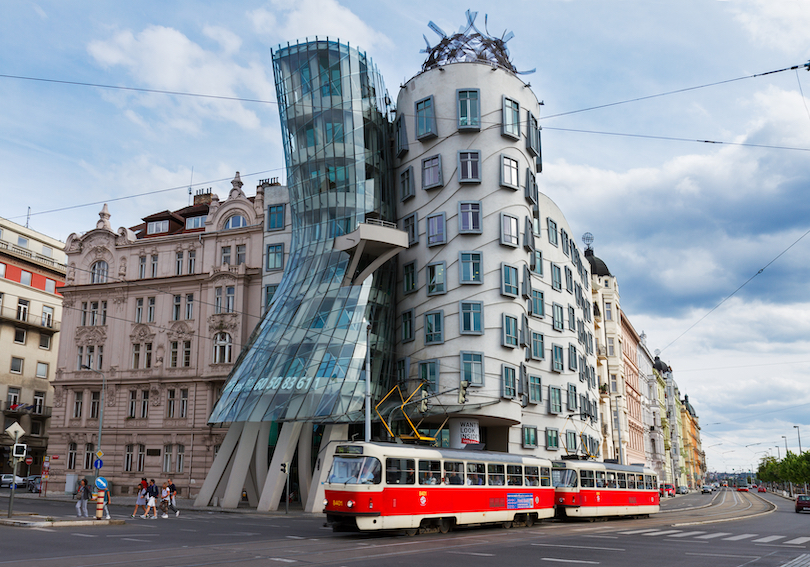
The Dancing House in Prague is one of the most unusual on this list. Not because it resembles an everyday object but because of its ingenuity in modern design. It is the brainchild of Frank Gehry, one of the world’s most famous architects, and it really offers a stark break from Prague’s traditional city architecture.
The design features two buildings side by side. One is curving and flowing, the other rigid and modern. Together, they create a structure that captures the fluidity of movement — a symbol of democracy and freedom that felt very welcome after years of communism.
Today, the building is used as a gallery and restaurant, with a rooftop terrace that boasts exceptional views of the Vltava River and the city.