
Space travel remains expensive and mostly reserved for billionaires or highly trained monkeys. Most people lack the budget for a rocket ship or the patience for freeze-dried ice cream. Thankfully, Earth hides several pockets of pure cosmic weirdness that look like they belong in a distant galaxy. These landscapes defy logic and skip the boring green-and-brown color palette of a standard forest.
Pack a bag and leave the passport to the Milky Way at home. These national parks have bubbling mud, jagged stone forests, and orange dunes that could fool any Mars rover. Visiting these spots bring you close enough to alien wonder without the risk of an unwanted planetary invasion while proving that our own planet is the strangest rock in the solar system.
17. Teide National Park, Spain
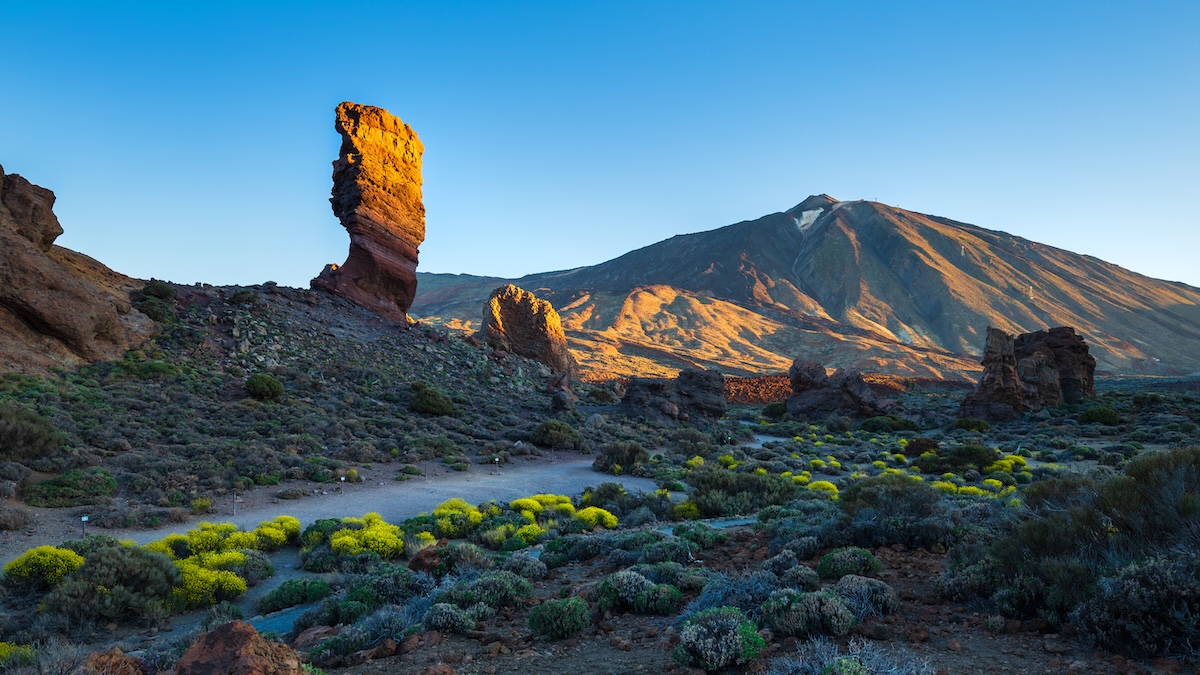
While you are blissfully paddling in warm, clear water, Western Europe highest peak peers over your shoulder. When you make the nausea-inducing drive up its side, you are swept away by rusty red rocks and twisted lava flows that dominate the high-altitude landscape. The air smells slightly of sulfur and the ground feels crunchier than a bowl of stale cereal.
The silence is heavy in the Caldera de las Cañadas. Bizarre rock formations like Roques de García sprout from the ground like calcified monster teeth. Hikers often say the stepp off a plane and onto the surface of Mars. The absence of trees makes every view feel lonely and prehistoric. Shadows stretch across the volcanic debris in a way that suggests ghosts might be watching. It is a sun-scorched playground for anyone tired of standard European meadows.
16. Bromo Tengger Semeru National Park, Indonesia

East Java hides a vast dusty basin that encircles several smoldering volcanic cones. Mount Bromo constantly belches thick plumes of white sulfur smoke from its massive, unsettled stomach. This monochromatic terrain replaces island greenery with layers of fine gray ash while the ground absorbs every sound to guard its secrets. The morning sun often struggles to pierce the heavy volcanic haze hanging over these desolate plains.
Determined travelers trek across the vast caldera to reach the crumbly rim of the active crater. Local ponies carry weary hikers across the gray flats and add a bizarre touch to the already strange scenery. This park showcases the messy internal plumbing problems of the planet and reminds visitors that humans are remarkably small and quite flammable.
15. Jiuzhaigou Valley National Park, China

This Chinese valley features lakes with colors that should be biologically impossible but minerals and algae in shades of turquoise and emerald beg to differ. Calcium carbonate deposits also form natural dams and terraced waterfalls across the rugged terrain. Water stays so clear that depth remains a confusing mystery to the naked eye.
To make it even more peculiar, ancient fallen trees sit perfectly preserved at the bottom of these crystal pools. The Five Flower Lake also changes its hue depending on the specific angle of the afternoon sun. Massive mountains surround the area and trap this magical atmosphere inside a rocky bowl.
14. Mungo National Park, Australia

New South Wales hides a prehistoric lakebed where the Walls of China dominate the horizon. These ridges of sand and clay result from thousands of years of persistent wind. This dusty graveyard for a dried sea reveals a patchwork of cracked mud and ancient secrets. Time seems to stop moving entirely in this desolate corner of the Australian outback.
Ancient human remains rest beneath the shifting silt of this massive dry basin. Mungo Man and Mungo Lady survived here back when the world was much wetter and greener. Today, the lunettes resemble a crumbling fortress built by a clumsy giant. Every gust of wind reshapes the landscape and exposes fossils of extinct megafauna.
13. Auyuittuq National Park, Canada

The name of this park translates to “the land that never melts,” which sounds quite ominous. It sits on Baffin Island and has massive granite peaks like Mount Thor which has the world’s steepest vertical drop of 1,250 meters. The landscape looks brutal, cold, and entirely indifferent to human life. It is the ultimate destination for those who find standard mountains too friendly.
Hikers must navigate boulder fields and icy rivers in this Arctic wonderland. Summer brings twenty-four hours of daylight but very little warmth. Nature here is raw and sharp enough to cut and this park reminds everyone that the ice age never really ended in the far north.
12. Tassili n’Ajjer National Park, Algeria

This Algerian plateau resembles a stone city as erosion carved the sandstone into a maze of arches and spindly pillars. Deep orange rock rises from the Sahara sand to challenge the empty horizon, a labyrinth of stone that defies the surrounding sea of shifting dunes. The wind whistles through these corridors and creates an eerie, hollow soundtrack for visitors.
Thousands of ancient paintings decorate the hidden walls of these rock cathedrals too. These sketches depict a green Sahara once filled with swimming hippos. Today, the parched ground holds only dust and the ghosts of a wetter era.
11. Haleakala National Park, USA

Maui usually suggests palm trees and overpriced drinks, yet the summit of Haleakala offers a much grittier reality. This massive shield volcano rises over 10,000 feet above the Pacific Ocean to greet the passing clouds. Inside the basin, a cinder desert displays colorful mounds that appear entirely extraterrestrial to the naked eye. Rare silversword plants sprout from the volcanic rubble, posing as metallic urchins from a distant galaxy.
Thick clouds often roll over the rim to create a dense ocean of white static inside the crater. Walking on the crunching volcanic rock resembles exploring a neglected corner of a lunar construction site while wearing hiking boots. This park provides a necessary escape for anyone tired of sand in their shoes and sunburnt tourist crowds.
10. Purnululu National Park, Australia

Western Australia hides thousands of orange and black striped domes that formed over millions of years. Cyanobacteria created the dark bands while rusted iron provides the orange layers across the stone. No outsiders knew about these structures until the 1980s, despite their obvious location in a dusty wilderness, so these geometric miracle remains one of the most distinctive sights in the entire outback.
Narrow gorges and hidden pools tuck between these stone lumps to bring relief from the sun, while Cathedral George hypnotizes you with its acoustics. No other place features such organized and colorful geological bumps, and walking through the beehives mimics a stroll through a colony of alien dwellings on a distant planet.
9. Cappadocia National Park, Turkey

Volcanic eruptions and wind carved a valley full of pointed fairy chimneys. What’s more, soft rock allowed ancient civilizations to hollow out entire multi-story cities beneath the dusty surface. Giant stone pillars with narrow caps dot the landscape and resemble a fever dream of a medieval mason.
Hundreds of hot air balloons drift over the horizon every morning to observe the terrain from above. This subterranean maze contains ancient churches and dwellings carved directly into the soft cliffs. Some boulders mimic camels while others imitate giant mushrooms to confuse passing travelers. This park remains a perfect destination for anyone who enjoys living in a literal hole in the wall.
8. Makgadikgadi Pans National Park, Botswana

Across the heart of Botswana, a shimmering white void replaces the usual African savanna. In this place, a massive salt flat messes with human depth perception until the horizon simply vanishes. During the dry season, a blindingly white crust covers the earth beneath a scorching sun. Along the edges, solitary baobab trees overlook the salty nothingness.
Under the midday sun, dancing mirages transform distant rocks into floating islands. Inevitably, everything changes when the rains arrive because the pans turn into shallow pools. Suddenly, thousands of pink flamingos descend to throw a noisy, feathered party. This salt-crusted void demands total respect from anyone brave enough to visit.
7. Cavernas do Peruaçu National Park, Brazil

Deep within remote Brazil, massive limestone caverns engulf the landscape to reveal an alien terrain. The Janelão Cave boasts a colossal natural skylight and record-breaking stalactites. Due to the staggering scale, visitors appear as tiny ants inside a stony giant’s throat. Lush forests even thrive inside the sinkholes to hide a world away from the sun.
For millions of years, the patient Peruaçu River carved these tunnels through solid rock. Sunbeams pierce the ceiling to illuminate the dusty air in dramatic streaks. On the walls, ancient rock art depicts hunters with better aim than most modern tourists. This underground vault proves that the planet hides its weirdest secrets beneath the surface.
6. Timanfaya National Park, Spain

Across Lanzarote, a scorched wasteland replaces the usual Spanish beaches. During the 1700s, massive eruptions buried the entire region in black ash and jagged lava. Because the soil remains incredibly hot, dry brush bursts into flames inside shallow holes. Nearby, artificial geysers shoot steam into the sky whenever water touches the boiling rock.
Inside the park, a specialized bus carries tourists through twisted craters and red cinder cones. Since no vegetation grows in this volcanic core, only sharp shapes and rusted soil remain. At the local restaurant, chefs even grill meat using raw heat radiating from the ground. Exploring this beautiful disaster area makes any other vacation spot feel far too green.
5. Tongariro National Park, New Zealand

Within the North Island, three grumpy volcanoes control the horizon. Instead of gentle hills, this landscape propositions jagged lava and hissing steam. Since it famously portrayed a dark fantasy realm, the terrain feels appropriately villainous. Glowing brightly, Emerald Lakes feature a neon green hue that suggests a chemistry experiment gone wrong.
To see red craters, brave hikers tackle the famous alpine crossing. Because the weather changes fast, the peak often hides behind a grumpy curtain of fog. Underfoot, crunching scoria provides a noisy soundtrack for every clumsy step. For travelers bored of greenery, this park remains a perfect destination.
4. Tsingy de Bemaraha National Park, Madagascar

Deep within Madagascar, a vast forest of needle-sharp limestone pinnacles pierces the sky. Because the local name means “where one cannot walk barefoot,” visitors should probably take note. Erosion carved narrow canyons and deep fissures into this gray stone maze. Over millions of years, rain and wind sharpened the landscape into a literal fortress.
Across the sharp peaks, agile lemurs leap with an ease that mocks human gravity. To help travelers navigate the terrain, suspension bridges hang over the deep drops. Since the jagged rocks stay white and gray, the landscape feels entirely drained of color. Exploring this park requires significant upper body strength and zero fear of heights. Truly, this place serves as a convincing stand-in for a planet made of razor blades.
3. Bryce Canyon National Park, USA

Southern Utah hosts a massive amphitheater overflowing with thousands of red rock hoodoos. These tall spires suggest a silent crowd frozen in stone by an ancient curse. At an altitude of 8,000 feet, the thin air often leaves hikers gasping for breath. This masterpiece presents an inverted forest carved from prehistoric sandstone.
In winter, fresh snow caps the hoodoos to deliver a sharp contrast against the red rock. Winding trails lead hikers directly into the heart of this crumbling stone maze. Along the Navajo Loop, towering walls and narrow slots squeeze the dusty path. These delicate formations survived for ages against the biting wind and erosion.
2. Namib-Naukluft National Park, Namibia

Across the Namibian coast, massive orange dunes collide with the blue Atlantic Ocean. These towering sand piles rank among the highest on Earth. Deep within the desert, Dead Vlei showcases skeletal camel thorn trees that refuse to rot. Because the air remains dry, these blackened trunks have stood for many centuries without complaining.
Persistent winds constantly reshape the sharp crests into elegant, sweeping curves. At dawn, long shadows stretch across the white clay pans to paint a haunting visual. Despite the harsh heat, strange beetles survive on morning fog while humans melt into puddles in this rust-colored void, which remains one of the most beautiful places on Earth.
1. Vatnajökull National Park, Iceland

Iceland’s massive eastern park does not come across as shy with its colossal glaciers and active volcanoes that constantly fight for dominance. On the ground, ancient volcanic tantrums carved a geometric pipe organ into the black basalt columns. Because the earth vibrates with subterranean heat, the frozen ground feels remarkably alive. This icy wilderness offers a front-row seat to the messy birth of a planet.
Deep inside the glaciers, translucent blue ice caves reveal a hidden world without sunlight. Near the coast, pitch-black beaches collect sparkling ice chunks that glow against the dark sand. Since the scale remains so vast, visitors feel tiny against the infinite white horizon. This park provides the ultimate alien experience for anyone brave enough to face the cold.