
Christian Monasticism is a practice which began to develop early in the history of the Christian Church, modeled upon scriptural examples and ideals, including those in the Old Testament. Originally, all Christian monks were hermits seldom encountering other people (monos means alone in Greek).
But because of the extreme difficulty of the solitary life, many monks failed, either returning to their previous lives, or becoming spiritually deluded. As more people took on the lives of monks they started to come together and eventually lived in Christian monasteries.
10. Alcobaca Monastery
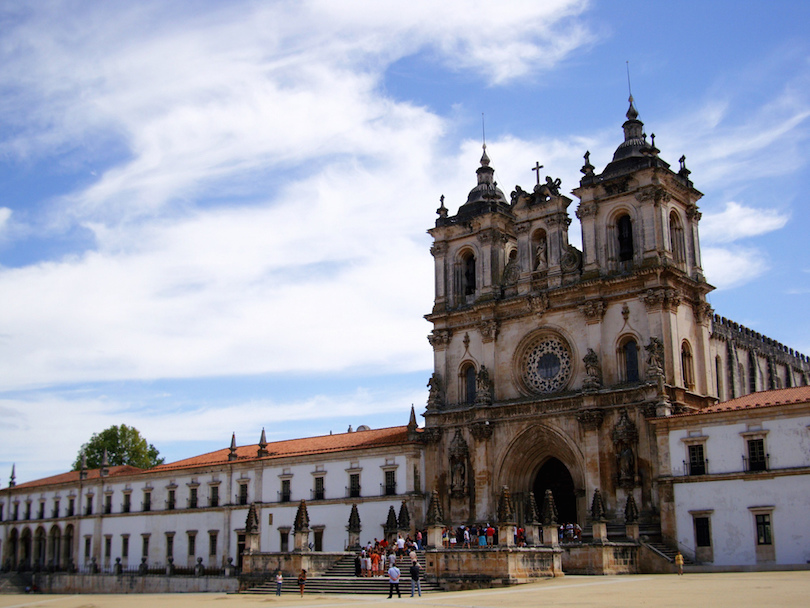
The Alcobaça Monastery is a Roman Catholic Monastery located in the town of Alcobaça, in central Portugal. It was founded by the first Portuguese King, Afonso Henriques, in 1153, and maintained a close association with the Kings of Portugal throughout its history.
The church and monastery were the first Gothic buildings in Portugal, and, together with the Monastery of Santa Cruz in Coimbra, it was one of the most important of the medieval Christian monasteries in Portugal.
9. Sumela Monastery
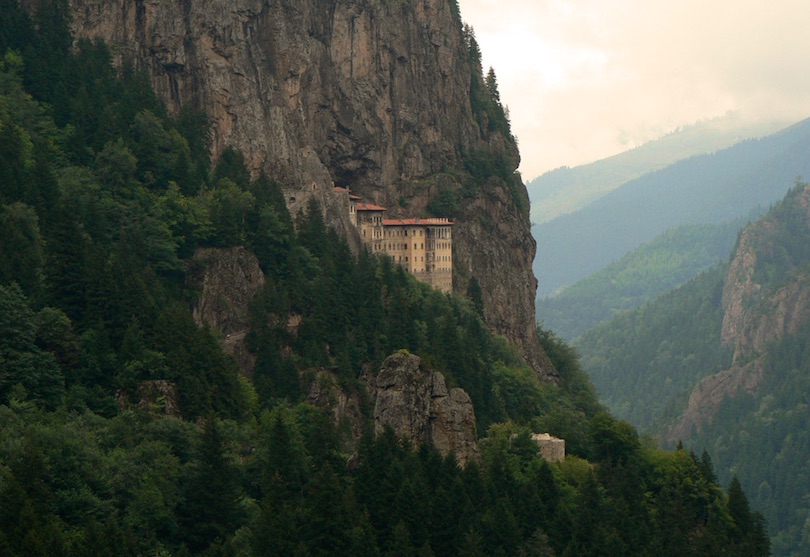
The Sümela Monastery is a Greek Orthodox monastery, standing at the foot of a steep cliff facing the Altindere valley in modern-day Turkey. It was founded in the year 386 AD during the reign of the Roman Emperor Theodosius I (375 – 395).
Legend has it that two priests undertook the founding of the monastery on the site after having discovered a miraculous icon of the Virgin Mary in a cave on the mountain. During its long history, the Sümela Monastery fell into ruin several times and was restored by various Roman Emperors. It reached its present form in the 13th century.
8. Ostrog Monastery
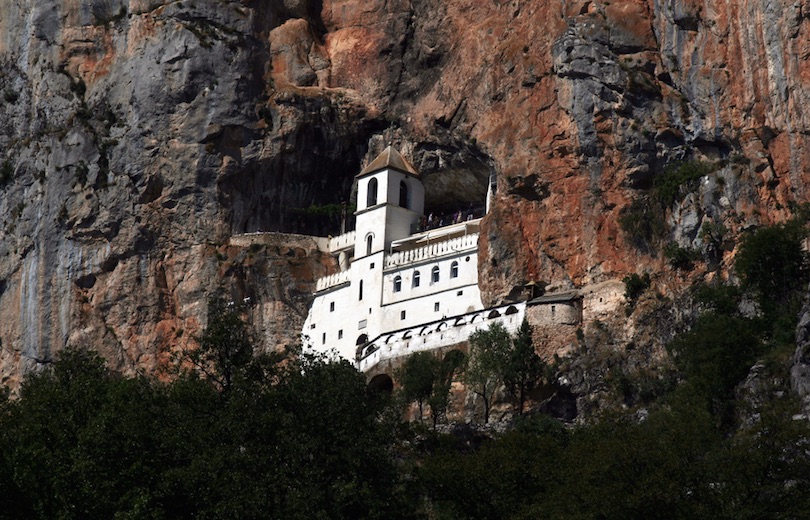
The Monastery of Ostrog is a Serb Orthodox monastery placed against an almost vertical background, high up in the large rock of Ostroška Greda. It is dedicated to Saint Basil of Ostrog and is the most popular pilgrimage place in Montenegro. Founded in the 17th century, the present-day look was given in 1923-1926, after a fire which had destroyed the major part of the complex. Fortunately, the two little cave-churches were spared and they are the key areas of the monument.
7. Kyiv Pechersk Lavra
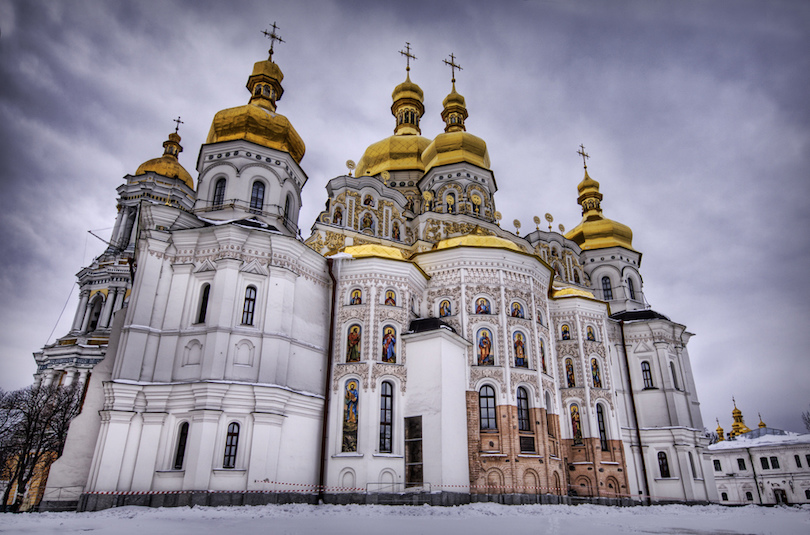
Kiev Pechersk Lavra, also known as the Kyiv Monastery of the Caves, is a historic Orthodox Christian monastery in Kyiv, Ukraine. Since its foundation as the cave monastery in 1015 the Lavra has been a preeminent center of the Eastern Orthodox Christianity in Eastern Europe.
The Kyiv Pechersk Lavra contains numerous architectural monuments, ranging from he Great Lavra Belltower, the notable feature of the Kyiv skyline, to cathedrals to underground cave systems and to strong stone fortification walls.
6. Gelati Monastery
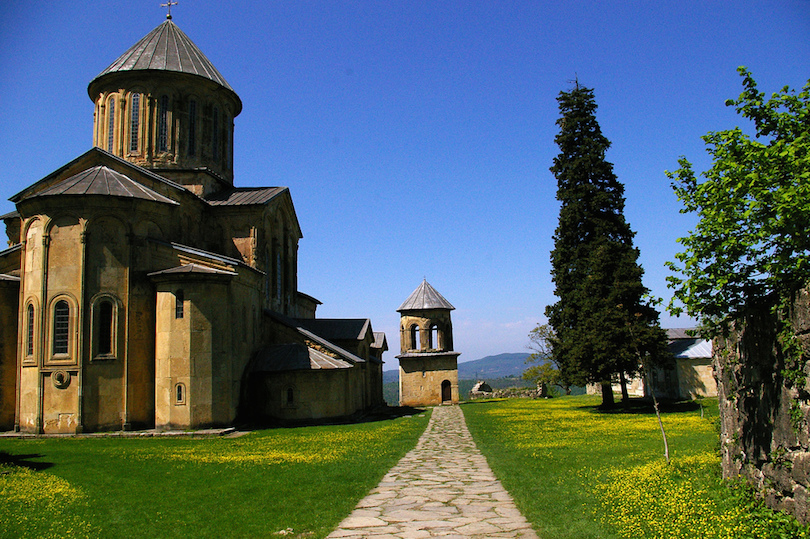
The Monastery of Gelati is a monastic complex in western Georgia. It contains the Church of the Virgin founded by the King of Georgia David the Builder in 1106, and the 13th-century churches of St George and St Nicholas. For a long time, the Gelati Monastery was one of the main cultural and intellectual centers in Georgia. It had an Academy which employed some of the most celebrated Georgian scientists, theologians and philosophers.
5. Mount Athos
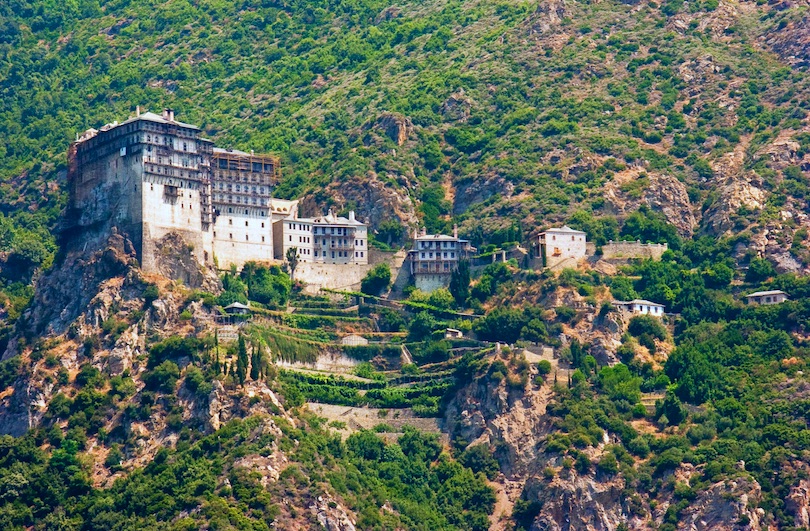
Mount Athos is a mountain and a peninsula in northern Greece. The peninsula, the easternmost “leg” of the larger Halkidiki peninsula houses some 1,400 monks in 20 Eastern Orthodox monasteries. An autonomous state under Greek sovereignty, entry into the area is strictly controlled and accessible only by boat.
Only males are allowed entrance into Mount Athos and only male monks male monks are allowed to live there. Of the twenty monasteries, one is Russian, one is Bulgarian, one is Serbian and the rest are Greek. There are also Romanian and Bulgarian communities of Christian hermits following a monastic rule (called sketae). The foreign monasteries and sketae are supported by their respective countries.
4. Rila Monastery
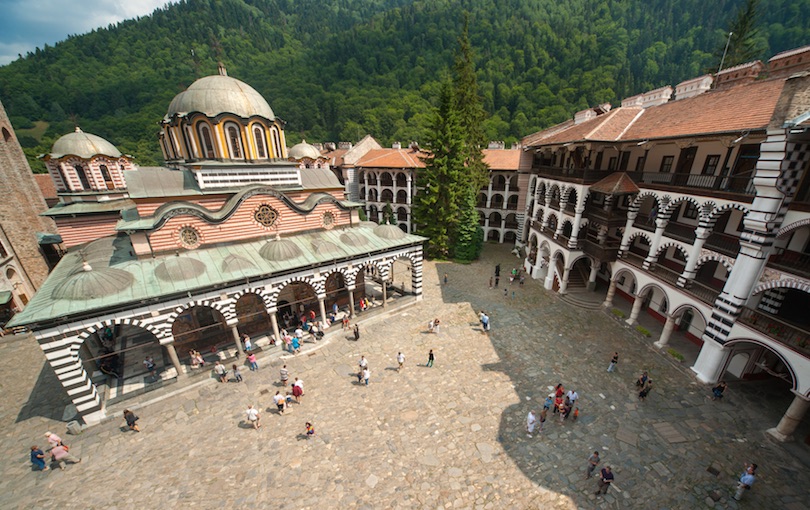
The Monastery of Saint Ivan of Rila, better known as the Rila Monastery is the largest and most famous Eastern Orthodox monastery in Bulgaria. It is situated in the northwestern Rila Mountains, in the deep valley of the Rilska River. It is traditionally thought that the monastery was founded by the hermit Saint Ivan of Rila, whose name it bears, during the rule of Tsar Peter I (927-968).
The hermit actually lived in a cave without any material possessions not far from the monastery’s location, while the complex was built by his students, who came to the mountains to receive their education.
3. Saint Catherine’s Monastery
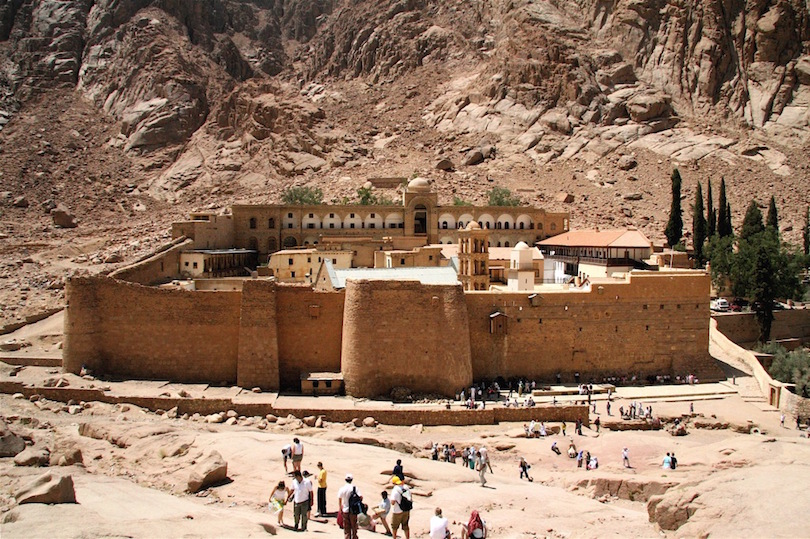
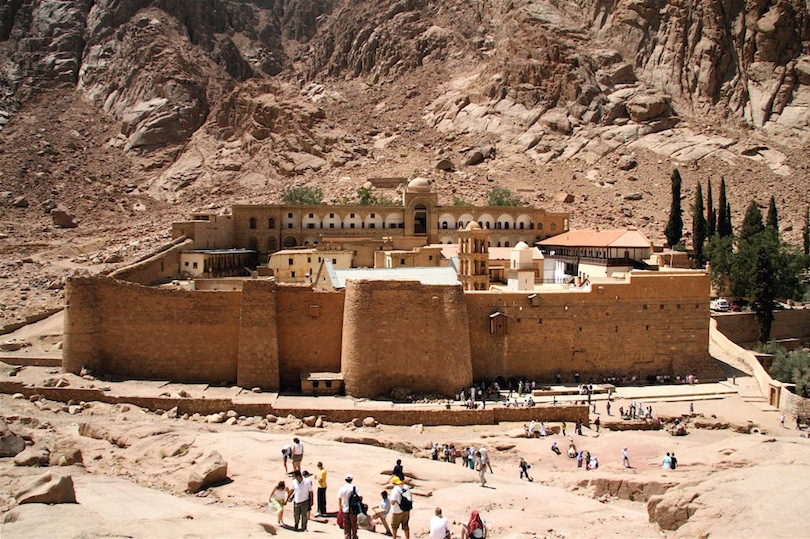
Saint Catherine’s Monastery lies on the Sinai Peninsula in Egypt, at the mouth of a gorge at the foot of Mount Sinai. The Orthodox monastery has been called the oldest working Christian monastery in the world, although the Monastery of Saint Anthony, situated across the Red Sea in the desert south of Cairo, also lays claim to that title.
The monastery was built by order of the Eastern Roman Emperor Justinian I (reigned 527-565) at the site where Moses is supposed to have seen the burning bush. The monastery library preserves the second largest collection of early codices and manuscripts in the world, outnumbered only by the Vatican Library.
2. El Escorial
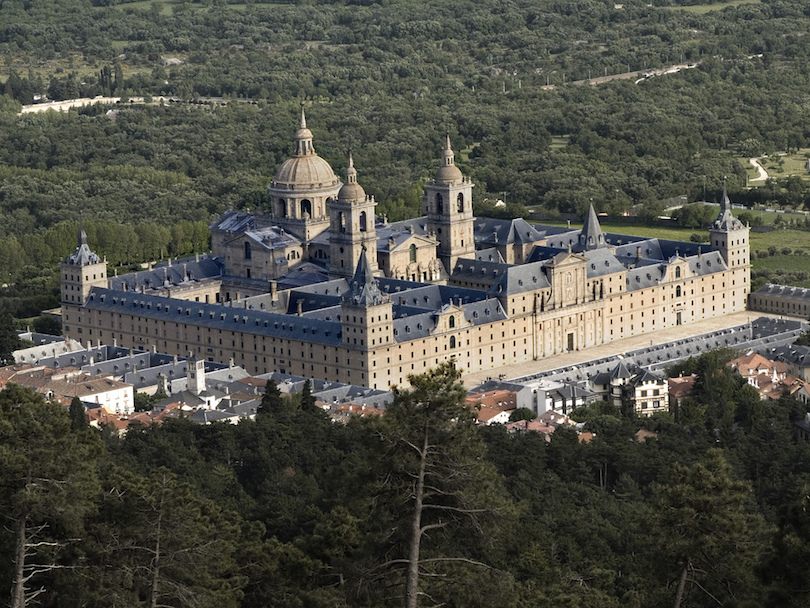
Nestled in the foothills of the Sierra de Guadarrama in Spain, the world famous Monastery of San Lorenzo de El Escorial (El Escorial for short), was the political center of the Spanish empire under King Philip II. Philip appointed Juan Bautista de Toledo as the architect in 1559. Juan Bautista had spent the greater part of his career in Rome, where he had worked on the basilica of St. Peter’s.
Together they designed El Escorial as a monument to Spain’s role as a center of the Christian world. Today it is one of the Spanish royal sites and functions as a monastery, royal palace, museum, and school.
1. Meteora
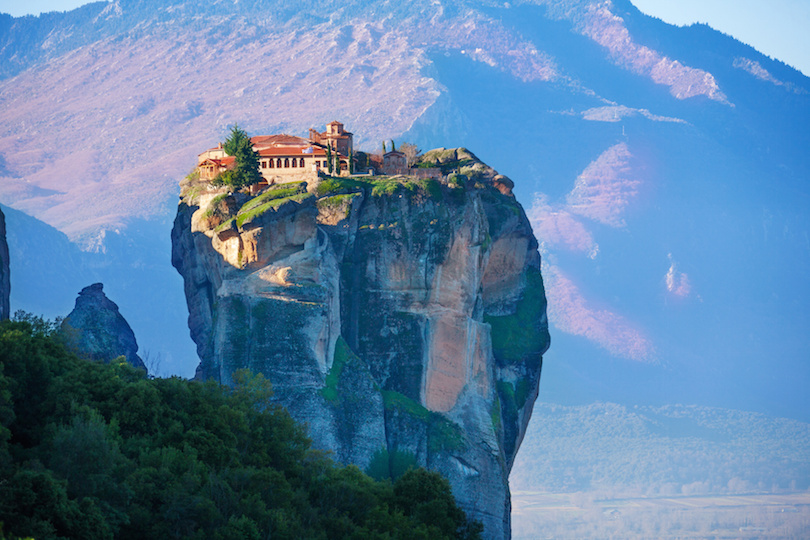
Metéora (“suspended in the air”) is one of the largest and most important complexes of Eastern Orthodox monasteries in Greece, second only to Mount Athos. The six Christian monasteries are built on natural sandstone rock pillars in central Greece. In the 14th century, Athanasios Koinovitis from Mount Athos founded the great Meteoron monastery on Broad Rock.
The location was perfect for the monks; they were safe from political upheaval and had complete control of the entry to the monasteries. Access to the monasteries was deliberately difficult, requiring either long ladders lashed together or large nets used to haul up both goods and people. This required quite a leap of faith – the ropes were replaced only “when the Lord let them break”.