
When cities first strung up electric lights in the 1880s, the goal was practical: fewer muggings, safer streets, longer shopping hours. Nobody was thinking about how a cathedral might look washed in amber, or how a river doubles every bridge it passes under. That came later, once people noticed that darkness edits a city for you. It hides the parking lots and the scaffolding, then hands the spotlight to whatever someone decided was worth lighting.
That decision is the interesting part. Some places plan their nights down to the bulb temperature. Others glow by accident, through dense neighborhoods, steep hillsides, or centuries of lanterns and candles.
Either way, the most beautiful cities after dark reward you for staying out past dinner. Use these picks to figure out where an evening walk becomes the highlight of a trip, and where you’ll want to skip the early night.
Ghent, Belgium
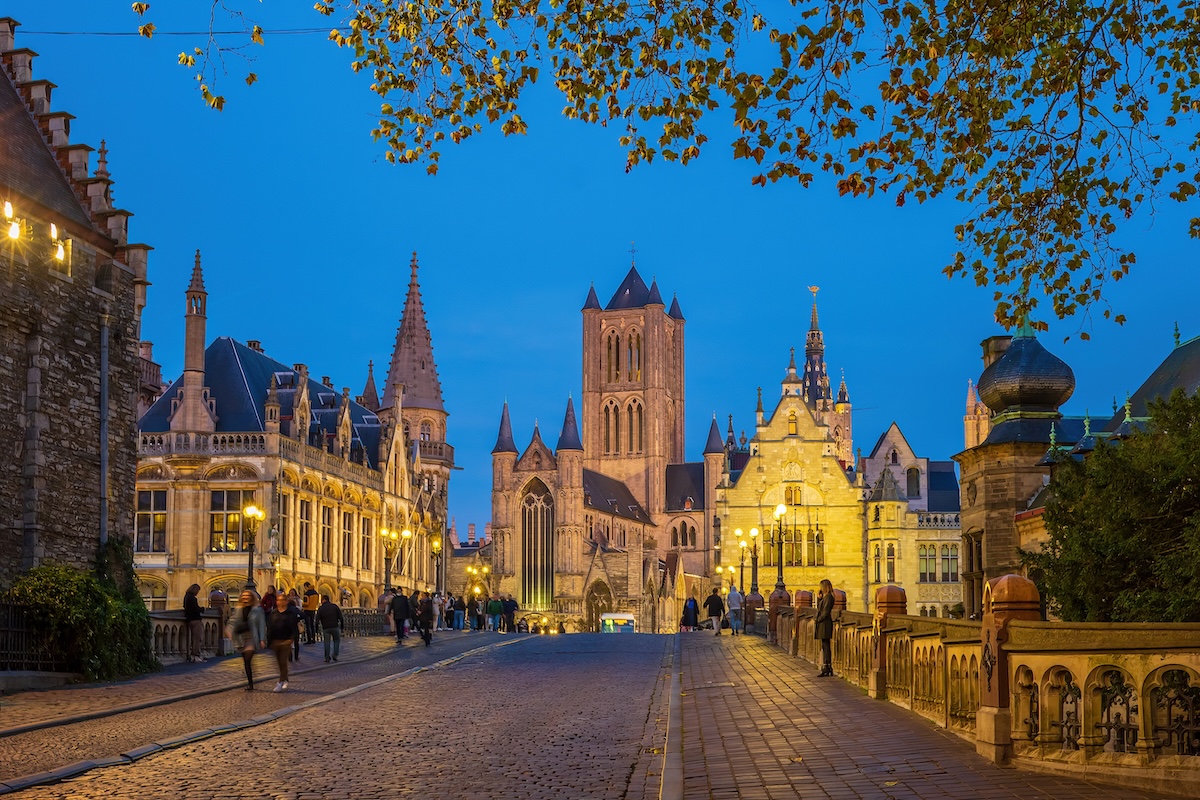
Ghent treats its nighttime lighting as a civic project, and it shows. Since the late 1990s, the city has followed a dedicated Light Plan that sets how each street, facade, and bridge gets illuminated, with warm, low-glare fixtures chosen so medieval stone looks golden without blinding anyone. Walk the Graslei and Korenlei after sunset and the guildhalls reflect in the Leie River almost perfectly, gables and all.
The plan covers more than the postcard spots. Lighting reaches into side streets and quieter quays, so wandering away from the crowds still feels deliberate and safe. The Gravensteen castle, the Belfry, and St. Bavo’s Cathedral each get their own treatment, and the Saint Michael’s Bridge gives you a single spot to see three towers lit in a row. Every few years, the Ghent Light Festival adds temporary installations on top of the permanent design, drawing hundreds of thousands of visitors in winter.
Shanghai, China
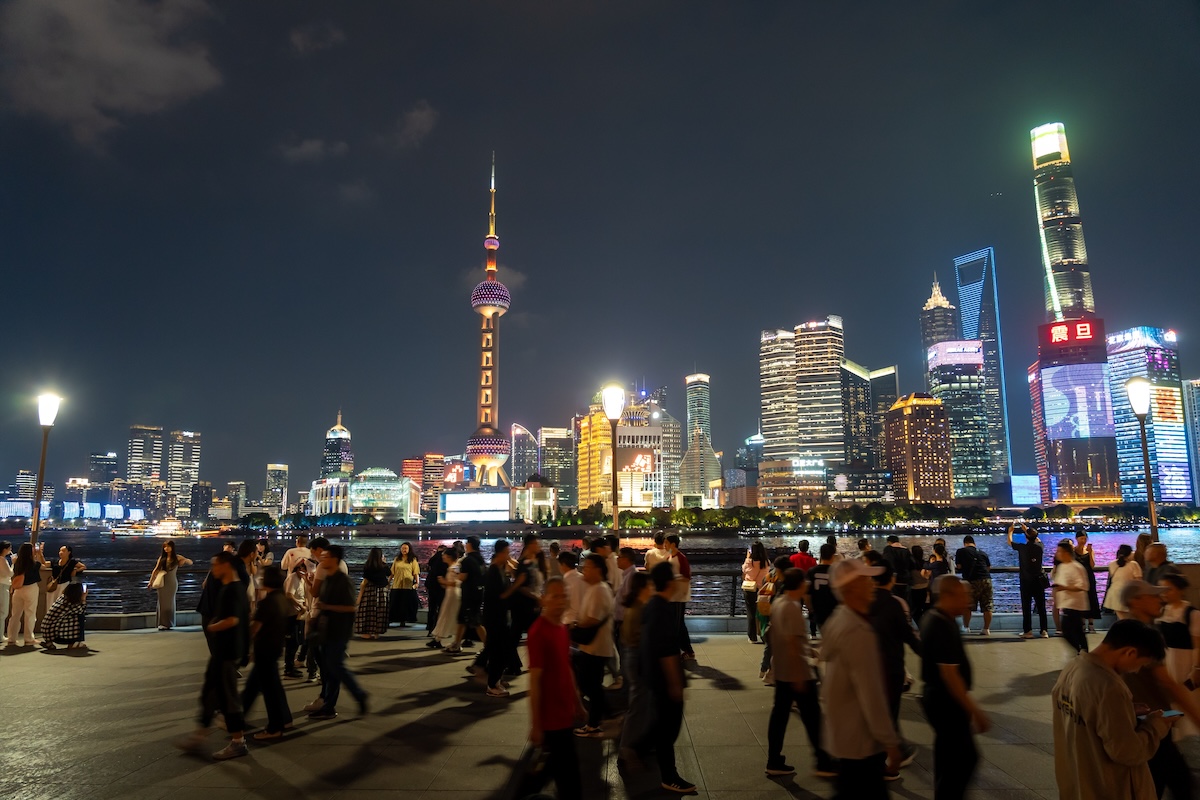
Few skylines put two centuries face to face the way Shanghai does across the Huangpu River. On the Bund, a mile of 1920s and 1930s banks and trading houses glows in gold, all columns and clock towers. Across the water, Pudong answers with the Oriental Pearl Tower and the Shanghai Tower, which rises 632 meters and ranks among the tallest buildings on Earth.
The best way to take it in is a river cruise from the Shiliupu or Bund piers, which lets you see both banks shift as you move. A quick warning: the big building lights switch off at a fixed hour, often around 10 or 11 p.m., so a late dinner followed by a stroll can leave you staring at a dark skyline. Head out right after sunset. If you want height instead, the Shanghai Tower observation deck sits well above the clouds on hazy nights, which is either magical or useless.
Matera, Italy
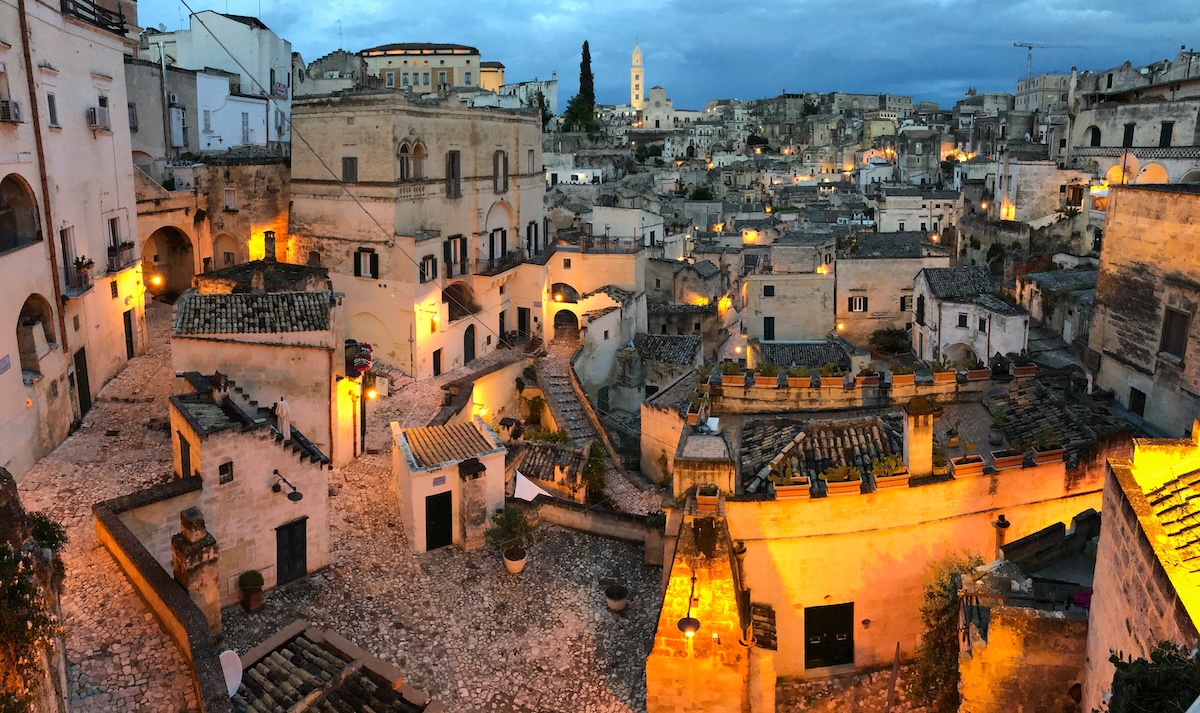
Matera spent part of the 20th century as an embarrassment to Italy. Its Sassi, a maze of cave homes carved into a ravine in Basilicata, held families living in poverty with livestock until the government relocated residents in the 1950s. Decades later, the same caves earned UNESCO status in 1993, and the town served as a European Capital of Culture in 2019.
Night is when that turnaround makes the most sense visually. Warm lights flicker on across layer after layer of stone dwellings, churches, and stairways, and the whole hillside looks like a nativity scene someone kept building for 9,000 years. Filmmakers noticed; Matera has stood in for ancient Jerusalem and hosted a chase in a James Bond movie. Find a spot at the Belvedere Luigi Guerricchio or along the Via Madonna delle Virtù, and you can watch the Sasso Caveoso light up over the gorge with almost nobody else around.
New York City, USA
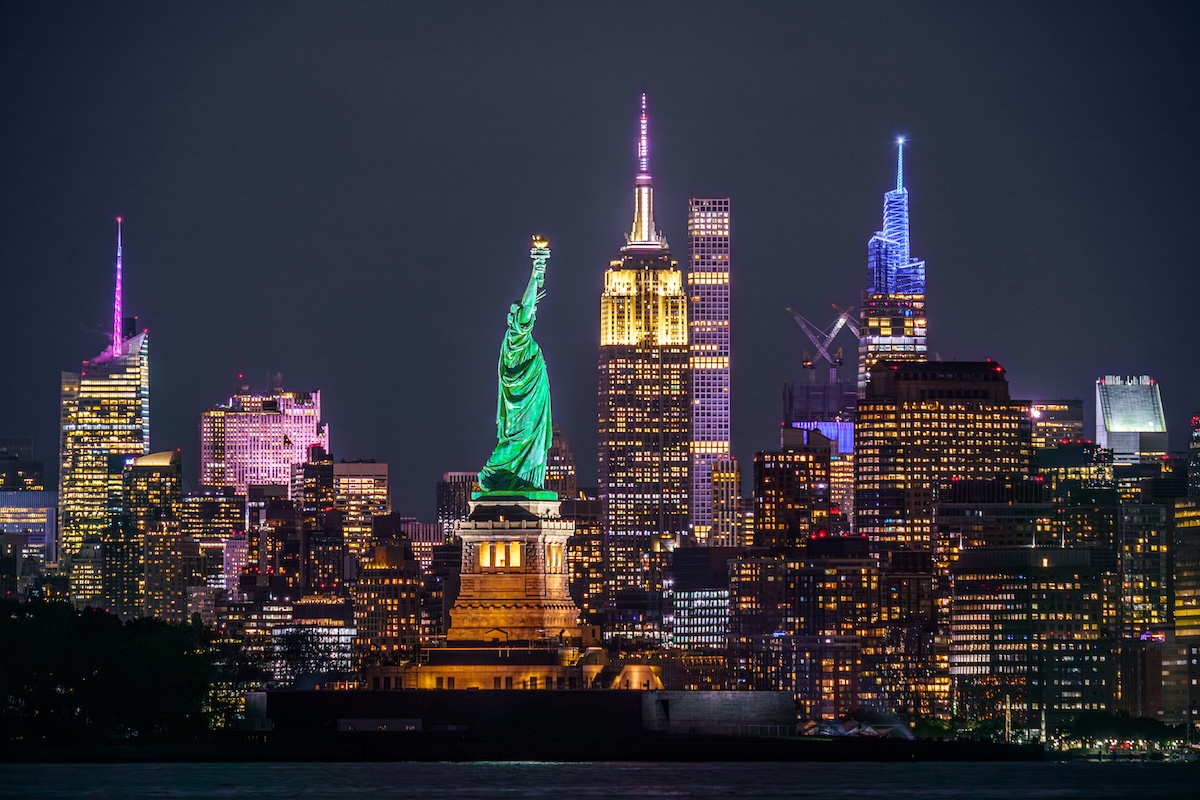
New York earns its night reputation through sheer density. Millions of office windows, apartment lamps, and billboards stack up into a skyline that never fully goes dark, and the best view of it comes from slightly outside it. Head to Top of the Rock to see the Empire State Building framed by Midtown, or catch the ferry to Brooklyn and watch Lower Manhattan from the waterfront at DUMBO.
The Empire State Building deserves its own mention. Its tower lights switched to LEDs in 2012 and can display millions of colors, so it changes for holidays, sports wins, and causes throughout the year (the building posts its schedule online). Times Square will hit you with a wall of screens that’s loud and a little absurd, worth one pass. For something calmer, walk the Brooklyn Bridge toward Manhattan after 9 p.m., when the cables catch the light and the crowds thin out.
La Paz, Bolivia
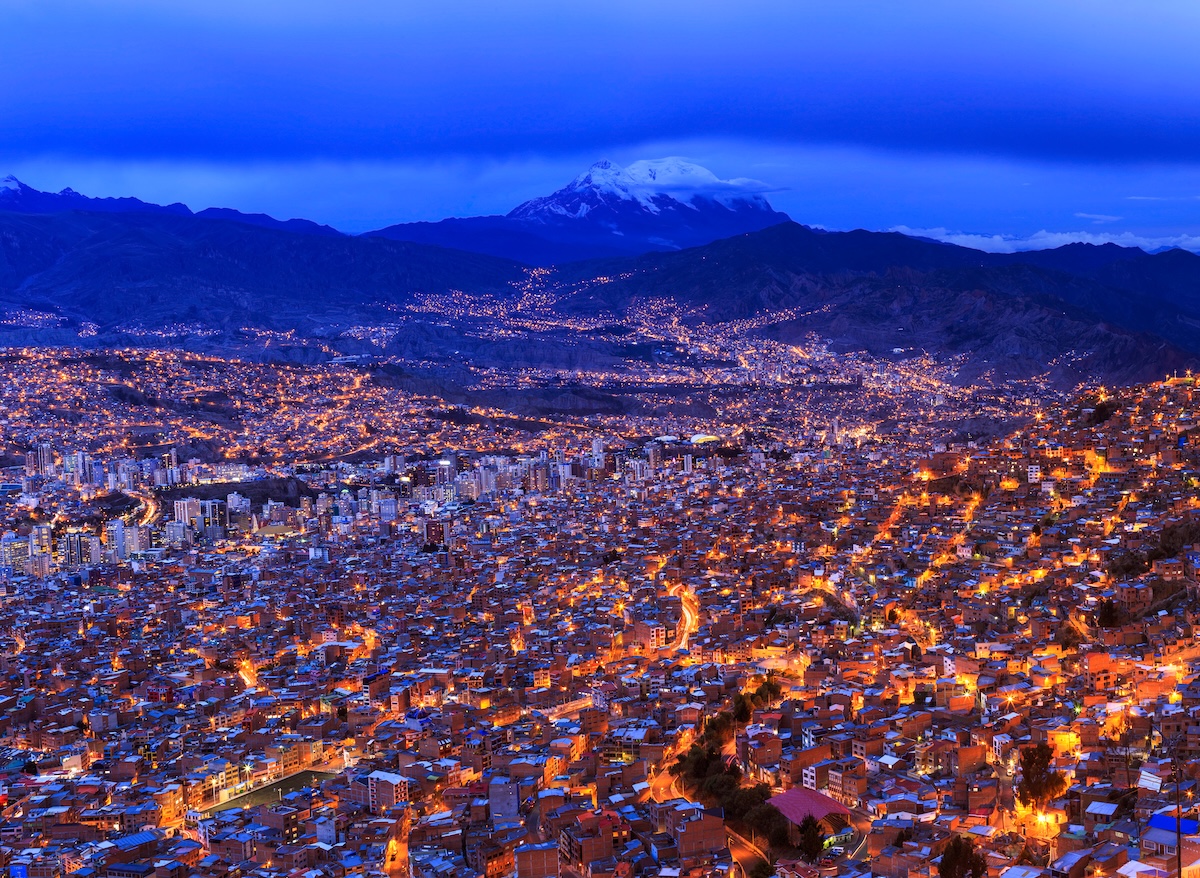
La Paz sits in a giant canyon, and at night the city lights climb its walls like a bowl filled with embers. Neighborhoods spill from the valley floor up to El Alto on the rim, which stands above 4,000 meters. Because homes cover nearly every slope, the glow wraps around you from almost every angle.
The trick is getting above it, and La Paz has an unusual solution. Mi Teleférico, the urban cable car system that opened in 2014, ranks as the largest of its kind in the world, linking the valley to El Alto with gondolas that run into the evening. A ride on the Red or Yellow Line after dark turns your commute into a sightseeing flight over millions of lights. On clear nights, the snowcapped Illimani peak stays faintly visible behind it all. Bring a warm jacket; temperatures drop fast at this altitude, and the thin air makes the climb up any staircase feel heroic.
Sydney, Australia
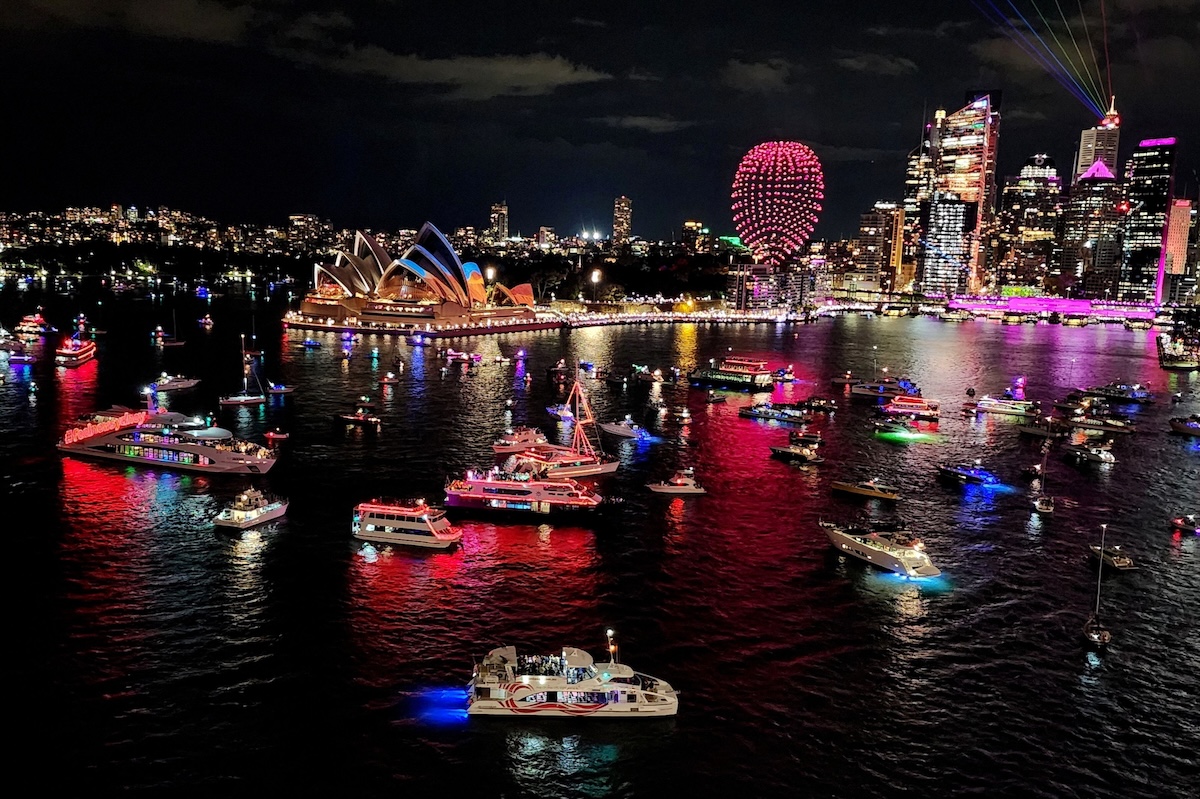
Sydney’s harbor does most of the work after dark. The Opera House sails and the steel arch of the Harbour Bridge sit across the water from each other, both lit and both reflected, and Circular Quay puts you within a few minutes’ walk of each. A table at the Opera Bar or a bench at Mrs Macquarie’s Chair gives you a view that never seems to get old for locals either.
If you can time a winter trip, aim for Vivid Sydney, a festival that runs from late May into June. The Opera House becomes a projection screen, buildings around The Rocks and Darling Harbour get light installations, and the city stays packed well past dinner. Outside festival season, take a night ferry. The run from Circular Quay to Manly costs a regular transit fare and gives you a slow, wide look back at the skyline sliding past.
Cuenca, Spain
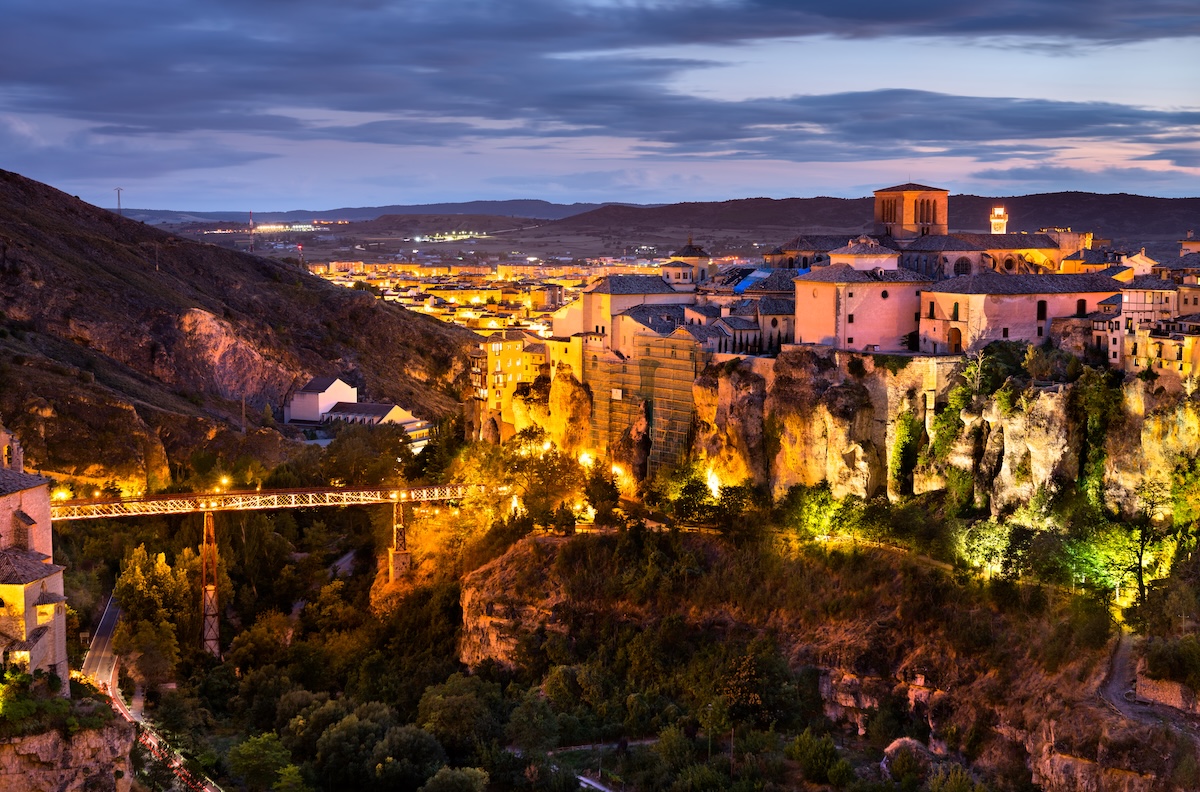
Cuenca’s Casas Colgadas, or hanging houses, cling to the edge of a cliff over the Huécar River gorge, with wooden balconies sticking out over a sheer drop. By day they look precarious. By night, floodlit from below, they look impossible, as if the town forgot gravity was a rule.
The best seat is the San Pablo Bridge, an iron footbridge from 1902 that spans the gorge directly across from the houses. Walking it at night takes nerve if heights bother you, since you can see the river far below through gaps in the planks. Behind the hanging houses, the old town climbs a narrow ridge between two gorges, and its cathedral and Plaza Mayor glow over quiet, steep lanes. Cuenca sits about an hour from Madrid on the high-speed train, which makes staying overnight easy, and staying is the only way to see it lit.
Hong Kong, China
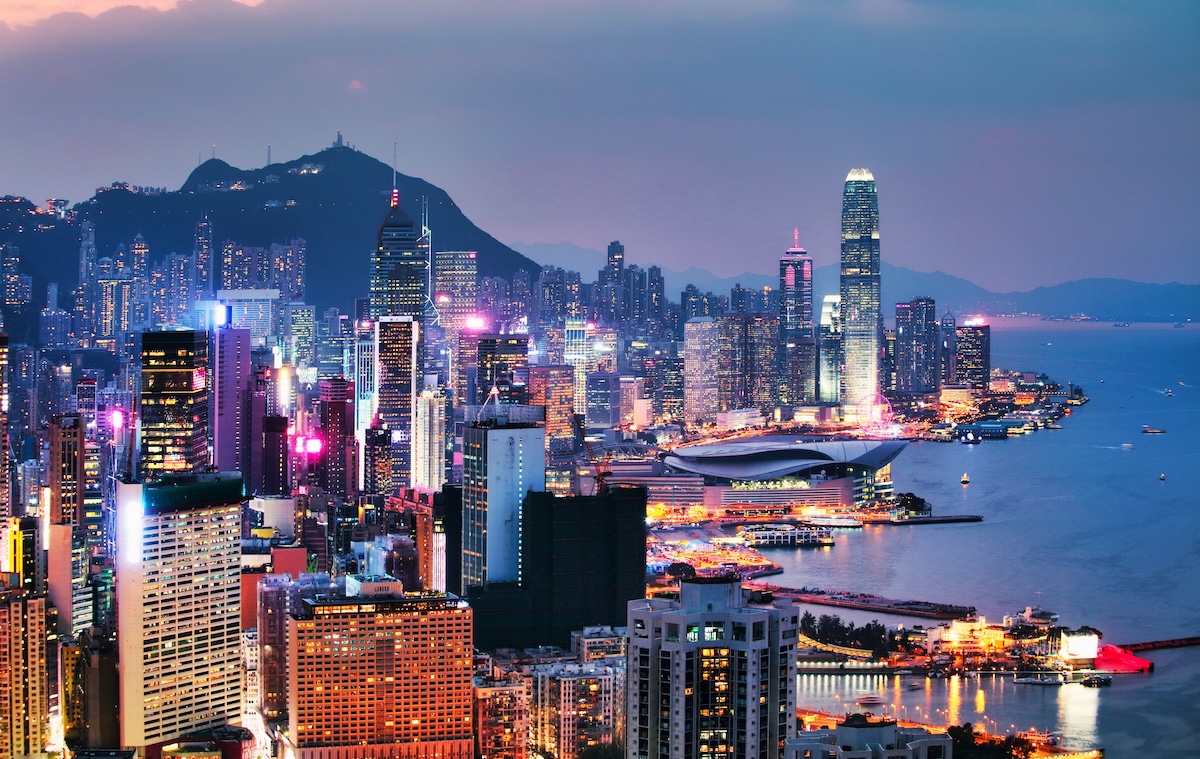
Hong Kong packs one of the densest skylines on the planet around a single harbor, so the night view comes at you from both shores. Stand on the Tsim Sha Tsui promenade in Kowloon and the towers of Central and Wan Chai fill the opposite bank, backed by the dark mass of Victoria Peak.
At 8 p.m. every night, A Symphony of Lights runs across dozens of buildings with lasers, searchlights, and music, a tradition since 2004. It’s a bit cheesy and still fun. For a better view than any show, ride the Peak Tram up after sunset and look down on the city from above. The Star Ferry, running since the 1880s, costs only a few Hong Kong dollars and crosses the harbor in about ten minutes. One thing you’ll notice: many of the famous neon signs have come down due to safety rules, so seek out the ones that remain in Mong Kok and Yau Ma Tei.
Paris, France
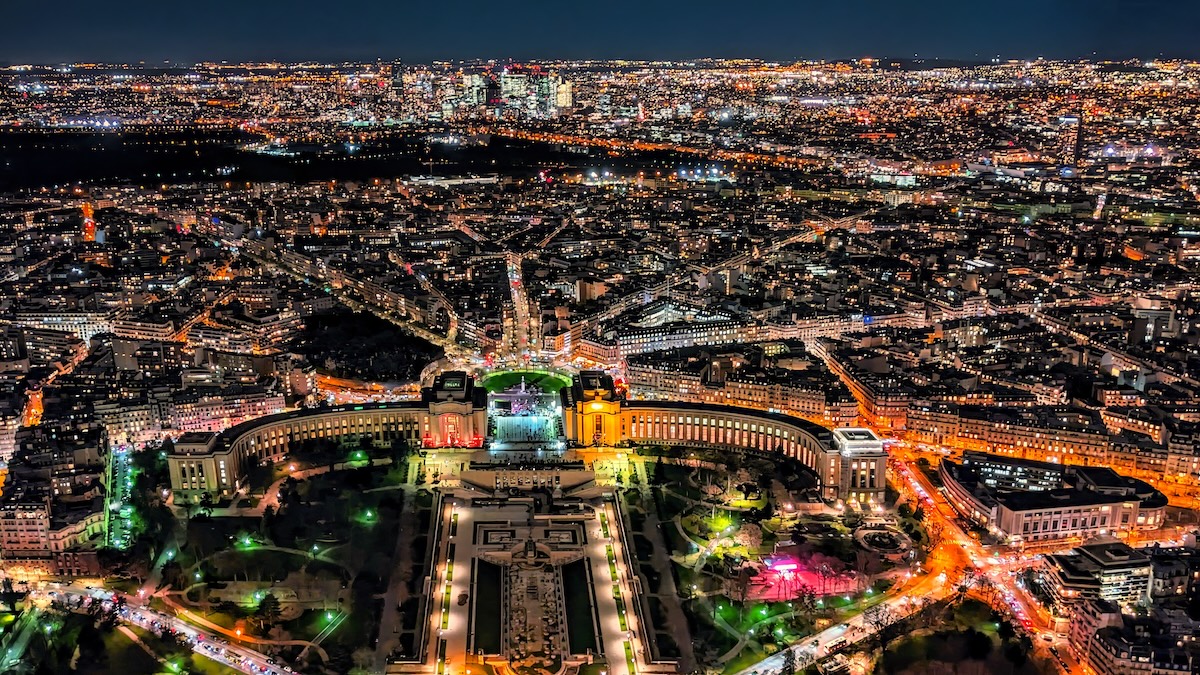
The Eiffel Tower is the obvious star of Paris at night, and it puts on a show to match. After dark, it sparkles with thousands of flashing bulbs for five minutes at the top of each hour, which turns every bridge and café terrace with a view into a front-row seat. Trocadéro gives you the classic angle; the Champ de Mars puts you right under it.
The rest of the city fills in nicely. The Seine is lined with lit bridges and stone embankments, and a river cruise from near the Pont Neuf takes you past Notre-Dame, the Louvre, and the Musée d’Orsay in about an hour. For a different perspective, climb Montmartre to the steps of Sacré-Cœur and watch the rooftops spread out below. The “City of Light” nickname predates electricity, tied partly to the city’s early adoption of gas street lamps in the 19th century.
Busan, South Korea
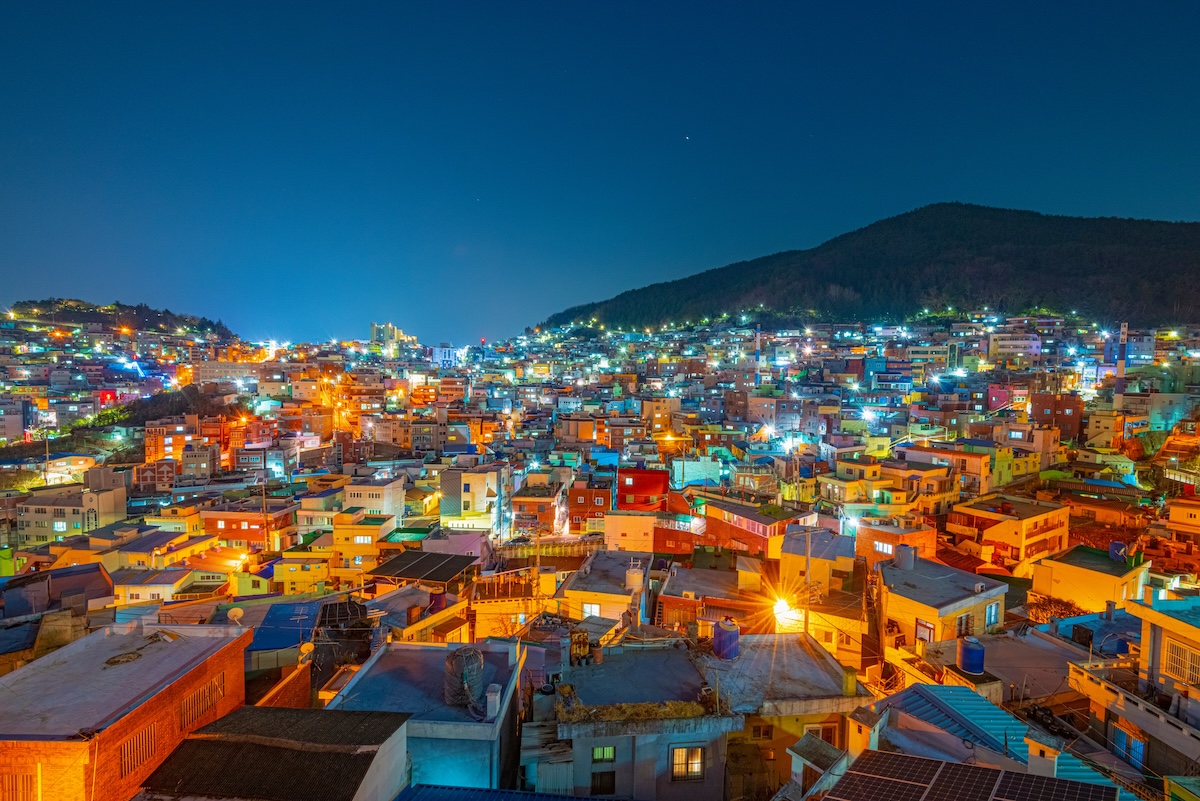
Busan’s nights center on the beach, which makes it different from most big cities on this list. Gwangalli Beach faces the Gwangan Bridge, a long suspension bridge whose LED lights shift colors after sunset, and the sand stays busy with families and couples well into the evening. Seafood restaurants and rooftop bars line the waterfront behind you.
Haeundae Beach, a short ride away, adds a ring of high-rises and the Marine City towers, which look especially sharp from the Dongbaekseom Island walking trail. Every autumn, the Busan Fireworks Festival launches over Gwangalli and draws enormous crowds; book a waterfront restaurant or hotel room early if you want a good view without fighting for space on the beach. On normal nights, a drone show above Gwangalli runs on weekends, which is a fun extra.
Prague, Czechia
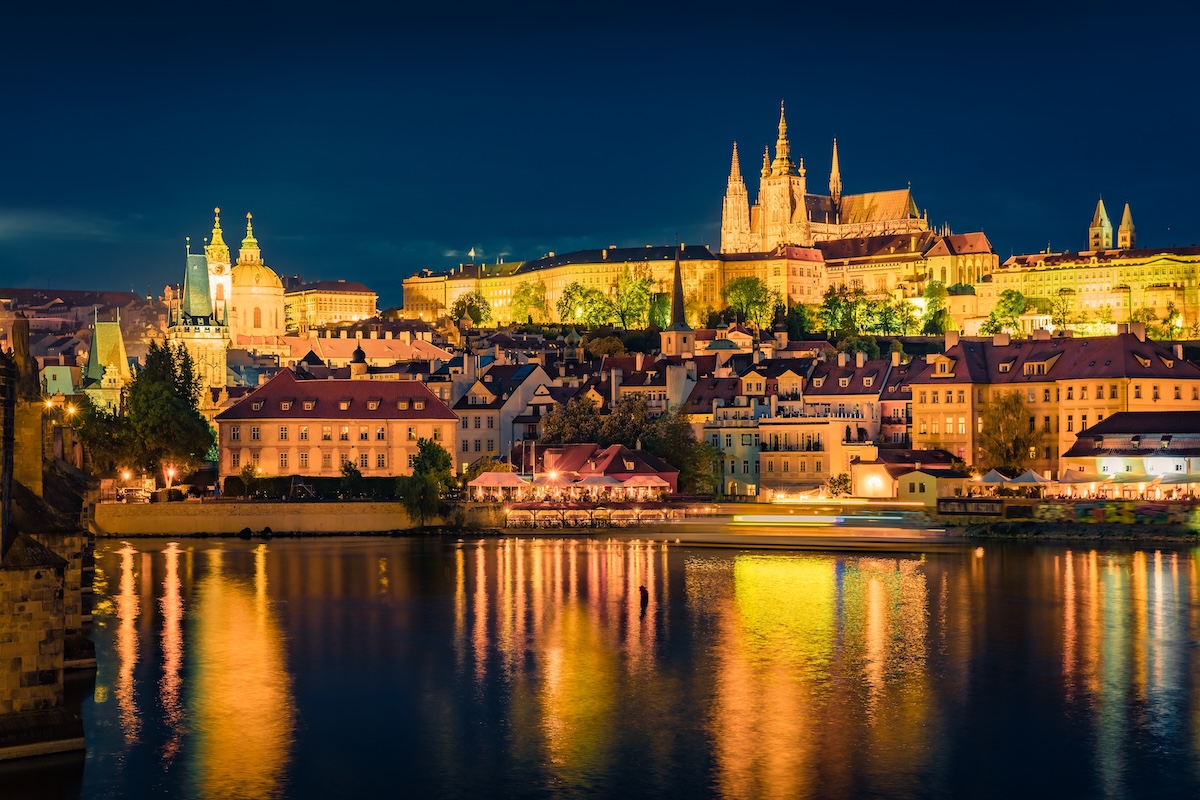
Prague looks best once the tour groups leave Charles Bridge. After dark, the Gothic towers at each end glow, the statues along the bridge turn into silhouettes, and Prague Castle sits lit across the Vltava like a backdrop painted for an opera. Come around midnight or very early morning and you’ll have stretches of the bridge almost to yourself.
The city also holds onto some old-fashioned light. Hundreds of gas street lamps still operate in the historic center, and during the Christmas season, lamplighters in period clothing light some of them by hand near the bridge. For the wide view, walk up to Letná Park, where a terrace beer garden overlooks the river and its string of bridges. The Old Town Square, with its Astronomical Clock and the spiky Týn Church, holds a Christmas market from late November into early January, which adds stalls and a tree to the scene.
Granada, Spain
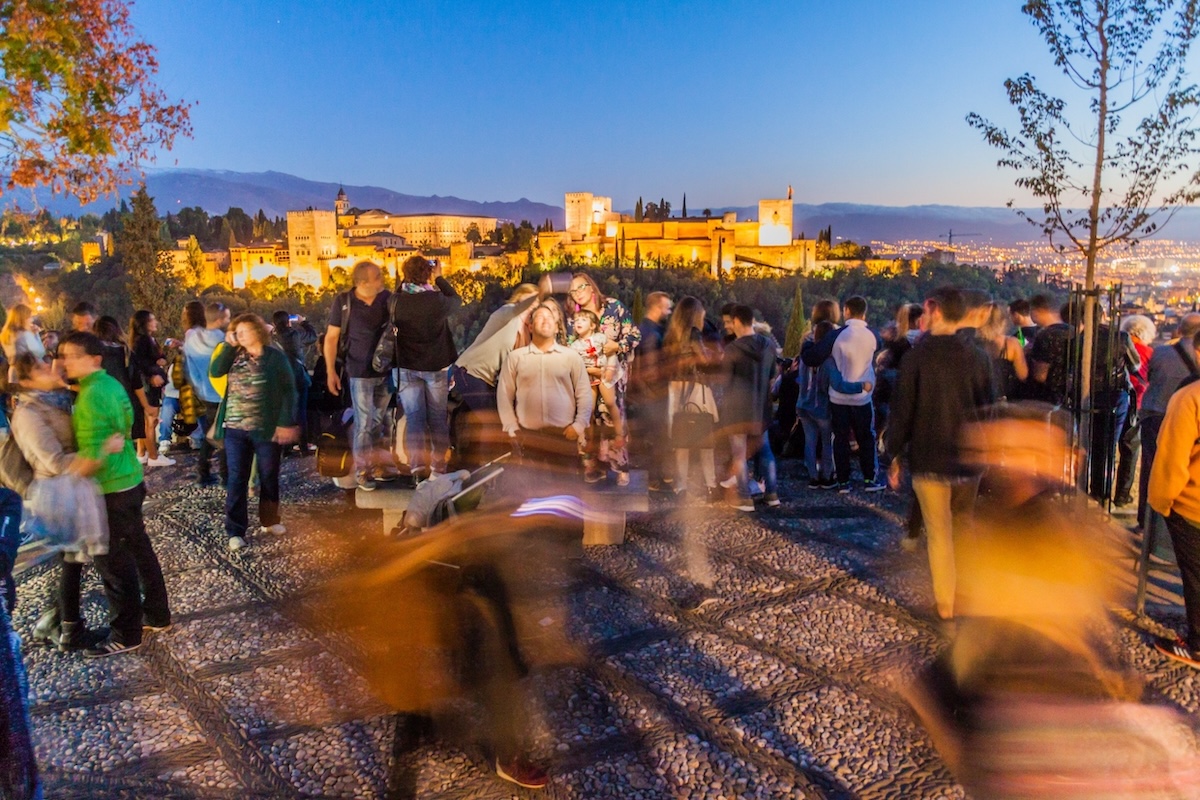
Granada’s most famous view at night belongs to the Alhambra, the Moorish palace complex that crowns a hill across the valley from the Albaicín neighborhood. As the sun goes down, it turns from orange to gold under floodlights, with the Sierra Nevada mountains behind it often still snowcapped well into spring.
The Mirador de San Nicolás is the classic place to see it, and it fills up with buskers, flamenco guitar, and people with drinks in hand. For a calmer version, try the Mirador de San Cristóbal. You can also go inside after dark: the Alhambra sells night visit tickets for the Nasrid Palaces, and seeing the carved stucco and courtyard pools lit softly feels quite different from a crowded midday tour. Book in advance, since tickets sell out weeks ahead in busy months. Afterward, the Albaicín’s winding lanes lead down to tapas bars where a drink still comes with free food.
Isfahan, Iran
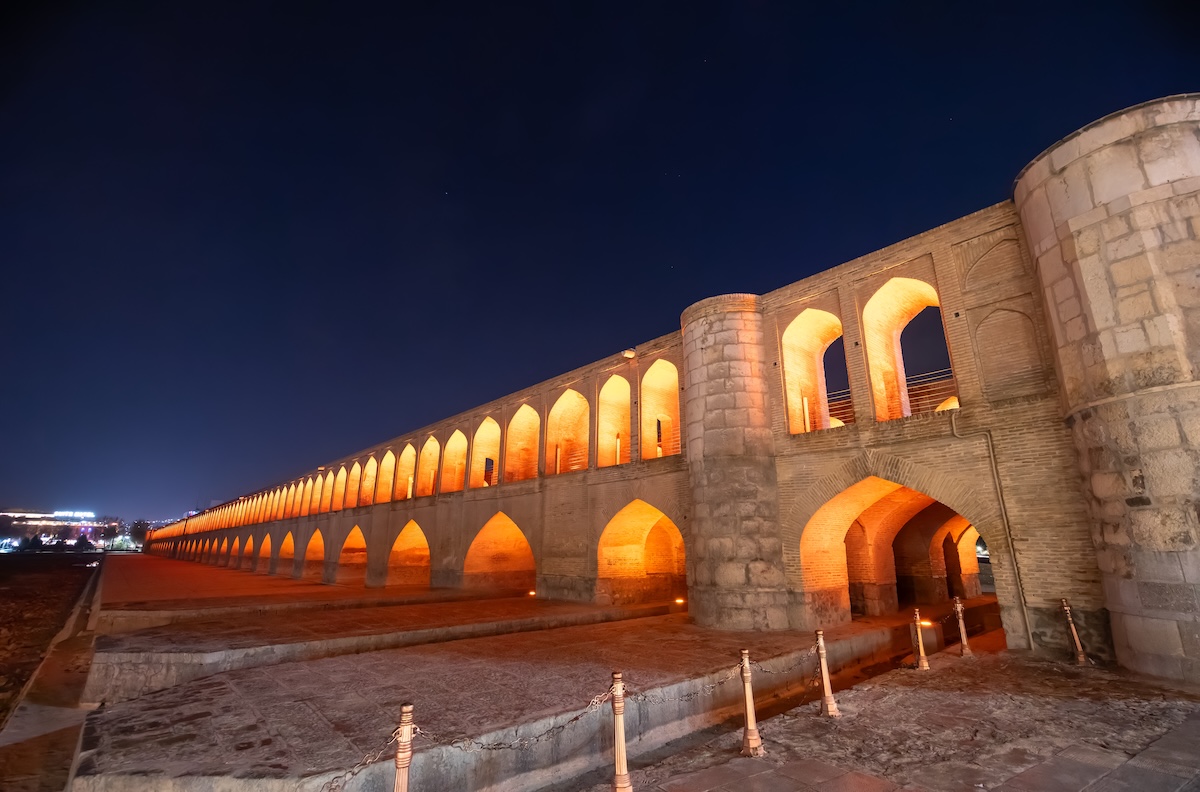
Isfahan’s centuries-old bridges are the reason to stay out late. The Si-o-se-pol, with its 33 arches, and the Khaju Bridge, built in the 17th century, both glow over the Zayandeh River at night, and locals gather in the arched alcoves to chat, picnic, and sometimes sing. The acoustics under the Khaju Bridge carry voices beautifully.
The river has run dry for long stretches in recent years due to drought and upstream water diversion, so the reflections you see in old photos aren’t guaranteed. The social scene goes on regardless. Naqsh-e Jahan Square, one of the largest city squares in the world, offers the other big night moment, with the Shah Mosque and the Ali Qapu Palace lit around a broad lawn where families gather after dark. Check current travel advisories before planning a trip, since entry rules and safety guidance for U.S. citizens can change quickly.
Singapore
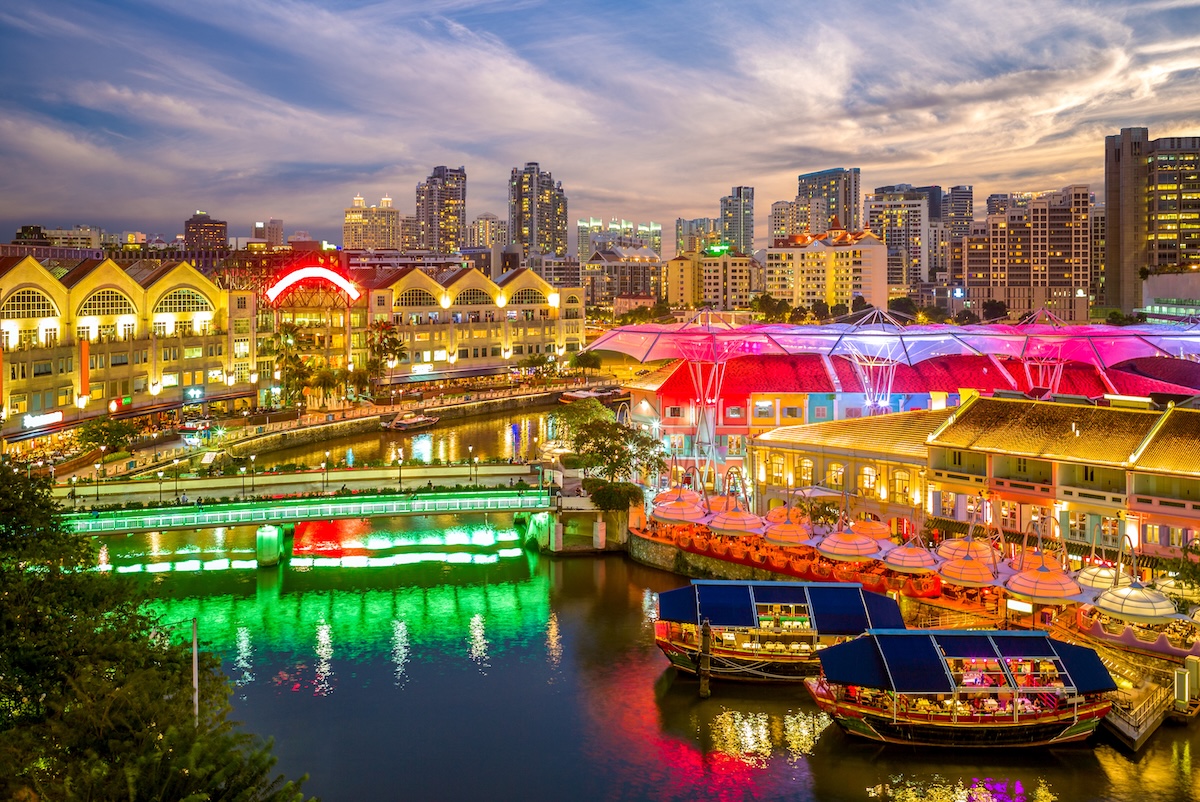
Singapore designs its nights with the same precision it applies to everything else. Gardens by the Bay holds the Supertree Grove, a cluster of steel tree-shaped towers up to 50 meters tall, and every evening at 7:45 and 8:45 p.m., the Garden Rhapsody show syncs their lights to music. Lie down on the ground under the trees for the best angle; locals do it, so you won’t look strange.
Across the bay, the Marina Bay Sands complex runs Spectra, a free light and water show at its waterfront promenade most nights. Walk the loop around Marina Bay between the two shows and you’ll pass the Merlion, the Helix Bridge, and the ArtScience Museum. Food is a big part of night here too. Lau Pa Sat, a Victorian-era market in the Financial District, closes one street to traffic in the evenings so hawker stalls can grill satay outdoors.
Kotor, Montenegro
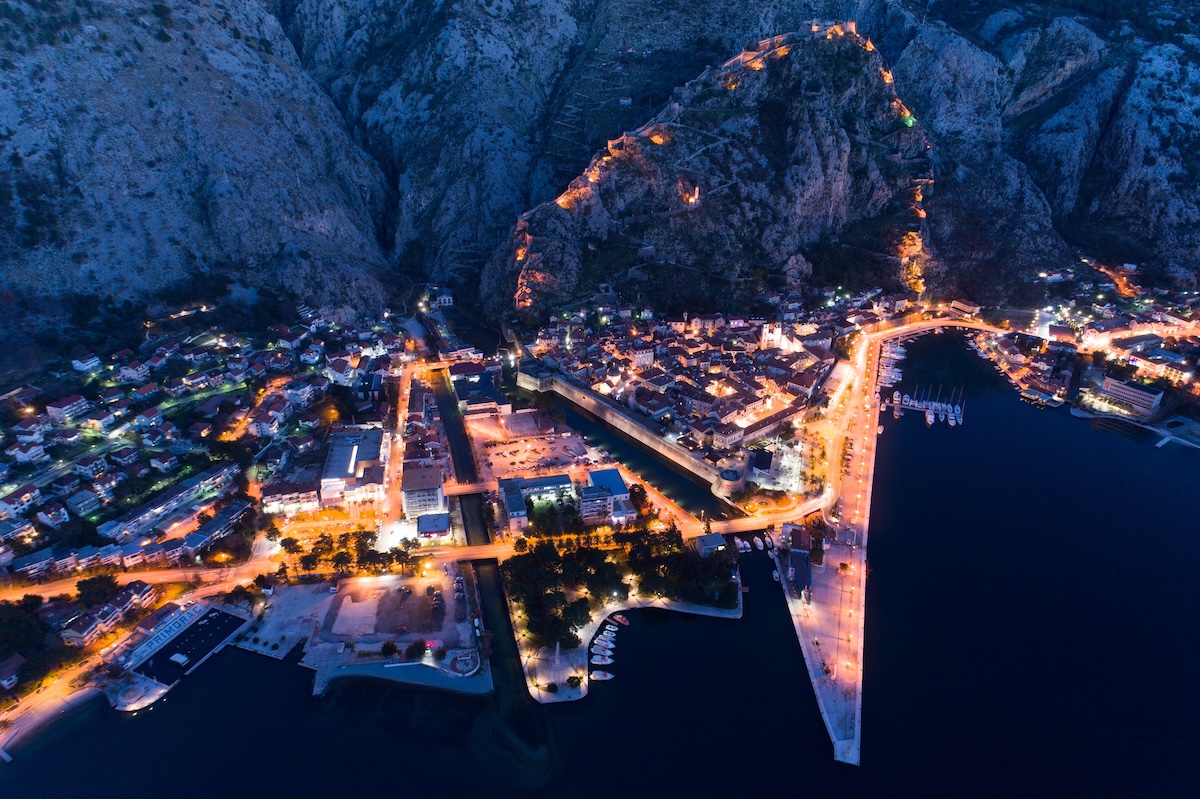
Kotor’s medieval walls climb straight up the mountain behind the old town, and at night they’re lit in a zigzag of lights that looks like someone drew a thin gold line up the cliff. The walls lead to the Fortress of St. John, about 1,350 steps above sea level, and the view from the top takes in the whole Bay of Kotor.
Start the climb about an hour before sunset so you reach the top in time to see the town and the fjord-like bay light up below you. Bring a flashlight for the walk down, as the steps are worn and uneven. Back in the old town, the marble lanes become much calmer once cruise passengers return to their ships, and the squares around the Cathedral of St. Tryphon fill with outdoor tables. The town also has a famous cat population, so expect company on your evening walk.
Cape Town, South Africa
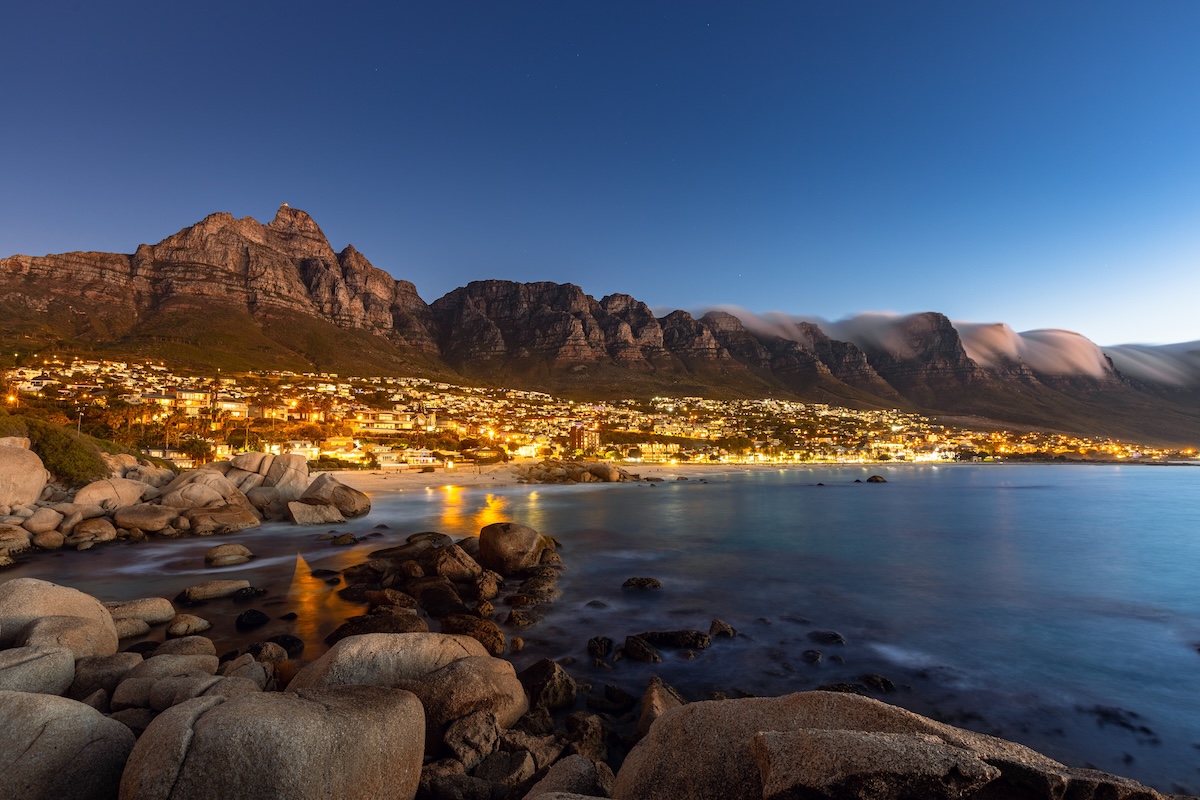
Cape Town’s setting gives its night views a dramatic edge: the city lights fan out in the bowl between Table Mountain and the Atlantic, so the dark mountain wall frames everything. Signal Hill is the go-to spot for watching sunset turn into city lights, with a road that lets you drive almost to the top.
For something more ambitious, locals hike Lion’s Head during full moons, a climb of about an hour or two each way with chains and ladders near the top. Go with a group and a headlamp. Back at sea level, the V&A Waterfront stays lively into the evening with restaurants, a Ferris wheel, and views of Table Mountain lit against the night sky. If you drive between viewpoints, stick to well-traveled routes after dark and ask your hotel for current advice on neighborhoods to avoid.
Symi Town, Greece
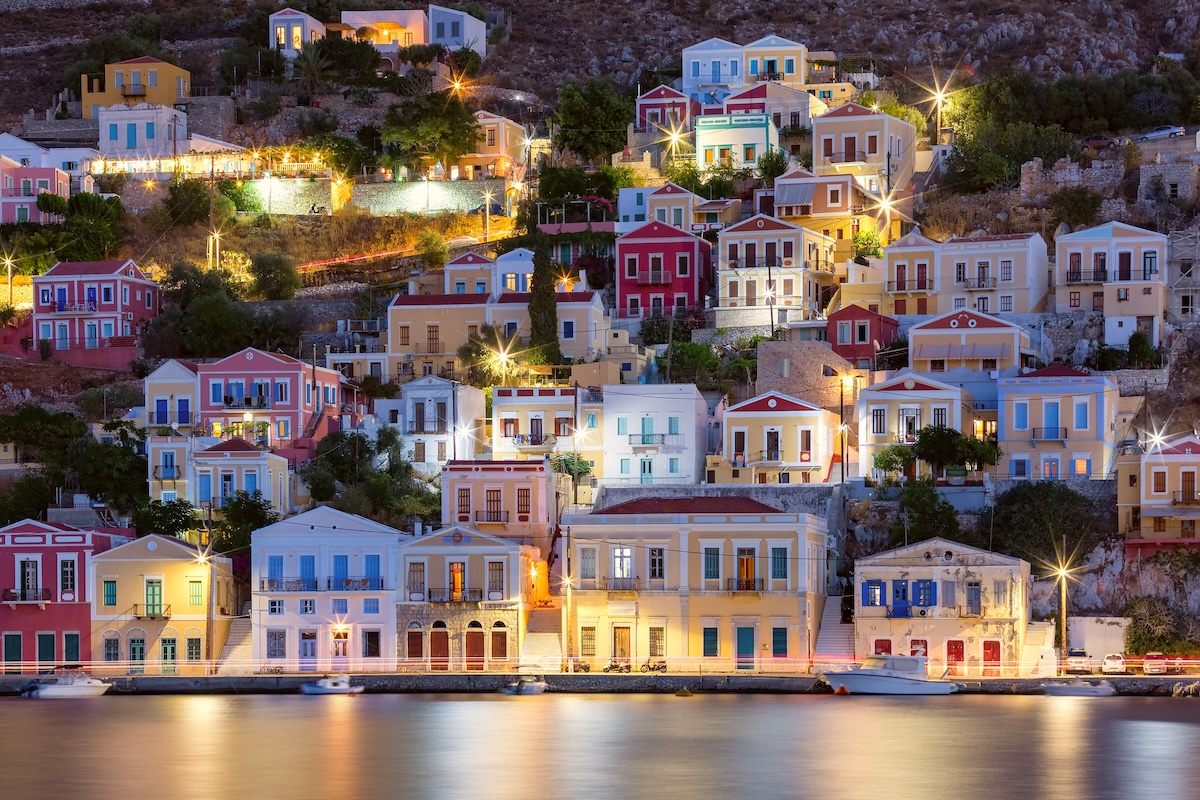
Symi Town is small, and that’s the charm. Its pastel neoclassical houses rise in tiers around a horseshoe harbor on a Dodecanese island close to the Turkish coast, and after dark their lights reflect off the water in a neat amphitheater shape. With day-trip boats from Rhodes gone by late afternoon, evenings belong to a quieter crowd.
The harbor area, called Gialos, fills with tavernas serving the island’s tiny local shrimp. For the full view, climb the Kali Strata, a long stone staircase linking the harbor to the upper town of Chorio. The houses stay lit as you rise, and halfway up you’ll get an angle over the whole bay with fishing boats bobbing under the windows. Symi is reached by ferry from Rhodes in about an hour, and most visitors who stay overnight say it’s worth more than the day trip.
Istanbul, Turkey
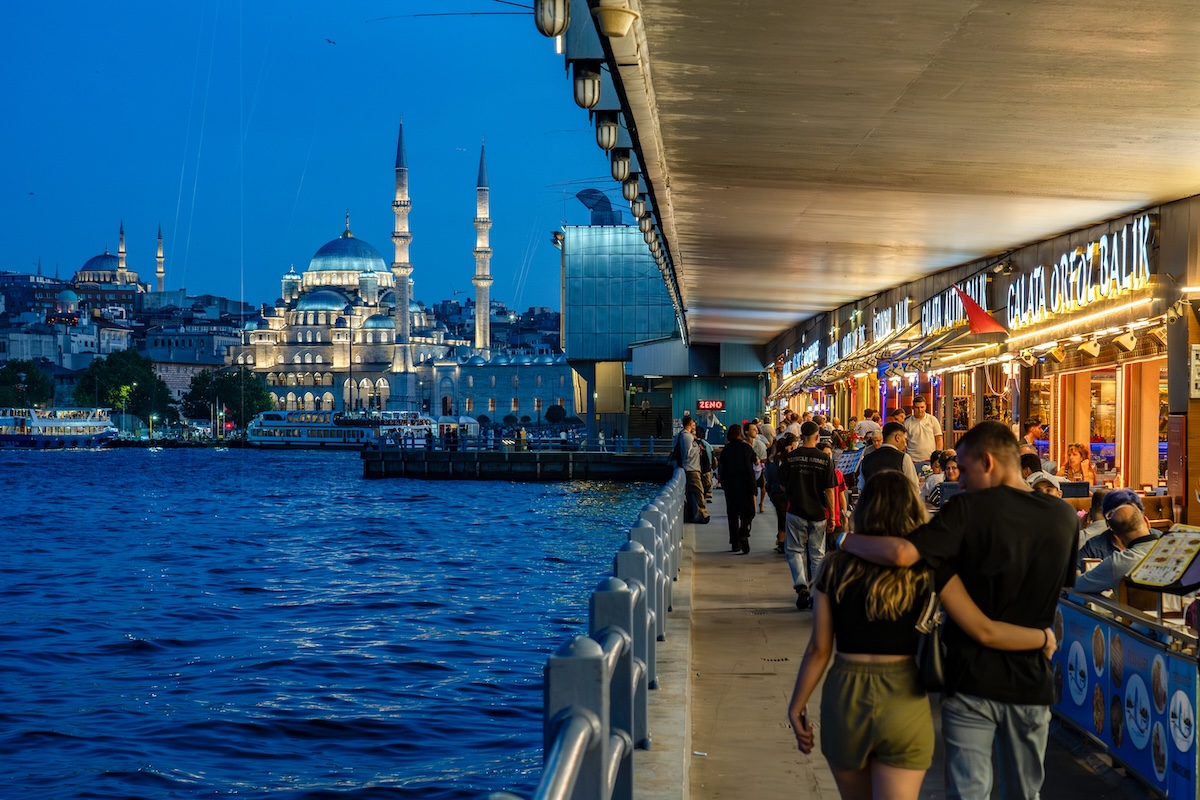
Istanbul at night is a city of silhouettes. The domes and minarets of the Blue Mosque and Hagia Sophia glow in Sultanahmet, the Süleymaniye Mosque presides over the Golden Horn, and the Bosphorus Bridge shifts colors between Europe and Asia. The skyline packs so many lit landmarks that the water seems to hold a second city.
The best way to see it costs almost nothing. Public ferries cross the Bosphorus between Eminönü, Karaköy, Kadıköy, and Üsküdar well into the evening, and the trip takes about 20 minutes. Sip a small glass of tea on deck and watch the waterfront palaces slide past. On land, the Galata Tower area gets crowded but rewards you with views back over the old peninsula. Üsküdar’s waterfront makes an excellent alternative, with a direct view of the Maiden’s Tower lit up just offshore.
Hoi An, Vietnam
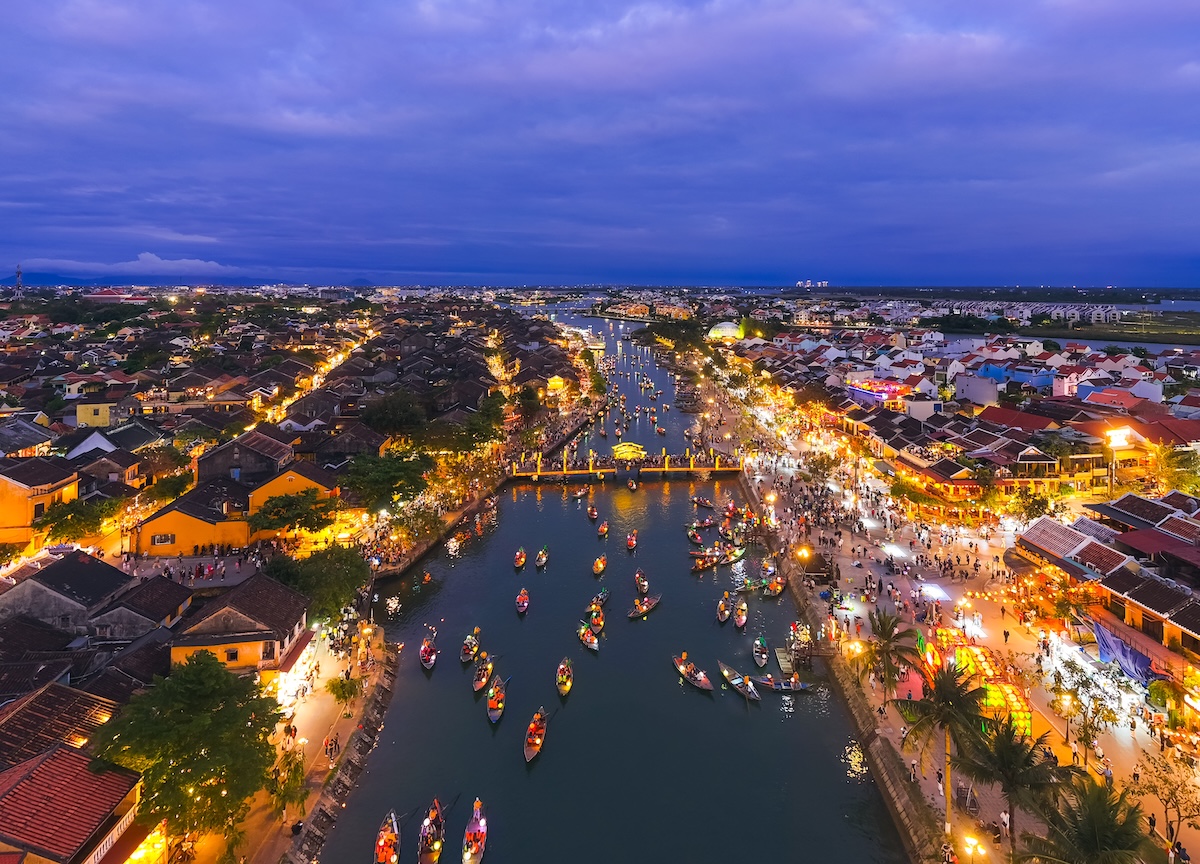
Hoi An lights itself with silk lanterns. The old trading port on the Thu Bồn River has hung colorful lanterns along its shopfronts for generations, and the Old Town, a UNESCO World Heritage site, glows red, yellow, and violet after dark. It’s a low, warm kind of light that suits the old wooden houses and the Japanese Covered Bridge.
The river is where the evening happens. Boatmen offer short rides from which you can release a paper lantern with a candle onto the water, a small ritual for luck. Every month on the 14th day of the lunar calendar, the town holds a full moon lantern festival and dims many electric lights, letting the lanterns and the moon carry the scene. Expect big crowds on those nights. For a calmer look, cross to An Hội island across the river and watch the Old Town from there.
Budapest, Hungary
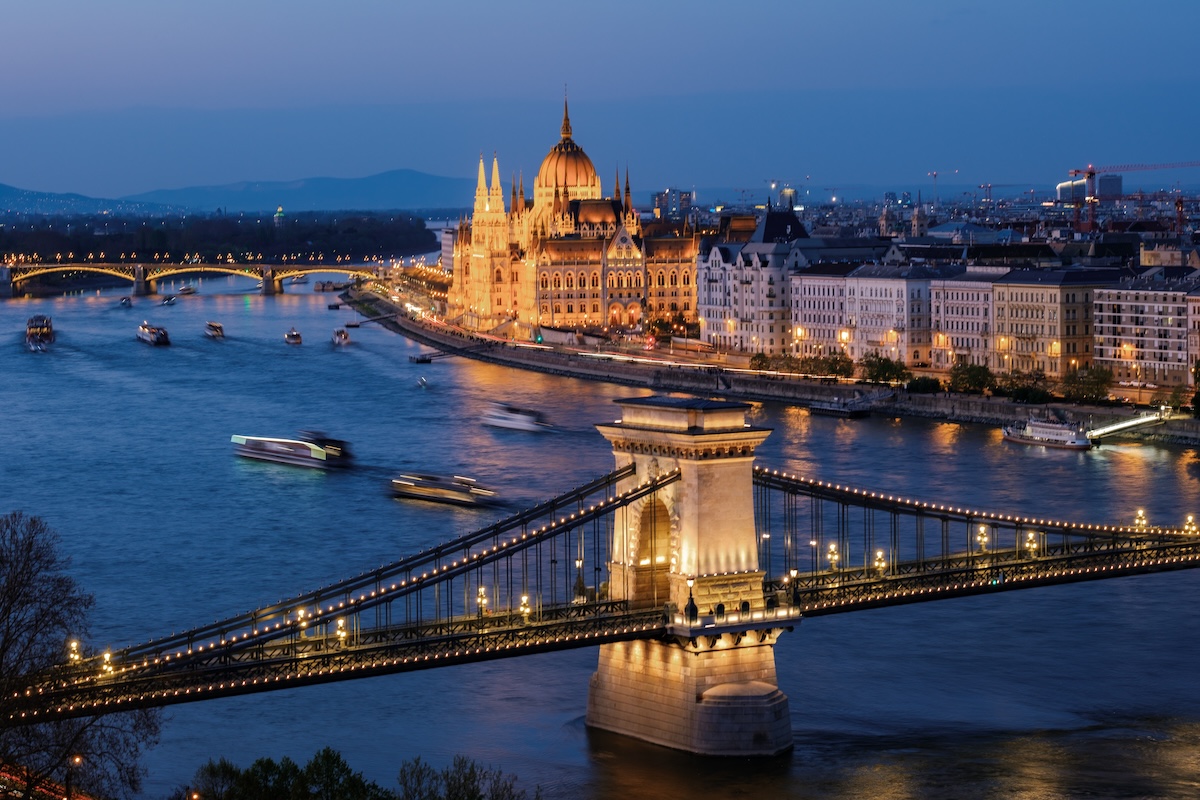
Budapest owns one of the grandest riverfronts in Europe, and it looks best after dark. The Hungarian Parliament Building, with its Gothic spires and red dome, glows gold on the Pest side of the Danube, while Buda Castle sits lit on its hill across the water. Between them, the Chain Bridge’s lights stretch across the river in tidy arcs.
A Danube night cruise covers it all in about an hour, and many boats leave from the docks near the Vigadó Square. For a free option, climb to the Fisherman’s Bastion or Gellért Hill and look down on the river curving through the city. Budapest also offers something few night cities can: thermal baths. The Széchenyi Baths stay open into the evening, so you can soak in a warm outdoor pool surrounded by yellow neo-Baroque buildings with steam rising into cold air.
Guanajuato, Mexico
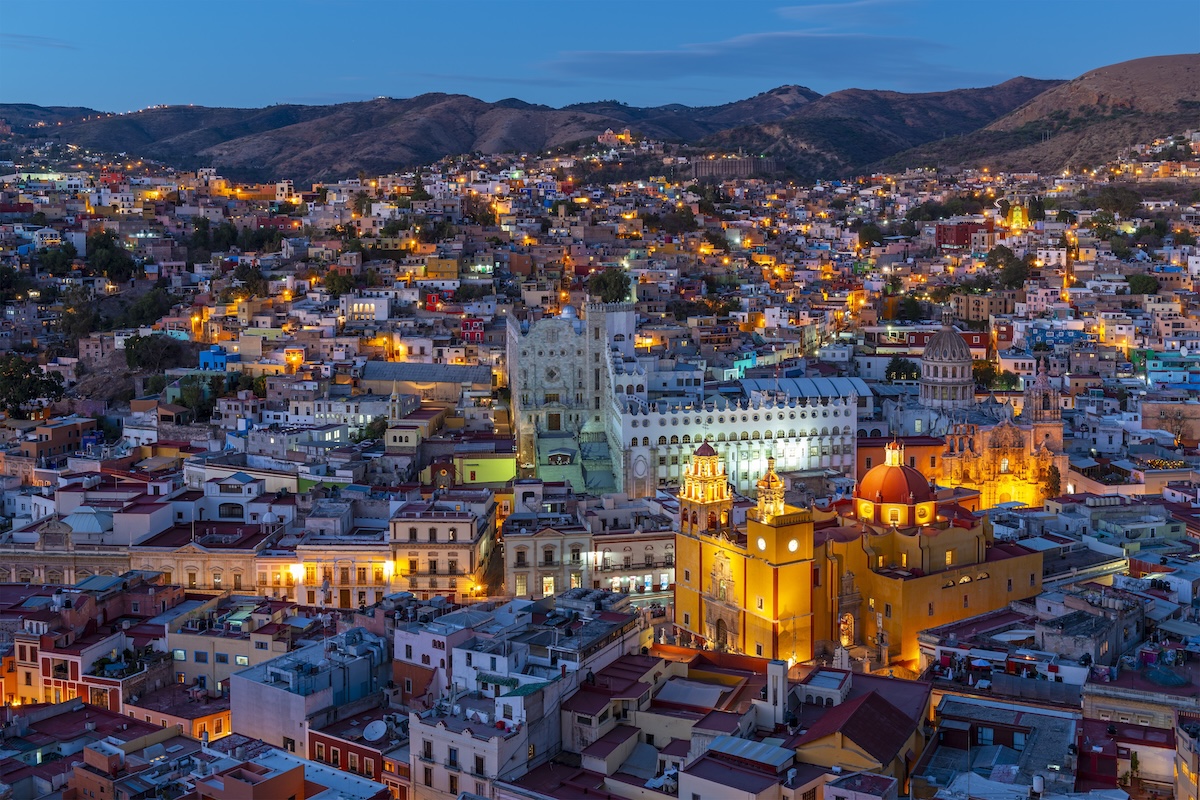
Guanajuato is a colorful colonial city built into a narrow ravine, and night turns its jumble of painted houses into a hillside of glowing windows. Streets twist so much that much of the traffic runs through underground tunnels, leaving the lanes above for pedestrians.
The callejoneadas are the signature night experience. Groups of musicians dressed in Spanish Renaissance-style costumes, called estudiantinas, lead crowds through the alleys while singing, telling stories, and passing around drinks. You’ll hear the legend of the Callejón del Beso, a lane so narrow that balconies nearly touch. For the panorama, ride the funicular up to the Monumento al Pípila, where the whole city spreads below you in pinks, yellows, and blues, softened by streetlights. Guanajuato also hosts the Festival Internacional Cervantino every October, which fills its plazas with performances late into the night.
Tokyo, Japan
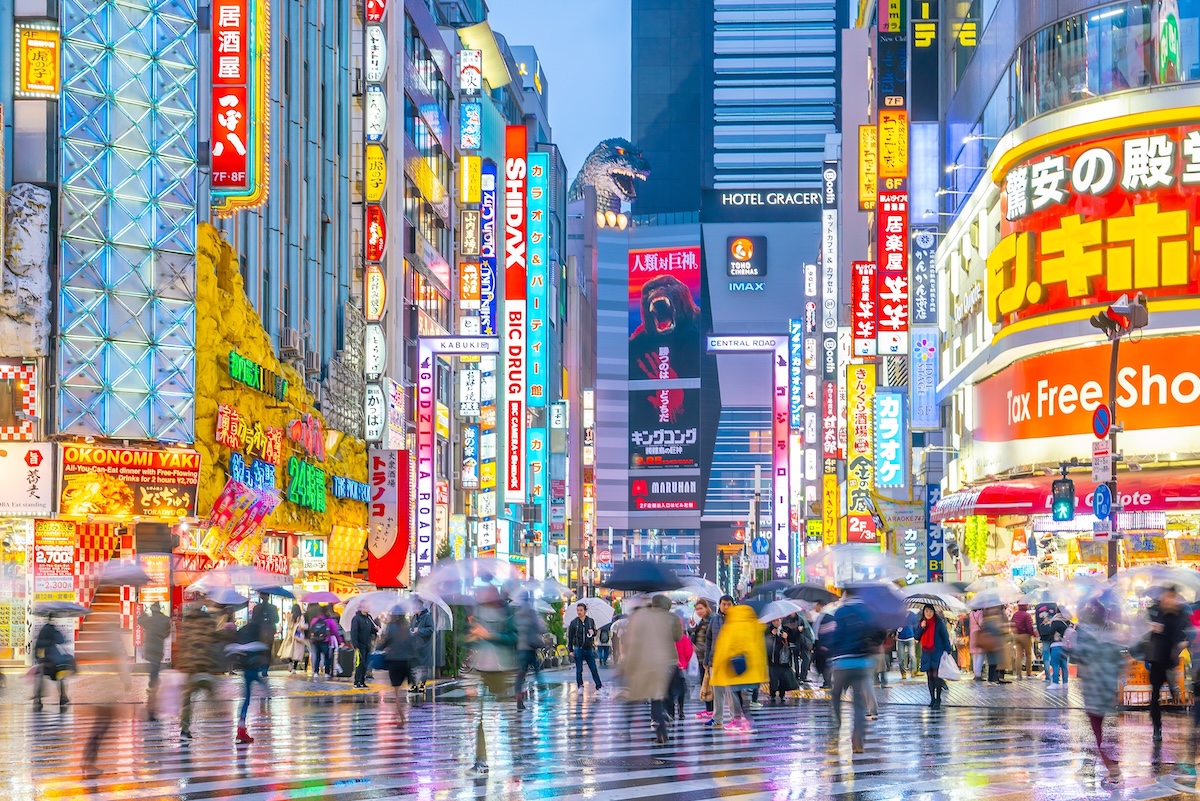
Tokyo after dark feels endless. Neon and screens light up Shinjuku and Shibuya, where the famous scramble crossing sends hundreds of people across at once under giant video billboards. The sheer scale of the illuminated city is hard to grasp until you see it from high up, and the observation decks at Shibuya Sky, Tokyo Skytree, and the free Tokyo Metropolitan Government Building all deliver.
The small stuff counts as much as the spectacle. Tucked between skyscrapers, alleys like Omoide Yokocho in Shinjuku and Golden Gai pack tiny bars and yakitori stands under paper lanterns and smoky light. Tokyo Tower, painted orange and white and lit in warm tones, looks great from the Shiba Park area or from Roppongi Hills. Trains stop running around midnight, so plan your night accordingly or settle in until the first trains around 5 a.m.
Porto, Portugal
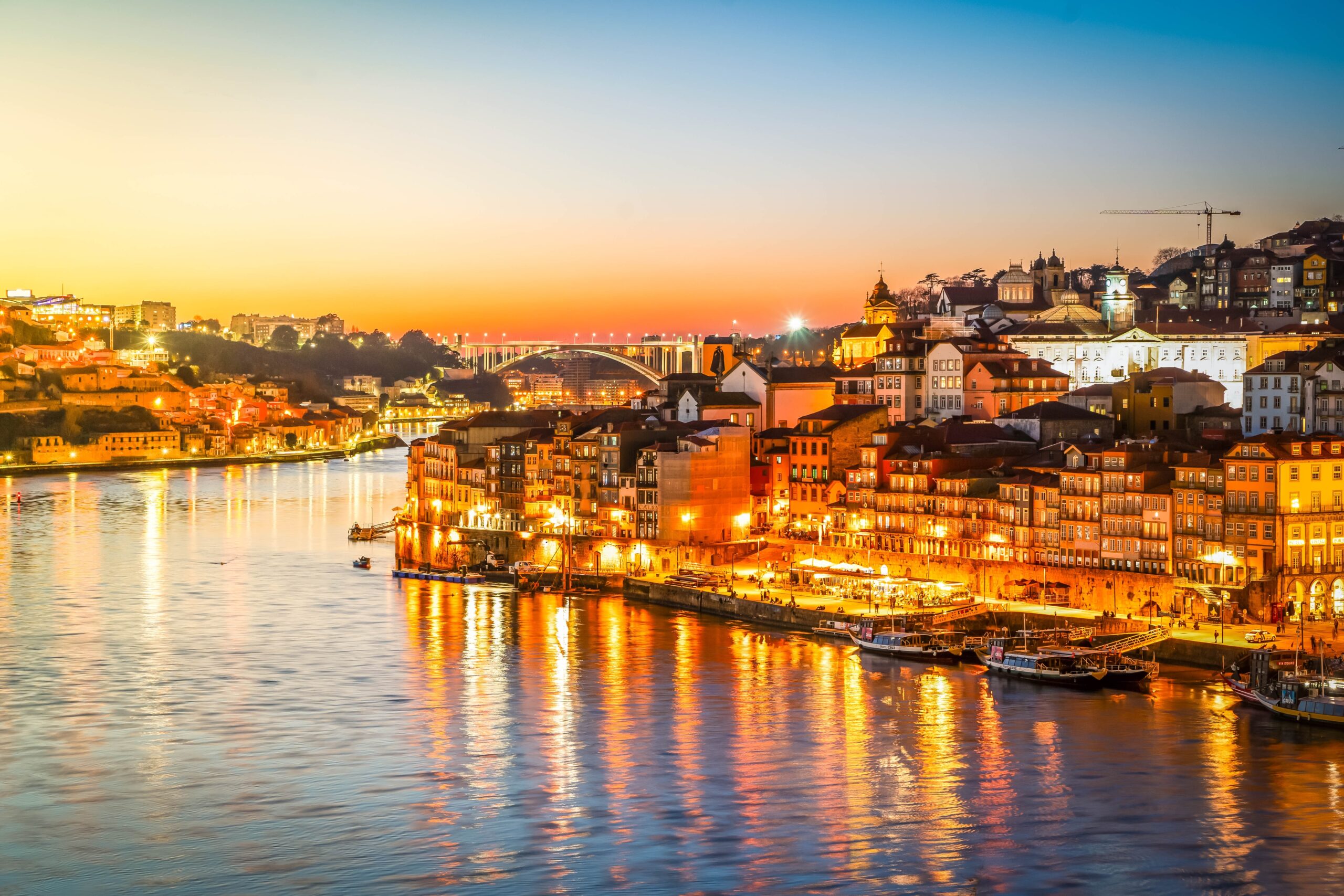
Porto’s riverside looks like it was built to be seen from across the water. The Ribeira district stacks narrow, tiled houses up the hillside above the Douro River, and at night their windows and the lit church towers shine back from the river’s surface. The Dom Luís I Bridge, a double-deck iron arch from 1886, frames the whole scene.
Cross the upper deck of the bridge on foot (it carries Metro trains too, so stay on the walkway) to reach the Vila Nova de Gaia side. The Jardim do Morro park there has one of the best views of Porto, especially at sunset as the city goes from gold to lamplit. Down on the Gaia riverfront, port wine lodges such as Sandeman, Graham’s, and Taylor’s offer tastings, and some keep their terraces open into the evening for a glass of tawny with the Ribeira across the water.
Venice, Italy
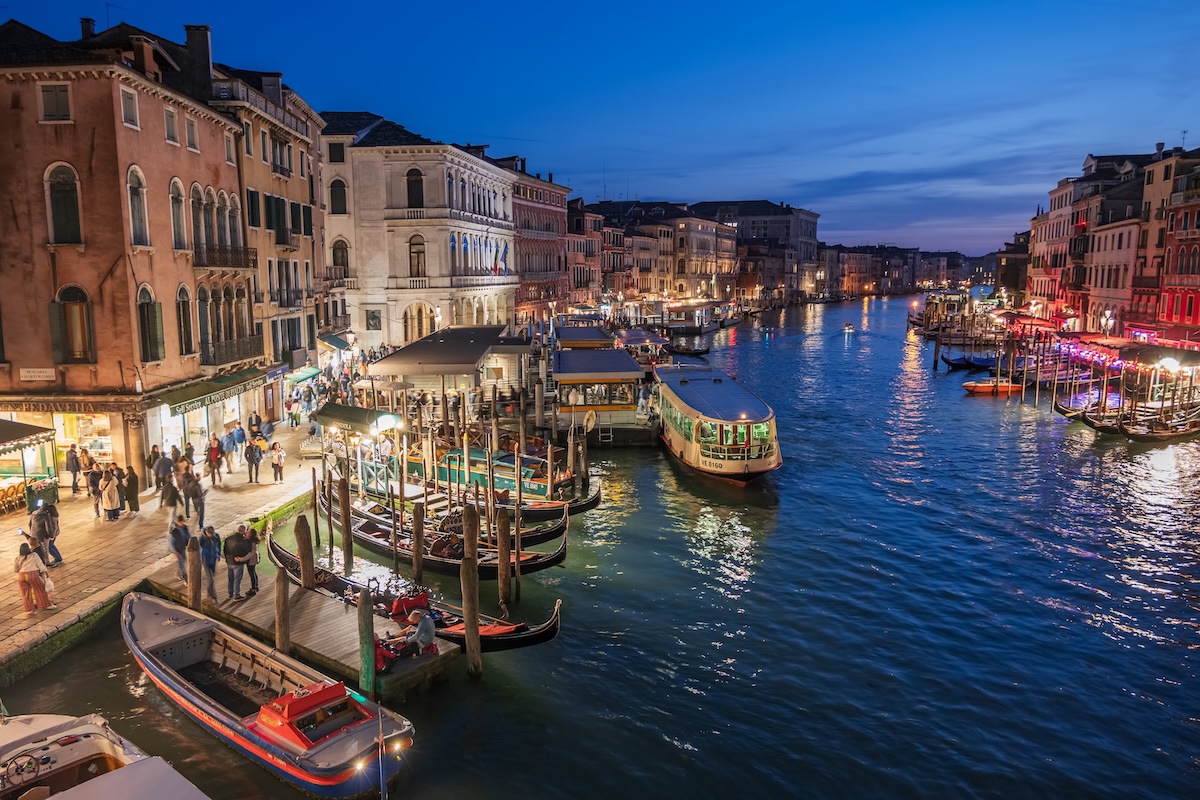
Venice belongs to the people who stay the night. Most day-trippers leave by early evening, and the city empties out into quiet canals and lantern-lit alleys. With no cars, the only sounds are footsteps, water slapping against stone, and the occasional gondolier calling out at a corner.
Piazza San Marco shifts mood after dark. The cafés Florian and Quadri keep small orchestras playing outdoors, and the basilica’s gold mosaics catch the lamplight. You’ll pay a hefty cover for a seat, but standing nearby is free. Wander away from the main square and get lost on purpose in Cannaregio or Castello, where locals sit outside bars sipping spritzes. The vaporetto Line 1 runs along the Grand Canal into the evening, giving you a slow tour past lit palazzos. Since 2024, Venice has charged day-trippers an entry fee on peak days, while overnight guests are exempt.
Chicago, USA
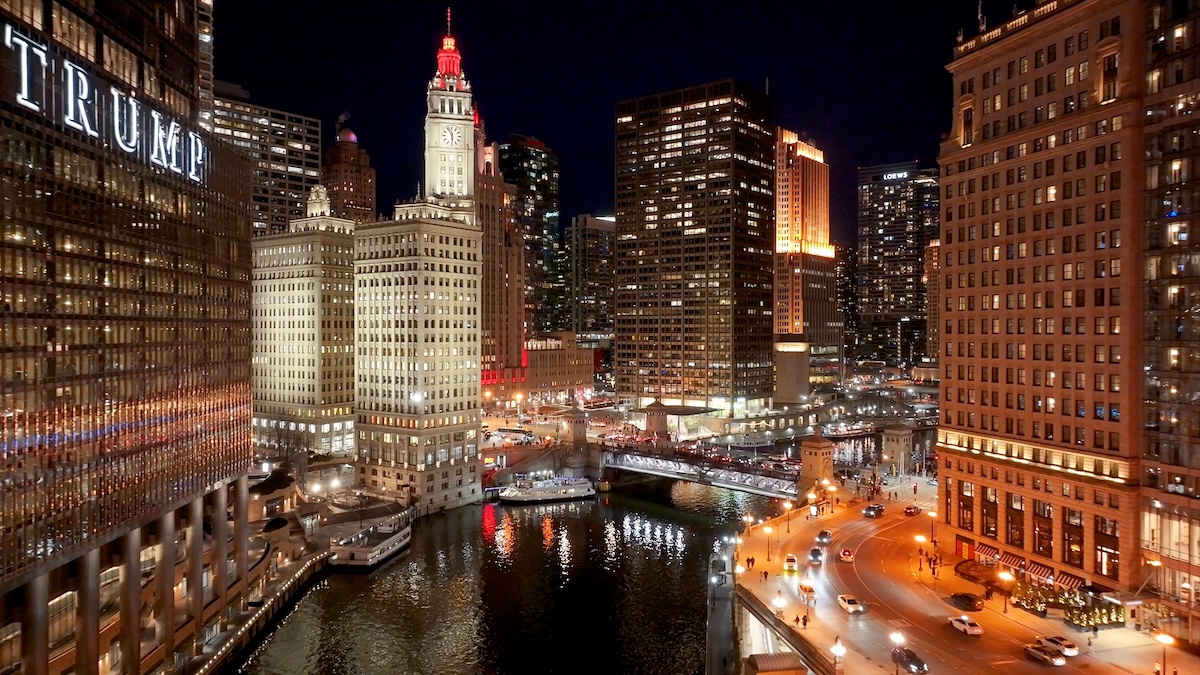
Chicago’s architecture shines brightest from the river. The Chicago River winds through downtown between skyscrapers, and nighttime architecture boat tours glide under its bridges past the corncob towers of Marina City, the Wrigley Building, and the Trump Tower. The Riverwalk lets you see much of the same on foot, with bars and restaurants along the water.
The city also turns buildings into screens. Art on theMART projects digital artwork onto the river-facing facade of the Merchandise Mart, which covers about 2.5 acres, on many evenings from spring through fall. Best viewing is from the Riverwalk between Wells and Franklin Streets. In summer, Navy Pier runs fireworks over Lake Michigan on select nights. For a skyline view, head to the Adler Planetarium’s lakefront, where the whole downtown spreads across the horizon.
Chongqing, China
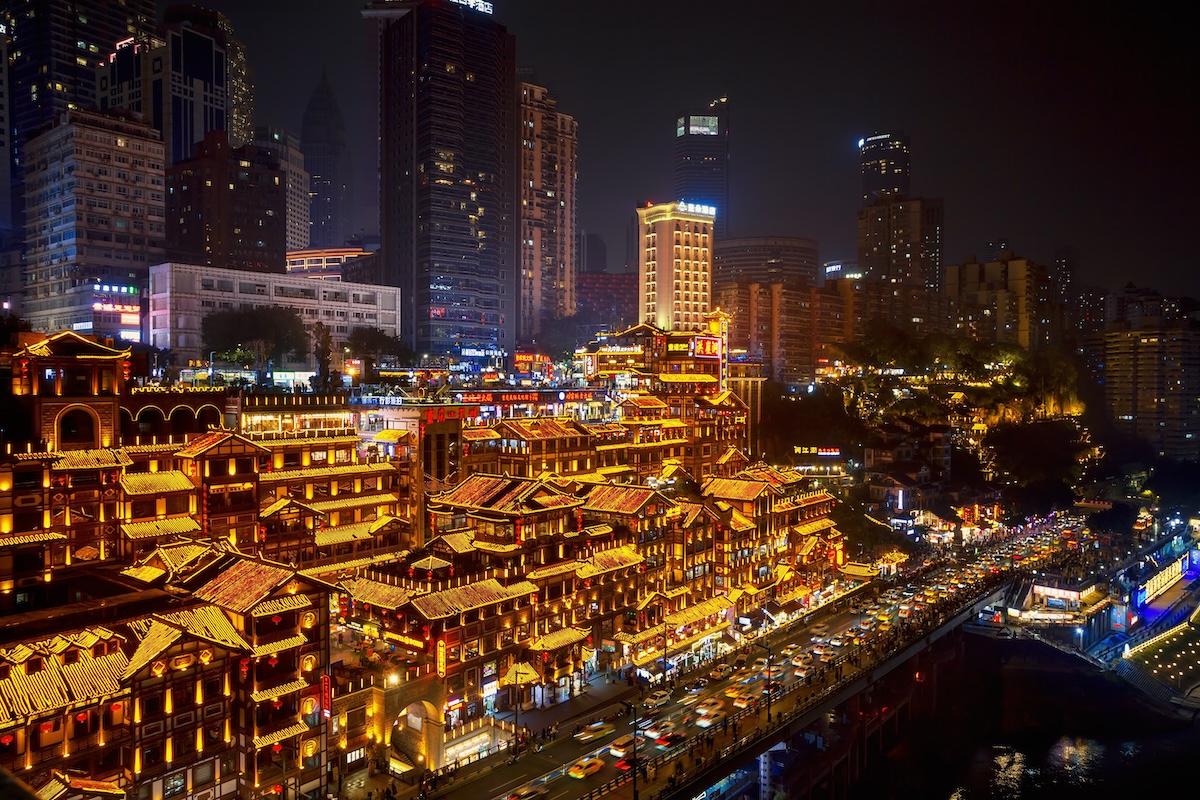
Chongqing looks like a city designed by a video game. Built on steep hills at the meeting point of the Yangtze and Jialing Rivers, it stacks roads, bridges, and buildings on top of each other, and at night everything lights up at once. Locals call it the 8D city because floors that seem underground turn out to be street level on the other side.
Hongyadong is the showpiece, a stilt-house complex that climbs the cliff above the Jialing River and glows gold at night. Many visitors compare it to the bathhouse in Spirited Away. Across the river, the skyline of the Jiefangbei district rises dramatically, and the Yangtze River Cableway carries you over the water for a view of both. Another oddity worth seeking out: at Liziba Station, a monorail train runs straight through a residential building, with lights from the trains flashing past apartment windows.