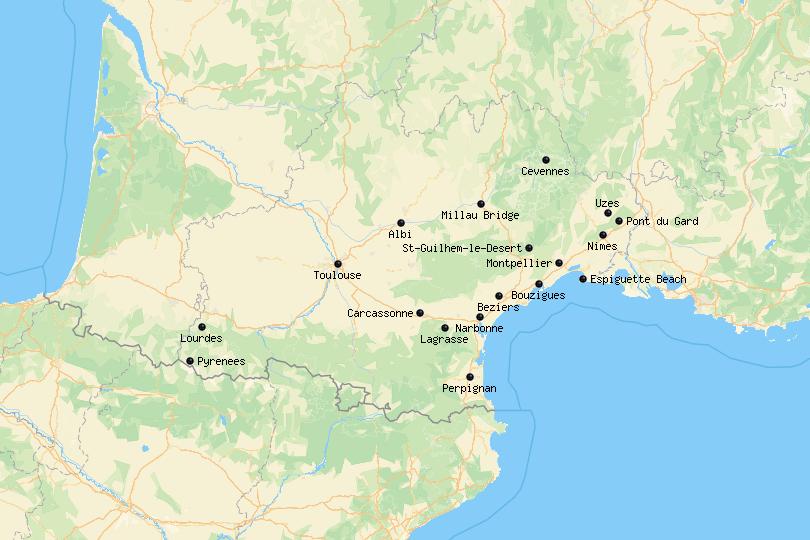
The Occitanie region in south-western France boasts a plethora of character-filled villages and extraordinary medieval architecture on the slopes of the snowcapped Pyrenees. Created in 2016 by the union of two smaller but well-known regions, Langeudoc-Roussillon and Midi-Pyrenees, the Occitanie region has plenty to offer even the most adventurous.
Whether you’re looking to explore magical Disney castles, indulge in the finest French wines and cuisine, discover the quaint culture of France’s traditional fishing villages, or hike the wildest expanses of the Pyrenees, Occitanie has it all.
19. Narbonne[SEE MAP]

Located along the glossy Canal de la Robine, Narbonne is not at all touristy. But with its tree-lined cobblestone streets, striking architecture, decadent food and wine, and scenic beaches, it easily could be. In fact, you’ll find some of the quietest beaches on the Med a short drive away.
Towering over the city, the Gothic Cathedral of Saint-Just et Saint-Pasteur is the perfect landmark for navigating the city streets. But it’s unusual in itself – construction began in 1272 but was never completed. Take a look at the incomplete yet still extravagant exterior and the beautiful stained glass windows inside.
Other noteworthy sights include the Archbishop’s Palace with its archaeology and art museums and beautiful gardens. Explore the city’s underground at the Horreum, hit the beach at Narbonne Plage, and tuck into wine and cheese at the Les Halles market – you won’t regret it.
18. Lourdes[SEE MAP]

Lourdes is a picturesque town tucked away in the Pyrenees foothills in southwestern France. It’s been a major Roman Catholic pilgrimage site since 1858 when a young woman by the name of Bernadette Soubirous claimed to have been visited by the Virgin Mary 18 times.
It’s only sensible then that the first port of call should be the Sanctuary of Our Lady of Lourdes, the pilgrim site next door to the Basilica. Millions line up every year to drink or bathe in the cave’s free-flowing spring, as Soubirous was supposedly counseled by the Madonna herself.
You can’t miss the hilltop fortress of Lourdes dominating the skyline on the outskirts of town. Other popular attractions include Le Cachot prison, the Byzantine Rosary Basilica, the Museum of the Miraculously Healed, the Wax Museum, and the nearby Pyrenees National Park.
17. Perpignan[SEE MAP]

Perpignan offers a quiet city escape near the Mediterranean. It’s not your typical tourist town, but that’s part of its appeal. The small city has a beautiful historic center and some excellent cafes and coffee shops.
The Palace of the Kings of Majorca is the town’s highlight. This fortress was built in the 13th-century, and while its Gothic-Romanesque exterior may look underwhelming, it’s the remarkable Catalan-influenced interior you’ll want to see.
Take a stroll through the winding alleyways, pick up a pastry from Halles Vauban market, visit the old red-brick town gate of Le Castillet, and discover the old town’s quaint churches, particularly the Cathedrale St-Jean.
16. Bouzigues[SEE MAP]

Like many of France’s underrated villages and towns, Bouzigues is not overridden with tourist attractions. Nestled between the Etang de Thau lagoon with its magnificent oyster beds and the vineyards hugging the hillside, the center is pretty, and the small beach dotted with fishing boats is like a scene from history.
Bouzigues has a wonderful café culture, and while it’s been a popular wine-producing area since the 6th-century, its better known for oysters and mussels. These industries only took off in the 18th-century, but likely date back to when local fishermen inhabited the caves along the shoreline.
Learn about the local fishing, oyster, and mussel farming industries at the Etang de Thau Museum, or about the Bouzigues’ earliest days at the Dinosaur Park and Prehistoric History Museum.
15. Canal du Midi[SEE MAP]

The Canal du Midi (Canal of the Two Seas) has meandered its way between the Mediterranean and the Atlantic for over 350 years. It flows from Toulouse and eventually into the Etang de Thau basin, the second largest lake in France.
But it’s the journey that really matters here; it’s packed full of nature, culture, and gastronomy. You can explore it all on foot, bike, or boat – but it’s the latter that’s the real treat! Plus, you don’t need a boat license to do it.
Wind past idyllic canal-side villages, vineyards, apple orchards, and sunflower fields, and wend your way through historic locks – Beziers has one of the most impressive lock systems in the world. Don’t miss the stone village of Le Somail with its bars and bookshops, the bustling markets of Narbonne, and the medieval city of Carcassonne.
14. Lagrasse[SEE MAP]

Lagrasse is officially listed as one of the most beautiful villages in France, and you’ll soon see why. Nestled in the foothills of the Pyrenees in the Corbieres wine region, it’s surrounded by picture-perfect stone buildings and the River Orbieu.
Dating back to the 7th-century, the village was built around the Abbey of Sainte-Marie, and the remains of the old town walls can be seen today. The abbey, with its Romanesque church and octagonal bell tower, is the highlight of the village, but there are two interesting bridges to see, too – particularly the humpback bridge that crosses the Orbieu!
As Corbieres is the largest wine-producing region in France, wining and dining here is a given. Don’t miss the quaint book and pottery fairs held in the summer.
13. Millau Bridge[SEE MAP]
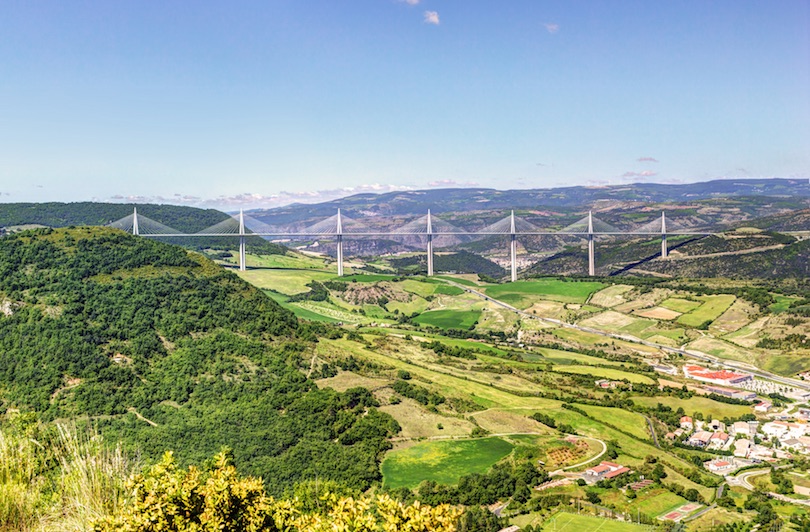
The Millau Viaduct is a road bridge spanning the Tarn Valley in southern France. Designed by an English architect and a French engineer and opened in 2004, it’s the tallest vehicle bridge in the world – soaring higher than the Eiffel Tower!
It’s also one of the longest suspended bridges in the world. It only touches the ground in nine places. The best way to see it is by parking your vehicle and walking up to a viewing point above the bridge, or admiring the view from Peyre and Millau. If you’re feeling adventurous, you can paddle beneath it in a canoe or even hang glide over it.
12. Espiguette Beach[SEE MAP]

Espiguette Beach is a long and wild stretch of sandy beach along France’s Languedoc coastline. The beach offers kilometer after uncrowded kilometer of rugged dunes, lagoons, and scrubby vegetation. You’re bound to find a spot for yourself – even in the middle of summer.
Apart from sunbathing, surfing, sandcastle building, and swimming, the main attraction is the lighthouse and fortress ramparts at the far end of the beach. While there are a few restaurants nearby, packing a picnic is the best way to while away a day at Espiguette Beach.
11. Beziers[SEE MAP]

One of the oldest cities in France, Beziers is fairytale-esque. Tucked along the secret French Riviera, an area that’s yet to be overrun with tourists, Beziers offers the quintessential French experience.
Dating back to 575 BC, the town has a desirable location. Surrounded on three sides by the Orb River and a canal, it’s about as photogenic as an old town gets. As the wine capital of Languedoc, it’s known for its red vino and bullfighting. Visit during the Feria festival in August and you’ll combine the best of both!
Explore the gorgeous rust-roofed old town, home to the 13th-century Romanesque Cathedral Saint-Nazaire, and the Museum of Fine Arts with its fascinating works of art. The glorious Canal du Mid is nearby; Beziers was actually the birthplace of Riquet, the man who built it.
10. Albi[SEE MAP]

Albi is a town on the Tarn River in southern France. Dating back to pre-Roman times, it’s most famous for the 13th-century Sainte-Cecile Cathedral of Albi. It was the largest brick structure in the world when it was built and boasts some impressive interior frescos, including one called the “Last Judgment.”
Explore the labyrinthine old town with its blissfully traffic-free streets, red brick buildings, quirky cafes, and regular markets. Don’t miss the landscaped gardens of Berbie Palace and the medieval Pont Vieux bridge.
If you’re interested in art, check out the Toulouse-Lautrec Museum dedicated to Henri de Toulouse-Lautrec, a famous painter born in Albi in 1864 who went on to paint turn-of-the-century Paris in his unique style.
9. Uzes[SEE MAP]
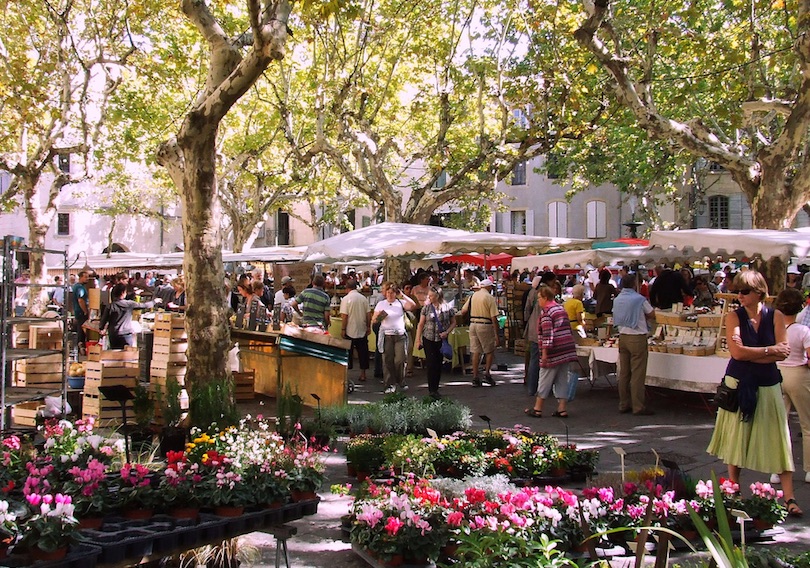
Once an important trading center for silk, linen, and licorice, Uzes is a city of beautiful contrasts, with medieval stone houses and Renaissance architecture alongside modern townhouses.
Highlights here include the Ducal Palace built on an old Roman camp, the Cathedral of Saint Theodorit, and a museum dedicated to Haribo sweets. Climb up the Window Tower for sensational views and stroll through the tranquil Medieval Garden.
The cobbled and fountained square of Place aux Herbes forms the heart of the city. Surrounded by lovely cafes, it’s also the site of two weekly farmer’s markets on Wednesdays and Saturdays.
8. Cevennes[SEE MAP]

There are few places as beautiful as the Cévennes. Filled with wooded hills, remote villages, olive groves, old silk mills, and vineyards, it’s one of the wildest and remote parts of France – and one that’s largely untapped by tourists.
Discover 4,000-year-old history in a place built for hiking and meditation. Supermarkets and cell reception are few and far between, but that’s part of its charm. Robert Louis Stevenson famously wrote about the area in ‘Travels with a Donkey,’ and you can follow his route yourself – donkey included.
There are several small villages worth visiting in the Cévennes, including the fortified La-Garde-Guerin and the attractive village of Le Pont-de-Montvert. Experienced hikers have a choice of hiking routes, but you can climb Mont Aigoual and most of Mont Lozere, the region’s highest point, easily by car.
7. Montpellier[SEE MAP]

One of the fastest growing cities in France, Montpellier is a lively place that’s often overlooked. But with its incredible architecture and old-world charm, it’s definitely worth a visit.
Most notable is its 13th-century Gothic Saint-Pierre Cathedral with its dramatic twin pillars and the Porte du Peyrou (Arc de Triomphe).
Get lost in the narrow streets of the old town, people-watch along Esplanade Charles de Gaulle, get a culture fix at the Fabre Museum, and orient yourself in Place de la Comedie – Montpellier’s central square. Don’t miss the Sunday market in the Peyrou Royal Square!
6. St-Guilhem-le-Desert[SEE MAP]

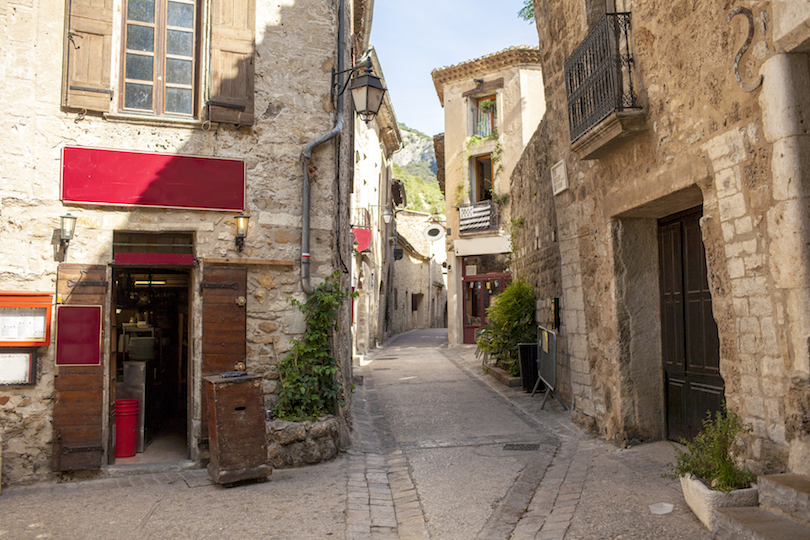
Hidden away in the remote Gellone Valley, the St-Guilhem-le-Désert is over one thousand years old. With humble beginnings as far back as the 9th-century, when an abbey was built in the Herault Gorges, it’s been an important pilgrimage site for nearly as long.
Architectural wonders include the Gellone Abbey with its Romanesque art, and Maison Lorimi and Sandonato with their impressive stone arches.
The 12th-century Tour des Prisons and the Chateau du Geant in the clifftops are stunning examples of the original village fortifications. Hiking to the nearby Clamouse cave, home to some of the most beautiful concentration of crystals in Europe, comes highly recommended!
5. Pont du Gard[SEE MAP]
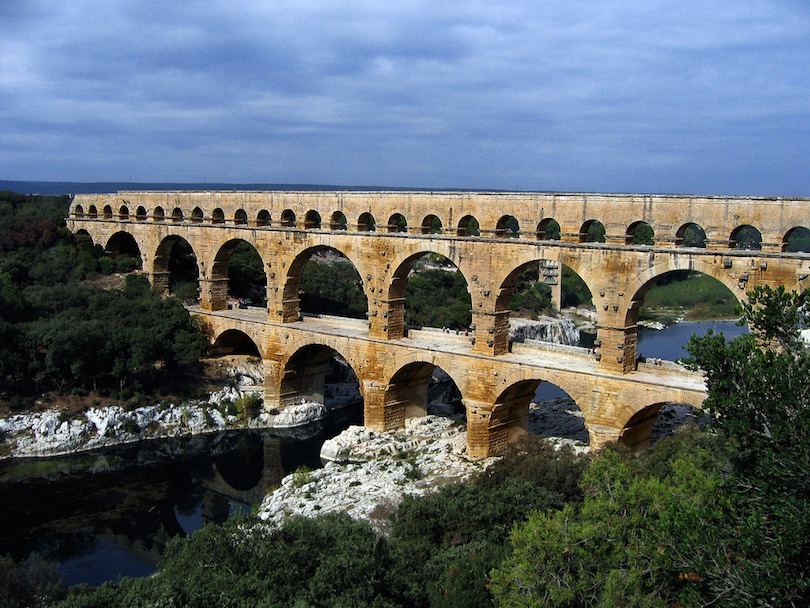
One of France’s most recognizable attractions, the Pont du Gard is an age-old Roman aqueduct dating back to the 1st-century AD. It was built as a way to transport water to the Roman colony of Nemausus (Nimes) and stands prominently over the Gardon River near the town Vers-Pont-du-Gard.
The Pont du Gard is the highest Roman aqueduct bridge in the world, and an impressive feat of Roman engineering for its time. It’s no surprise then that it’s also the most visited monument in France. Having served as an aqueduct until the 6th-century, a tollgate through the Middle Ages, and a road bridge between the 18th and 20th centuries, it now features a museum with guided tours.
Various trails lead up and around the bridge, and the riverbank is a popular spot for a picnic and a swim in the summer months. Don’t miss the incredible light shows over Easter and the River Rendez-Vous in summer.
4. Toulouse[SEE MAP]
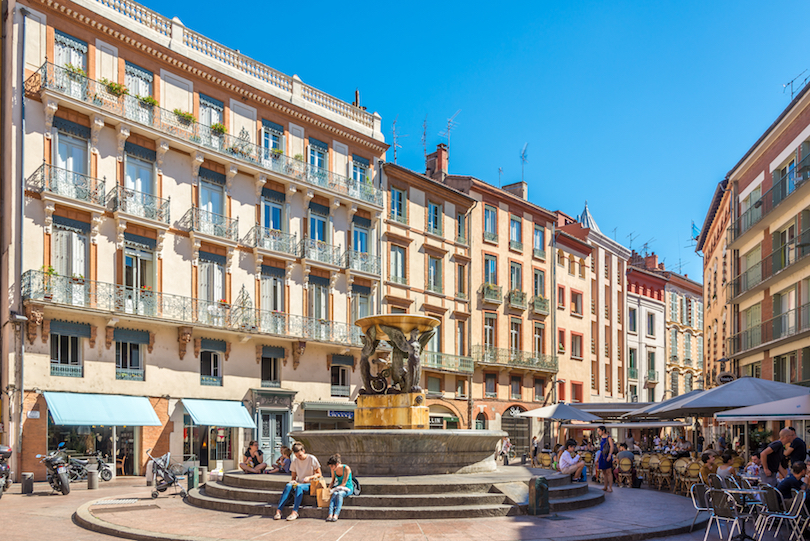
Lovingly dubbed ‘The Pink City,’ Toulouse, with its terracotta buildings, is the capital of France’s southern Occitanie region. Divided in two by the Garonne River, the city’s countless churches, museums, and gardens beg to be explored on foot, bike, or by car.
Famously the headquarters for European space study, Toulouse’s Cité de l’Espace science center makes for a fascinating visit. Prominent landmarks include the Basilica of Saint Sernin, the Augustins Museum, the Natural History Museum, and the Pont Neuf – the city’s oldest bridge.
People-watch at Capitole de Toulouse, explore the Japanese Gardens, admire the unusual palm-shaped vault at Jacobins Convent, and catch a show at the Theatre du Capitole.
3. Nimes[SEE MAP]
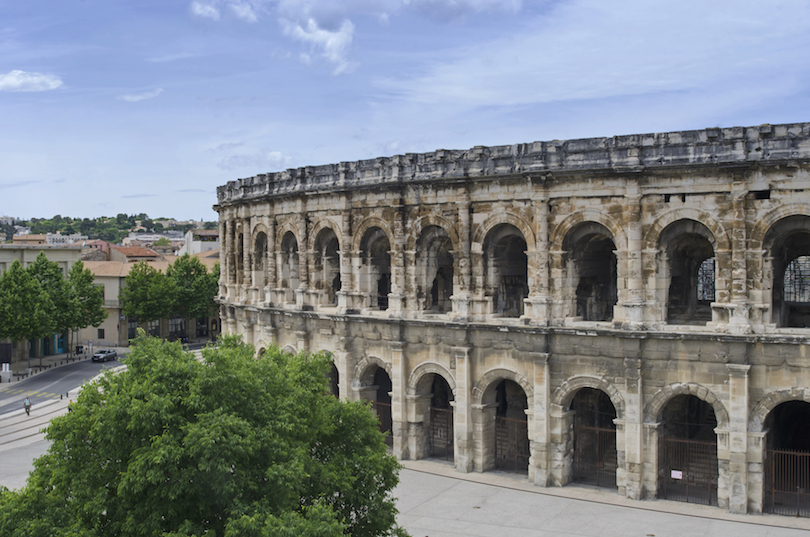
Once an important outpost of the Roman Empire, Nimes is packed full of beautifully-preserved monuments, including the Arena of Nimes – an ancient amphitheater still used for concerts and bullfights today.
The three-tiered Pont du Gard bridge is Nime’s major claim to fame. It was built in Roman times to transport water to the city. Other attractions include the Maison Carree temple, Nimes Cathedral, Les Halles market, and the Jardin de La Fontaine.
Interestingly, Nimes’ name inspired the word “denim,” and this textile has been made here since medieval times. Browse the shops for handcrafted, high-end jeans.
2. Pyrenees National Park[SEE MAP]

Stretching across the mountainous border with Spain, the Pyrenees National Park spans six valleys, from the Hautes-Pyrenees to the Pyrenees-Atlantiques. This wild and wonderful region is home to the highest summits in the French Pyrenees and hundreds of alpine lakes that simply beg to be explored.
Dense forests, purple Pyrenean irises, and rhododendrons creep up the snow-capped slopes alongside scenic hiking trails. The park can be visited all year round on the Little Trains railway or on foot – for outdoor activities in the summer, festivals in the fall, snow sports in the winter, and flowers in the spring.
Over 2,500 plant species call the park home, alongside some fascinating wildlife, including Golden eagles, Griffon vultures, bears, and the Pyrenean chamois. Keep an eye out for the Pyrenean desman, a mole-like creature only found here.
1. Carcassonne[SEE MAP]
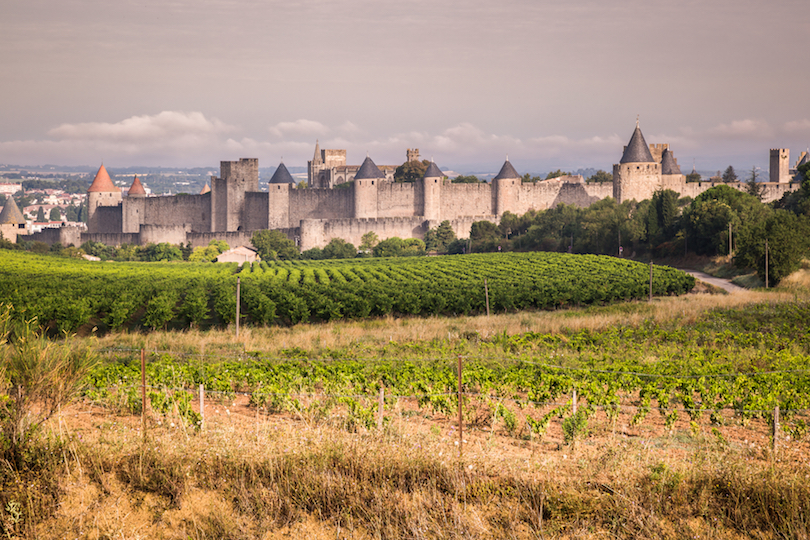
Historic Carcassonne is a medieval hilltop town that’s so well preserved you’ll feel as though you’ve traveled back in time. Dating back to the Gallo-Roman era, it’s filled with medieval fortresses, museums, mysteries, and legends.
With its charming stone buildings, often-deserted passageways, and castle-like walls on the Canal du Midi, the old town could easily have been inspired by Disney. Carcassonne was famous for its involvement in the Albigensian Crusades when it was a stronghold of Occitan Cathars.
Admire the Romanesque-Gothic Basilica of Saints Nazarius and Celsus, Cité de Carcassonne, Chateau Comtal, and the last-surviving Jacobin gate. Don’t miss the lovely food market open six days a week!