
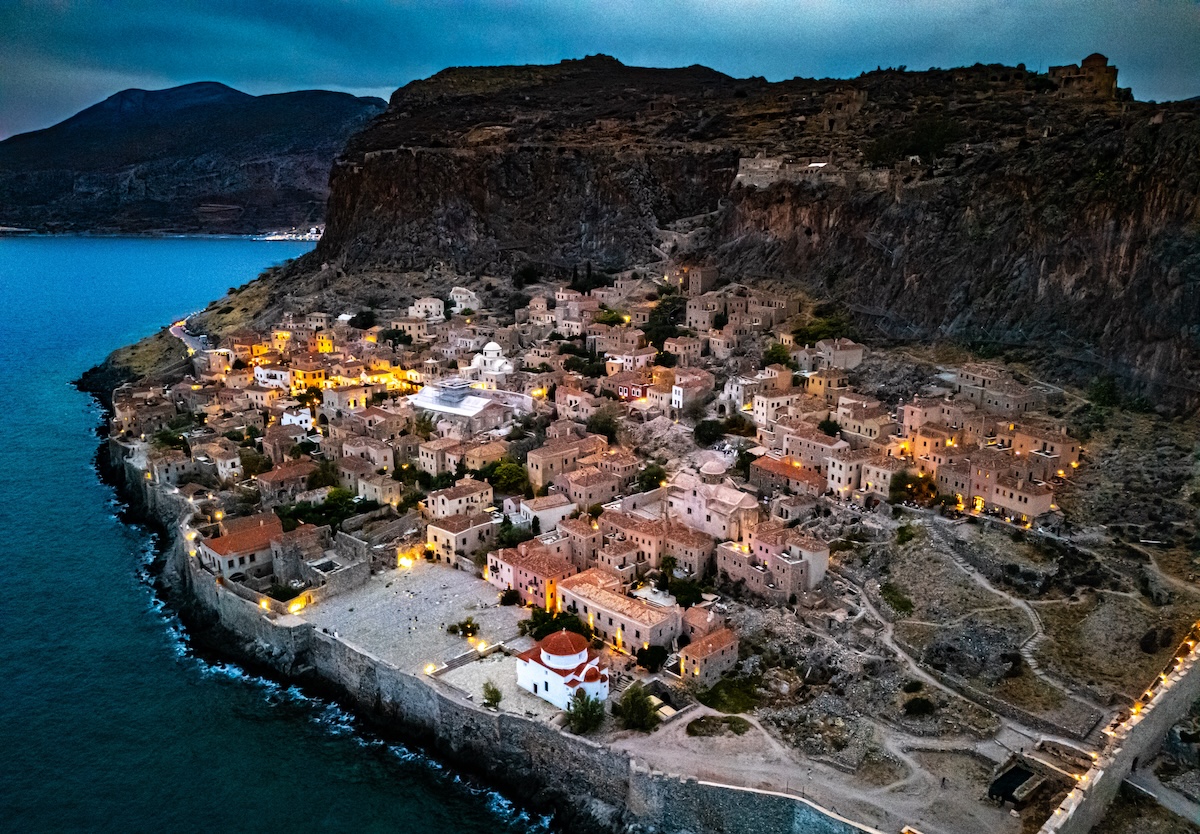
Somewhere on the southeastern coast of the Peloponnese, a massive limestone rock rises from the sea. From the mainland, you barely see a hint of what’s tucked away on the far side. You cross a narrow causeway, duck through an iron-clad gate wedged into thick stone walls, and suddenly you’re in a town that’s been lived in since the sixth century. This is Monemvasia, and honestly, there’s nothing else in Greece quite like it.
The name means “single entrance,” and it’s not just poetic. There’s only one way in. Once you’re inside, you find yourself in a compact medieval maze of stone houses, Byzantine churches, and quiet courtyards, all hidden from the rest of the world by the rock itself. Cars don’t make it in here. No modern sprawl creeps past the walls. The Myrtoan Sea stretches below, and the only things you might hear are conversation, footsteps, and the wind.
A Town Built Inside Defenses
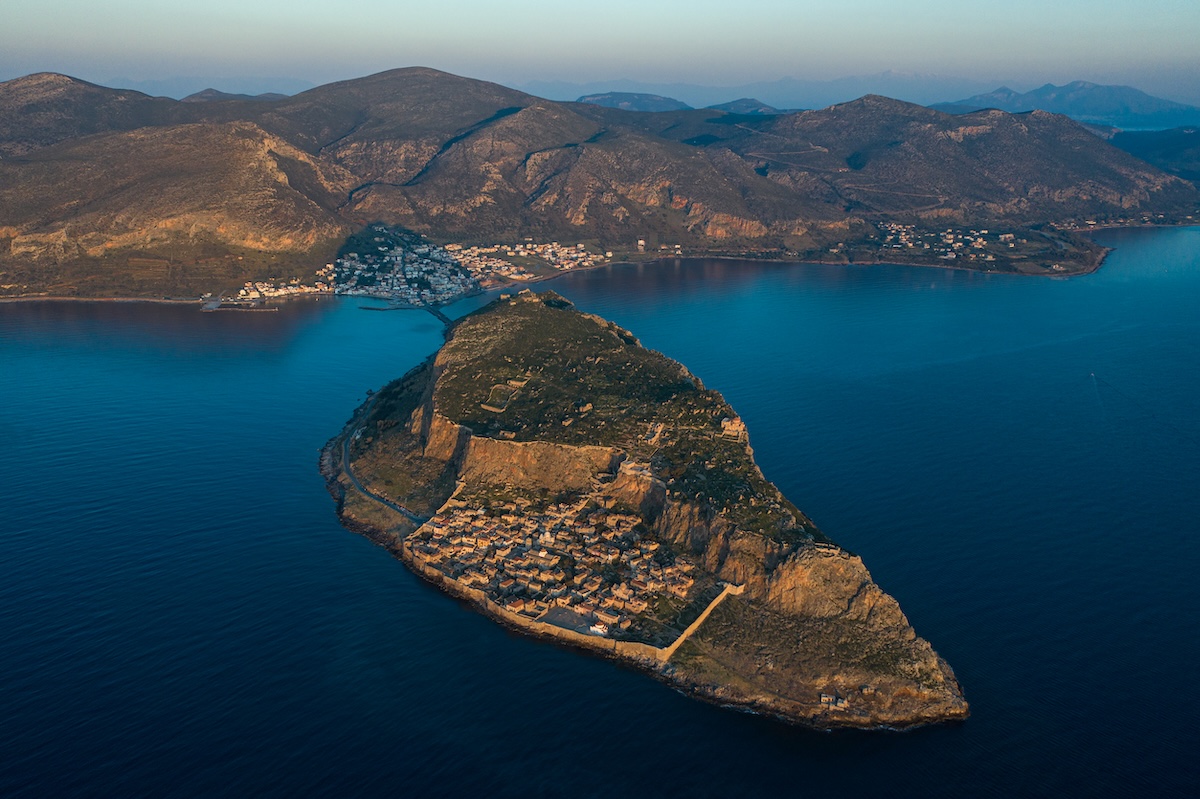
You don’t approach Monemvasia like you would most Greek towns. From the modern village of Gefyra on the mainland, you either drive or walk across a short bridge to the base of the rock. The old town hides behind sheer cliffs, rising about 100 meters above the sea. Emperor Maurice founded the place in the sixth century, and you can tell—everything about the layout feels strategic, almost secretive.
The main gate waits at the end of a zigzagging path cut right into the rock. After passing through a low, arched tunnel, the town opens up in front of you. Stone buildings line narrow lanes that wind with the terrain. Up above, on the upper plateau, the fortified citadel sits with its own walls, ruins of older structures, and the cliff-edge church of Hagia Sophia—a twelfth-century Byzantine chapel perched dramatically over the sea.
Byzantines, Venetians, and Ottomans all ruled Monemvasia at different times, and their marks show in the architecture. Venetian-era buildings lean against Byzantine churches—Elkomenos Christos and Panagia Chrysafitissa come to mind. The town’s walls held strong through a lot, and that defensive mindset shaped the dense, inward-looking streets you wander today. It’s funny—it wasn’t built for charm, but that’s exactly what you find.
Walking The Medieval Streets
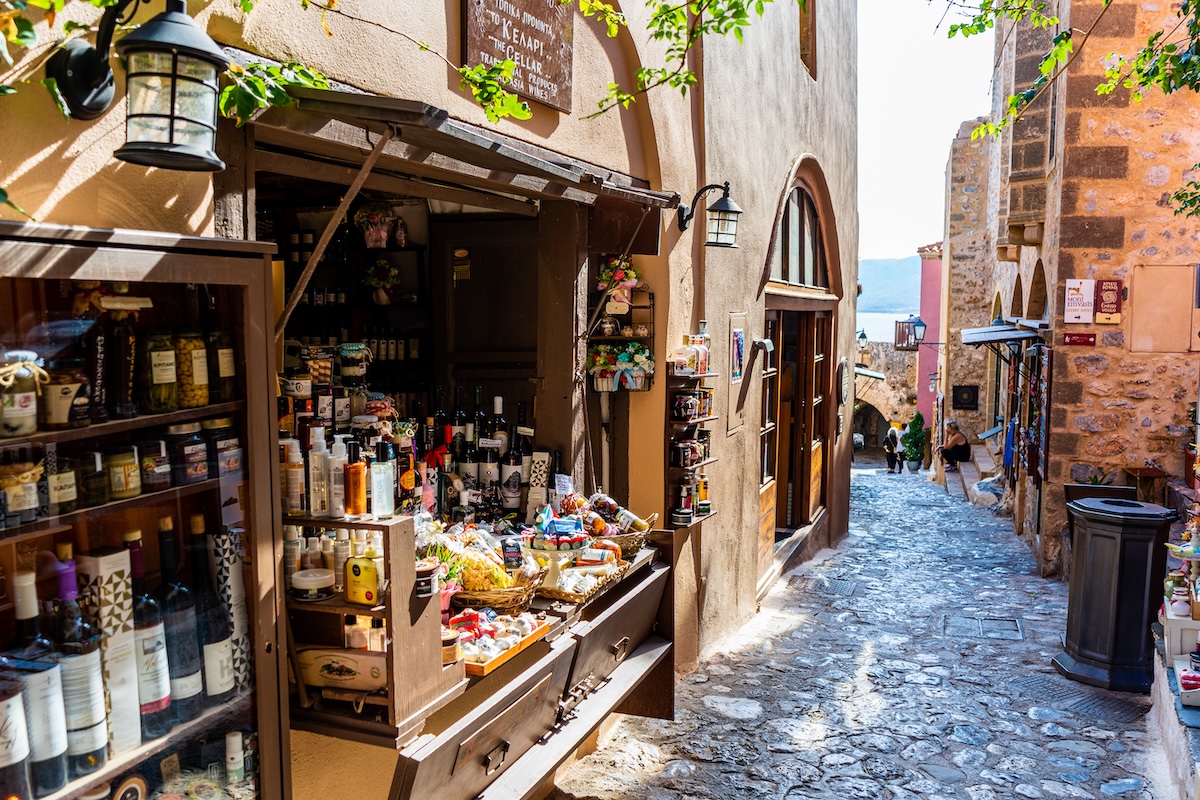
You’ll spend most of your time on foot, and the distances are short. The lower town follows a single main cobblestone street, with smaller lanes splitting off on either side. Cafés and tavernas fill restored stone buildings, some with terraces looking out over the water. Expect straightforward Greek cooking—grilled fish, local cheeses, and dishes brightened with herbs from the hills. Try a glass of Malvasia wine, the sweet local variety that once shipped all over the Mediterranean. It’s worth it, at least once.
The churches are easy to spot and free to enter. Elkomenos Christos, the main cathedral, holds a fourteenth-century icon of the Crucifixion, and it’s considered one of the best examples of Paleologian-era painting. Chrysafitissa sits quietly among houses—its stone exterior’s modest, but step inside and it’s quietly impressive. Neither will take you long, but both deserve a look.
If you climb to the upper town, it takes about twenty minutes up a sometimes tricky stone path. The citadel’s mostly in ruins, but the views from the top are wide open and pretty unforgettable. Hagia Sophia sits right by the cliff, nothing between you and the drop to the sea. On a clear day, you can see far along the Laconian coast. The walk gets steep, so bring sturdy shoes and water—especially if it’s summer.
Why This Place Feels So Distinctive
Maybe you’ve wandered through historic towns in Greece, where the old quarter’s just a handful of blocks hemmed in by modern buildings. Monemvasia doesn’t play by those rules. The rock itself draws an uncompromising line: one moment you’re outside, then you step through the gate and suddenly you’re deep inside a medieval world, sea on three sides, cliffs looming right behind you.
The lower town is home to about 15 permanent residents. Sure, tourism keeps things ticking, but it never gets swamped like Santorini or Mykonos. If you come in spring or early autumn, you might find yourself almost alone up in the citadel. Stone lanes soak up sound, and the light just keeps shifting across those old rock walls as the hours pass.
People like to compare it to Mont-Saint-Michel, and honestly, that’s not far off. Both are fortified, perched on rocks, linked to the mainland by a single road, and layered with history you can see right in the stones. But Monemvasia feels warmer, quieter, and—thankfully—nowhere near as commercial.
What really sticks with you is this odd mix of feeling enclosed and yet wide open. You’re surrounded by walls and rock, but the sea sneaks into view everywhere—through arches, over rooftops. Built for defense, sure, but now it’s just one of the most atmospheric spots to wander in southern Greece.