
Ancient Egypt has fascinated travelers for ages—pyramids, hieroglyphs, and those legendary pharaohs. But what if you could actually stay somewhere that really leaned into that lost civilization? Not just a themed lobby, but places where the architecture, the air, the little details all pull you back a few thousand years?
These imaginary hotels mash up ancient Egyptian ideas and modern comfort, giving you a chance to sleep under star-painted ceilings, eat next to lotus pools, and wake up to golden dunes out the window. Each spot borrows a little something from Egyptian culture, whether it’s the sacred temples, royal palaces, or something in between.
You won’t find these on any booking site, but it’s fun to picture what travel could feel like if the ancient world showed up in real life again. Some float on the Nile, others rise from the sand, and a few hide in lush gardens where ibises probably squabble at sunrise.
Falcon Crest Sanctuary
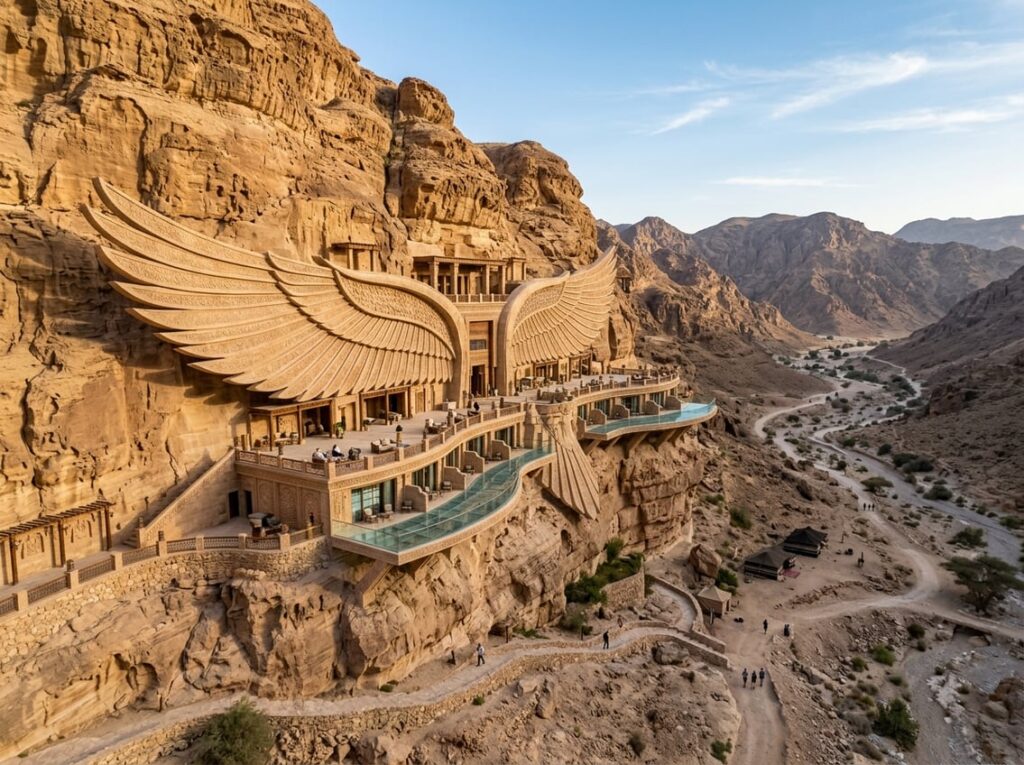
Carved straight into ocher cliffs above a remote desert valley, this hotel juts out in wing-shaped terraces inspired by Horus. Out on your glass-floored balcony, you can look straight down at ceremonial-style pathways on the canyon floor.
Stone corridors snake through the rock, blending ancient carving with all the comforts you’d expect. Evenings on the terraces become a ritual—watching shadows stretch across the wadi as the sun dips behind distant peaks. From up here, the processional paths below look like some forgotten sacred site, and you almost expect to spot a priest or two wandering the sands.
Obelisk House of the Horizon
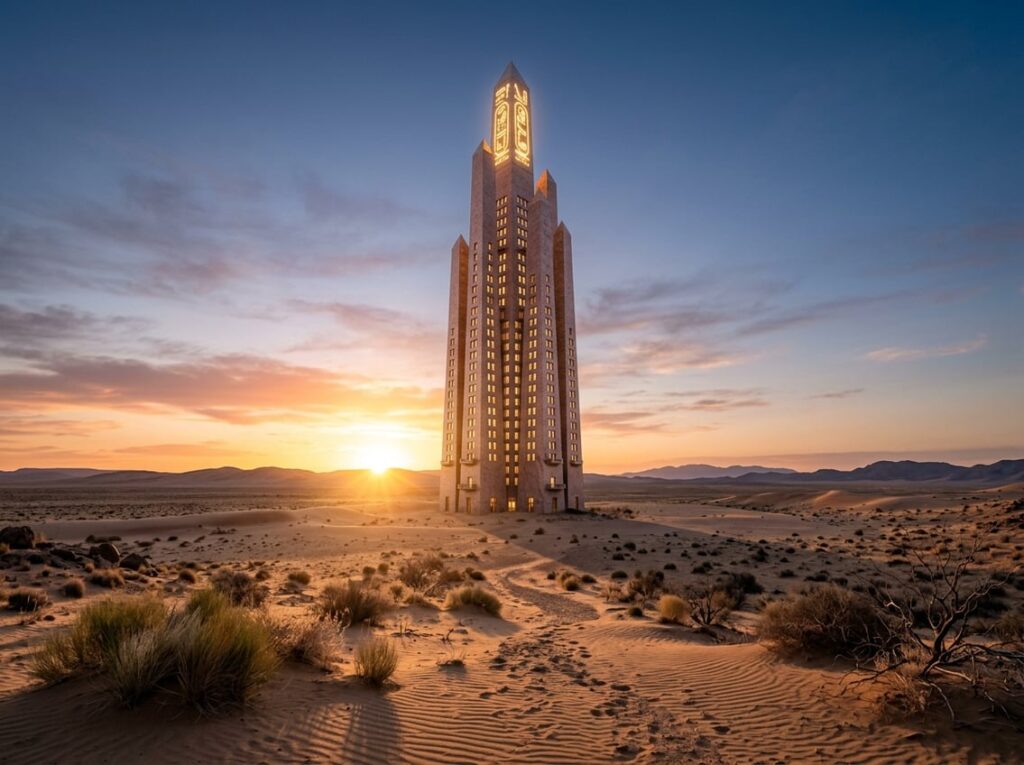
Granite towers shaped like ancient obelisks rise from the plateau, each one framing the eastern horizon for sunrise. Your room sits inside one of these slender towers, and every window catches that pink and amber morning light.
After dark, the tops light up with glowing hieroglyphic patterns, casting a soft wash over the desert. Watch the show from the rooftop terrace, where the stone under your feet feels almost untouched. The lobby snakes between the towers, making cozy nooks under the soaring shafts. Suites spiral up with glass walls facing the sunrise, while the other side displays carved symbols that echo the glowing exterior.
The Blue Lotus Necropolis
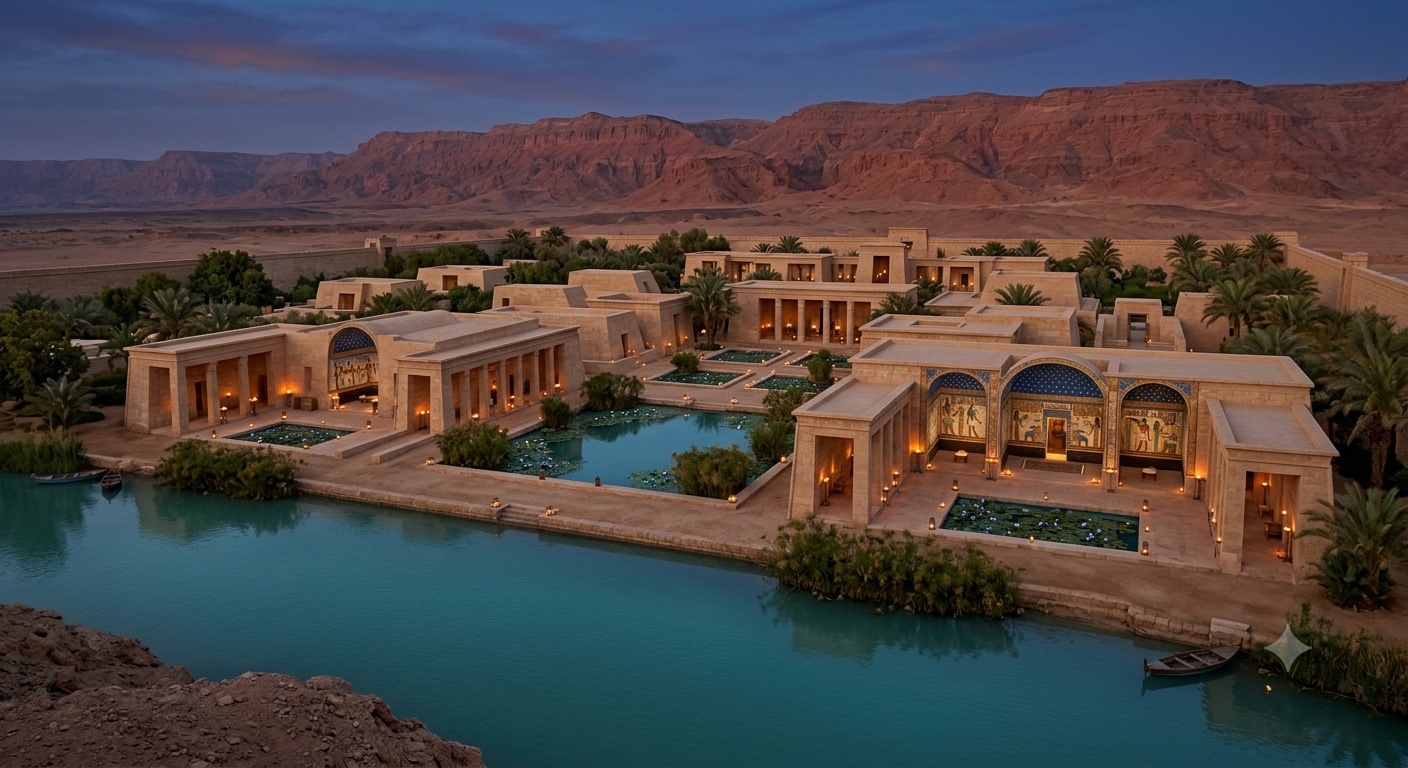
Low limestone pavilions sprawl across the desert, circling a turquoise oasis that mirrors the sky. Your room is tucked into one of these tomb-inspired buildings, with vaulted ceilings painted in marsh scenes and sacred ceremonies—all those ochres and deep blues. The thick stone walls keep things cool, and after sunset, you wander candlelit passageways connecting the pavilions.
Lotus pools outside reflect the stars, their surfaces scattered with fragrant blooms. Walk barefoot along stone paths between water gardens, or curl up in cushioned alcoves carved into the courtyard. The place stays almost reverently quiet, except for the sound of water trickling through limestone channels. Dawn brings a soft golden light over the oasis, and for a moment, you might believe you’ve stumbled into a pharaoh’s dream.
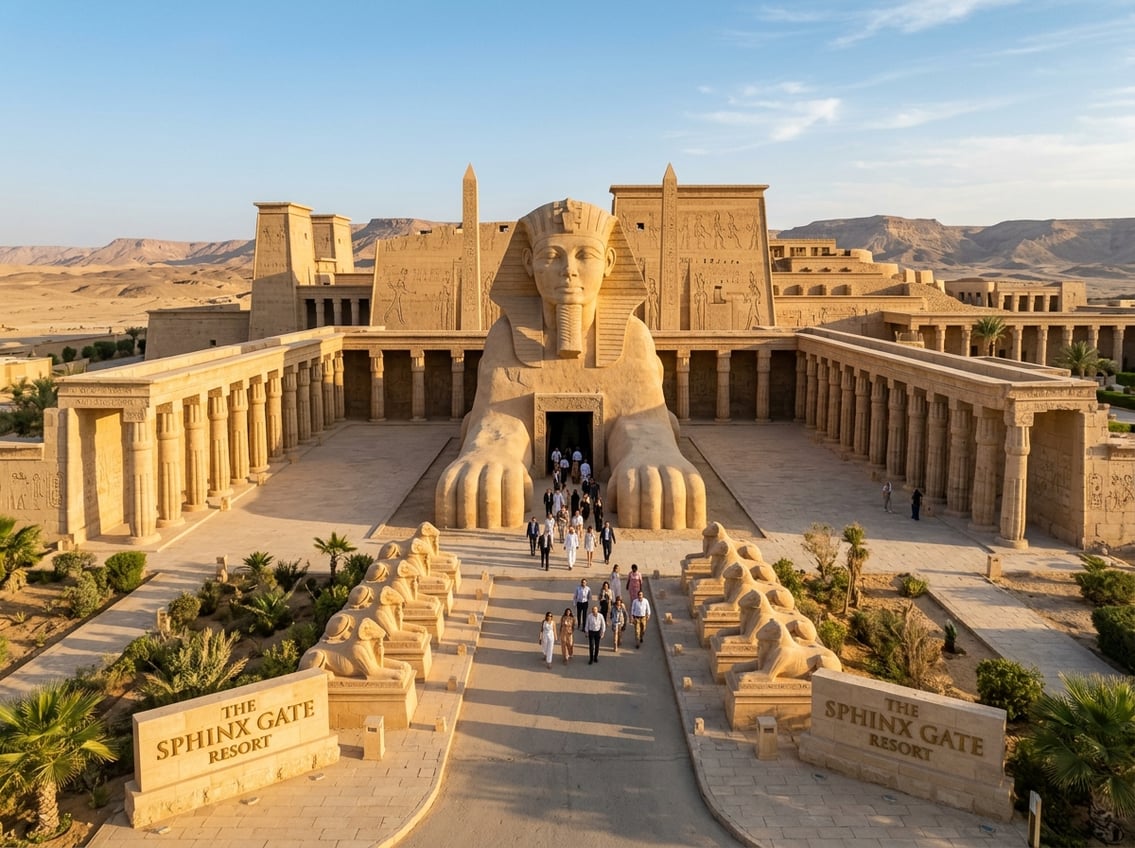
The Sphinx Gate Resort
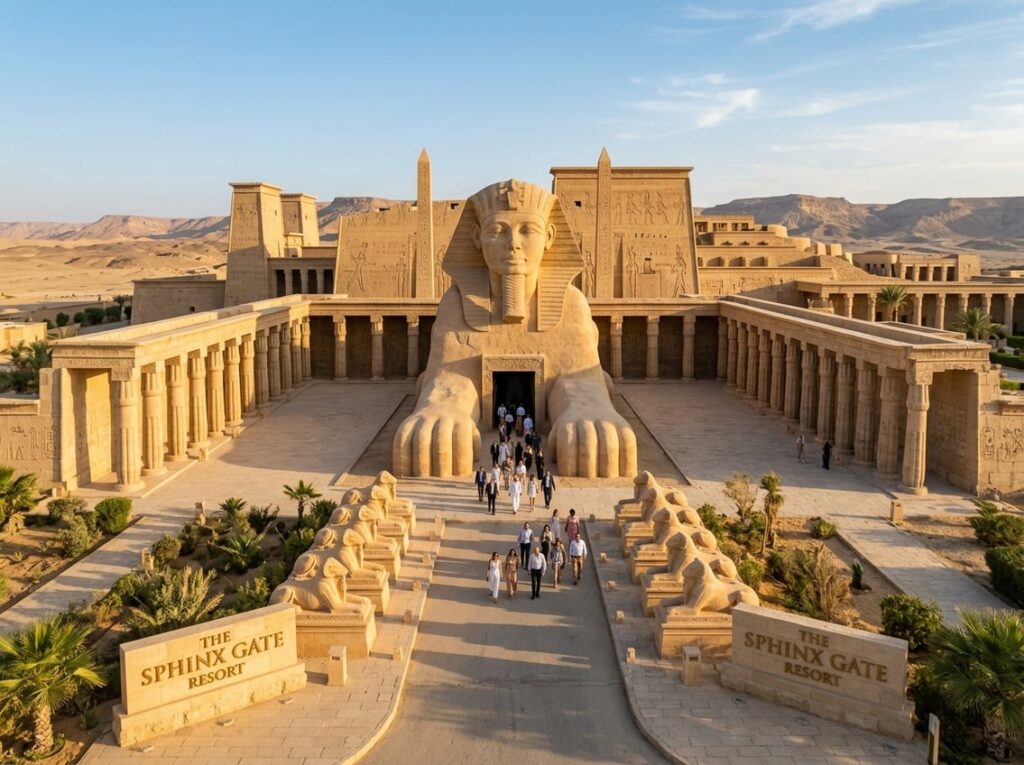
Arriving here means walking right under the massive paws of a reclining sphinx—no kidding, the stone form towers above you as you enter the compound. It sets the mood: monumental, dramatic, and definitely not your average hotel check-in. Inside, sand-colored courtyards open up, the walls changing color with the shifting light.
The property follows an avenue lined with ram-headed statues, softly glowing after dark to guide your evening strolls. Spend the hottest part of the day in shaded colonnades, where stone columns and flowing fabric keep things cool. The architecture always keeps you guessing, with archways framing distant dunes and interior spaces that feel like you’ve wandered into a newly uncovered temple. Every corner has that “just discovered” vibe, as if you’re the first to see it in centuries.
Papyrus Marsh Lodge
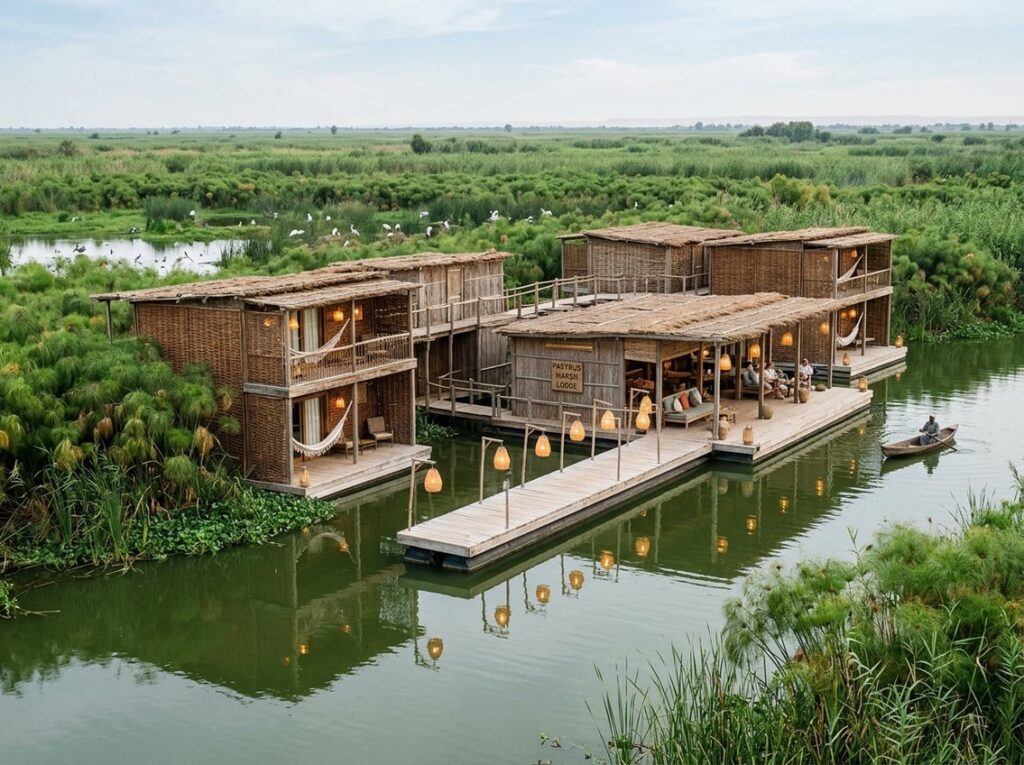
Floating on a quiet patch of the Nile Delta, this lodge is built from bronze screens and pale wood decks hovering just above the water. Your suite hides in a papyrus grove, tall stalks rustling in the evening breeze and giving your terrace natural privacy. At night, lanterns glow across the platforms and flicker on the water like scattered fireflies.
Mornings start with egrets hunting in the shallows as you sip coffee on your deck. The restaurant sits in a central pavilion, where you eat grilled fish while marsh birds call across the wetlands. Kayaks and little feluccas let you explore narrow papyrus channels, and honestly, the landscape feels like it hasn’t changed in thousands of years. The lodge runs on solar power and partners with local conservationists to protect the delta, so your stay actually helps keep the marsh wild.
The Pharaoh’s Mirror
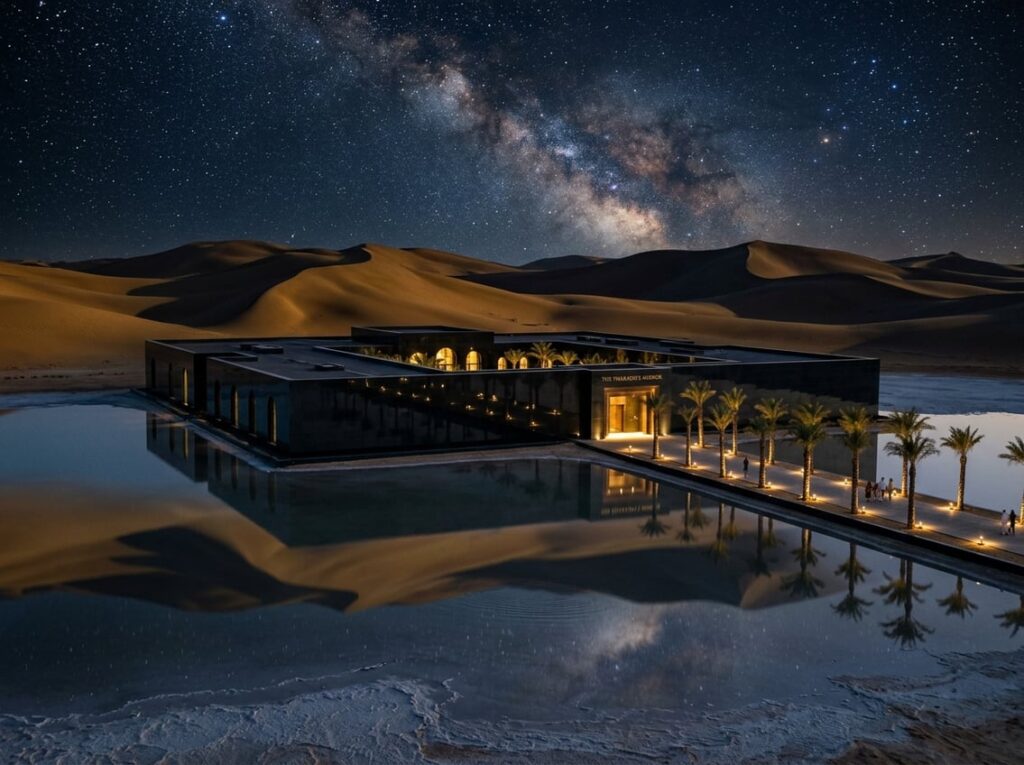
Black granite walls rise from the edge of a salt lake in Egypt’s western desert, their glossy surfaces reflecting everything—the dunes, the palm-lined causeway, even the sky. Walk through this low, horizontal palace and you’ll see the building almost vanish into its own reflection at certain times of day.
After sunset, the lake turns to glass. Stand on the terrace and watch the stars multiply in sky and water, the hotel’s dark stone framing this doubled universe. Guest rooms open onto private courtyards with shallow pools that extend the illusion. The spa uses heated salt water straight from the lake. On moonless nights, the Milky Way splits into two arcs, and it’s honestly hard to tell where the desert ends and the reflection begins.
The Solar Barque Palace
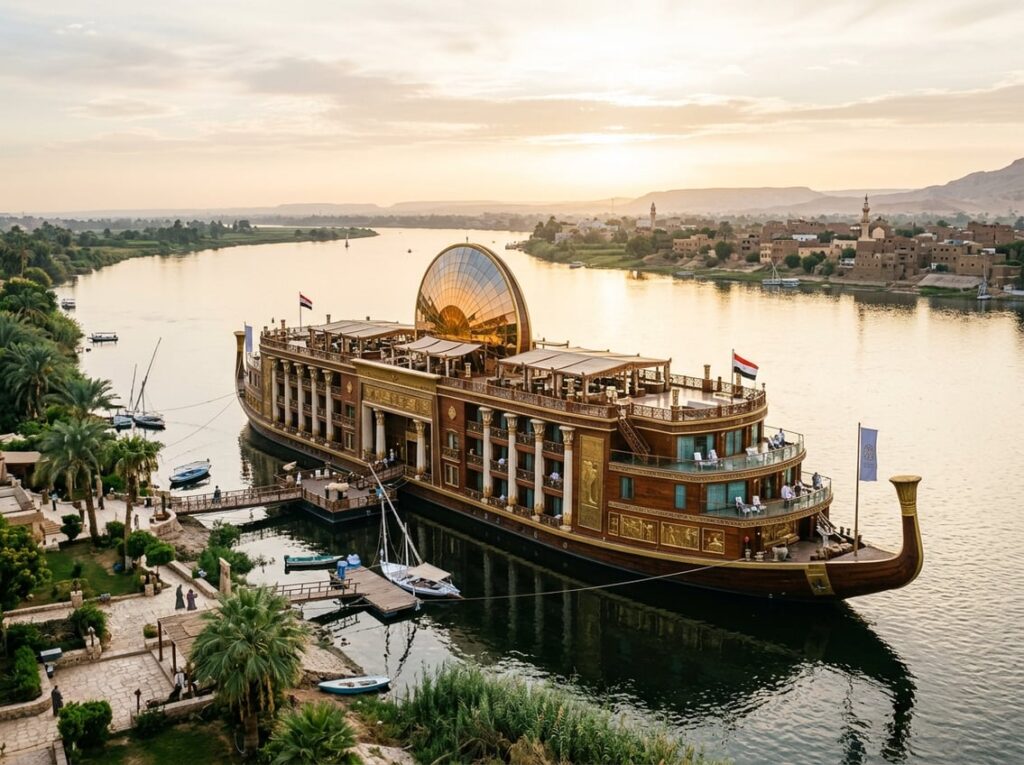
This place sits right on the Nile’s western bank, shaped like a massive ceremonial boat—seriously, the hull runs almost 400 feet along the water. It’s got those towering cedar-paneled decks and a bow that curves up just like something you’d see in a tomb painting. Your suite? Lotus-shaped columns, high ceilings, and river views everywhere you look.
The best part is the sun disk atrium at the center, all mirrors and bronze panels that catch the first light of day and send golden beams through five levels. Breakfast on the upper deck as feluccas drift by? Yes, please. There’s a spa at the waterline using honey, milk, and oils from old papyrus recipes. As the sun sets, the whole thing glows from within and looks ready to sail off into the afterlife.
Ankh Island Retreat
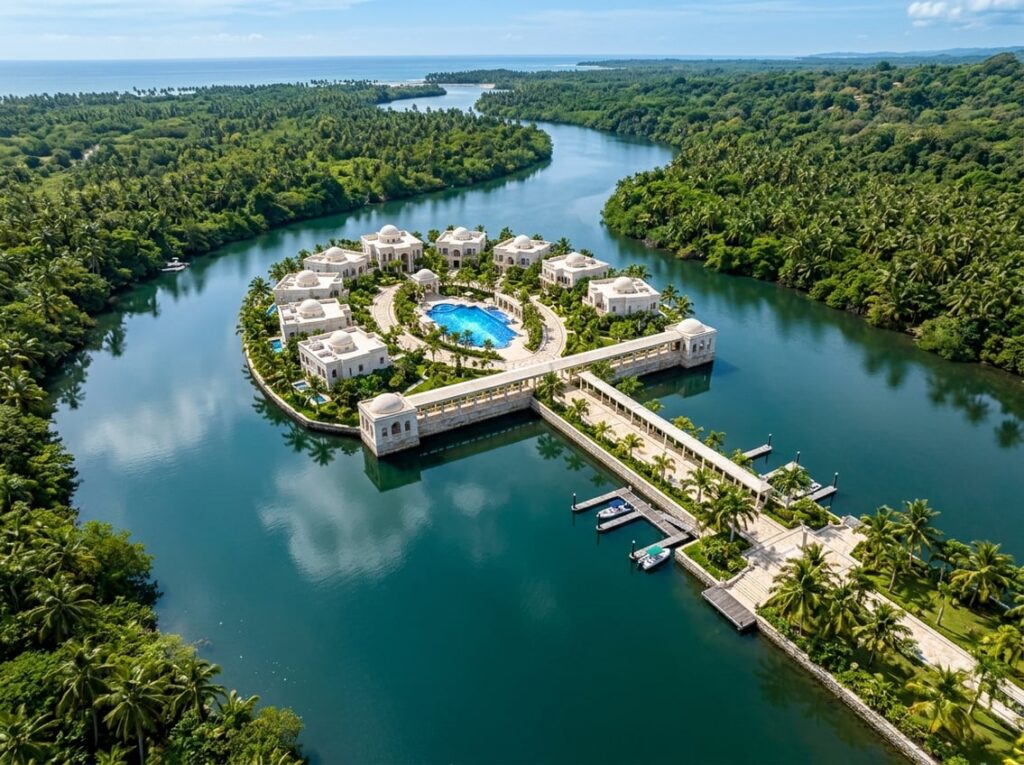
From above, the whole property forms the ancient ankh symbol, spread out across its own river island. Pale stone villas curve along the loop, each one with direct water views and breezy terraces.
Two raised causeways make the ankh’s crossbar, connecting east and west shores and creating a shaded passage for wooden boats. At the heart, a sacred pool lined with blue mosaic tiles glows at dusk. The water stays shallow and warm—more for contemplation than swimming, really. Walk the entire ankh path at sunrise, tracing the outline from your villa through papyrus and date palms, across stone bridges, and around to the pool where morning light makes the tiles pop.
The Painted Tomb Suites
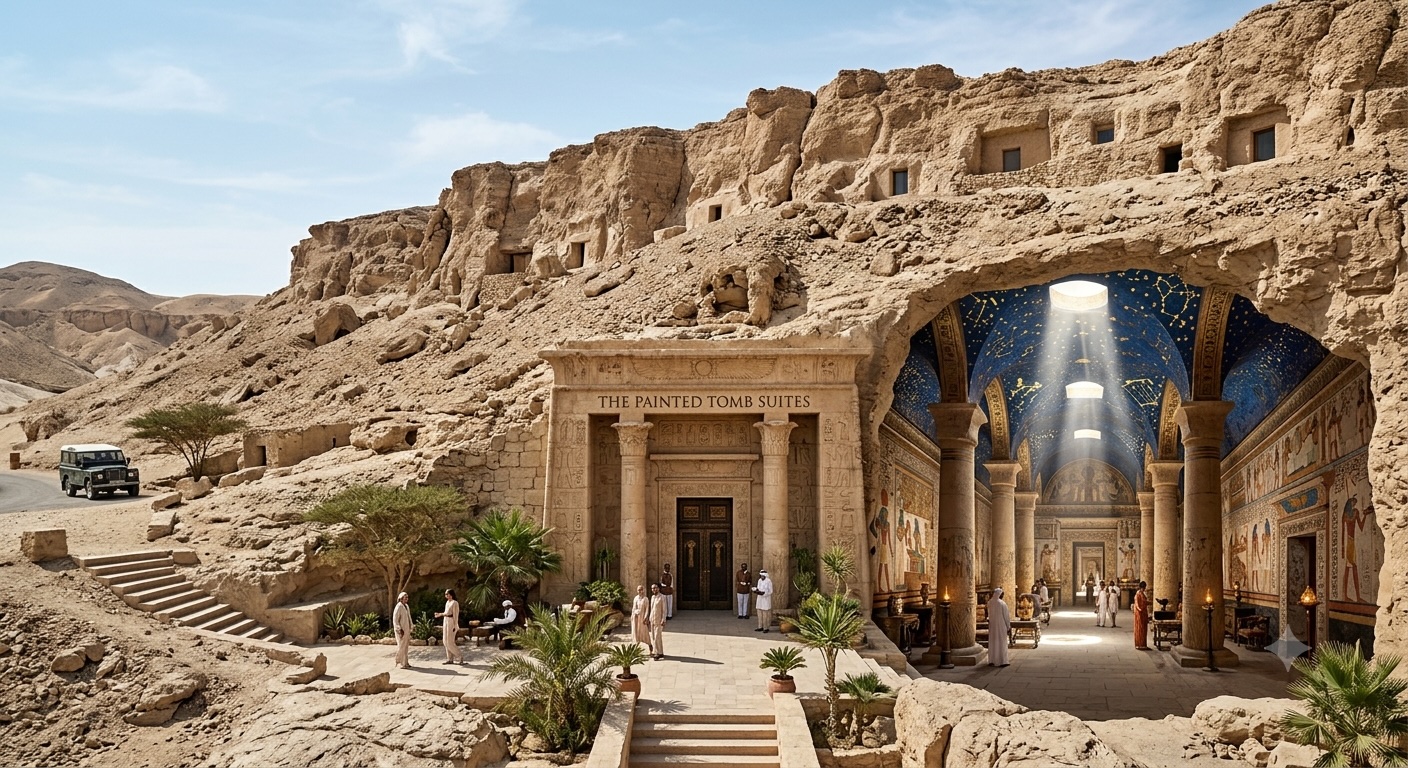
Rooms are carved beneath a desert ridge, reached through winding corridors in the bedrock. The walls glow with replicas of royal tomb art—hieroglyphs, gods, and celestial maps in ochre, lapis, and gold. Each suite mimics a different pharaonic burial chamber, right down to the vaulted ceilings and intricate cosmological scenes.
Natural light filters in through hidden shafts, casting soft beams across painted surfaces. A main subterranean hall connects all the rooms, its ceiling inlaid with gold-leaf stars in ancient constellations. Lounge here on low cushions, surrounded by lotus columns. The air stays cool, and the silence is nearly absolute—just the faint sound of other guests moving between chambers.
Temple of the Seven Pools
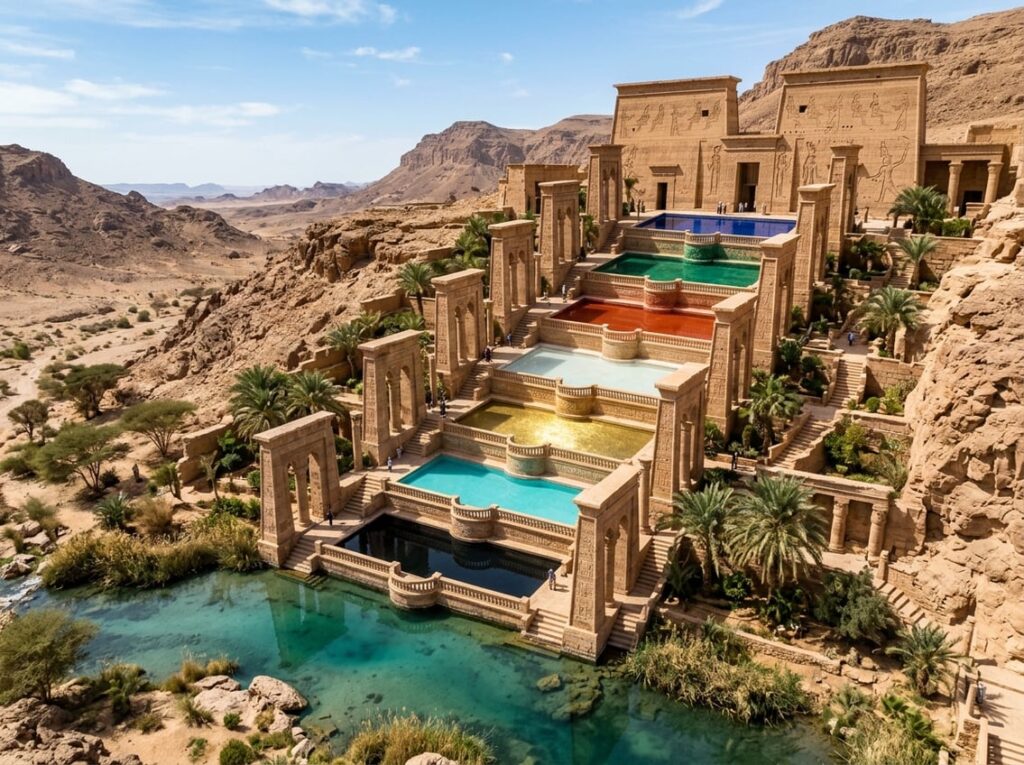
This resort steps down a sandstone hillside in terraces, each marked by towering pylons that frame your walk toward a natural spring. Seven ceremonial pools anchor the place, each one a different color—lapis blue, malachite green, carnelian orange, alabaster, gold, turquoise, and obsidian black. Spend your mornings drifting between pools, feeling the water change as it flows from the spring above.
Your room opens onto a terrace where carved hieroglyphs catch the late light. Each pool connects to a spa pavilion for treatments inspired by its color. At sunset, the golden pool seems to multiply the light across the stone. Stand at the lowest terrace and watch the obsidian pool reflect the stars, with the desert stretching away into darkness.
The Crocodile Moon Lodge
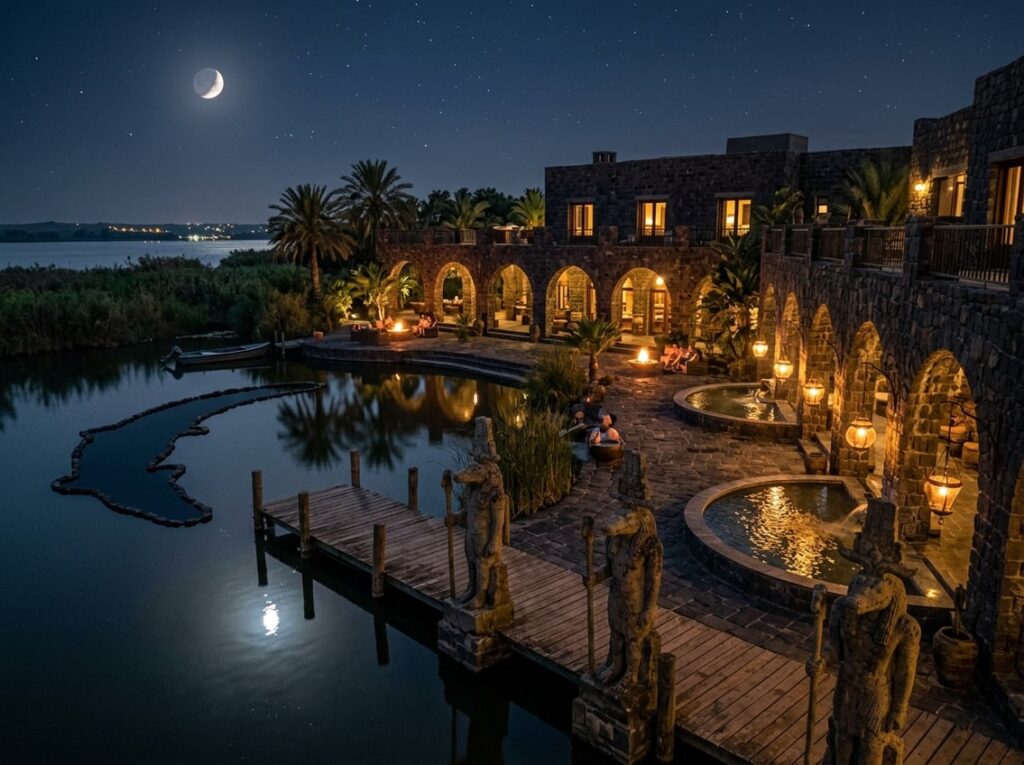
Dark basalt arches welcome you to this riverside hideaway, the buildings curving around a lagoon shaped like an ancient crocodile. Walk through moonlit courtyards lit by bronze lamps that cast rippling shadows. Carved Sobek guardians stand watch on the docks, their fierce heads turned toward the water.
Crescent-shaped pools glow under the lamps, little pockets of warmth against the dark stone. Evenings on your balcony mean watching the still lagoon mirror the sky, or wandering courtyards where the basalt holds the day’s heat. Temple-like columns and water features blur the line between ancient sanctuary and modern comfort, so every corner feels like a discovery.
Aten’s Glass Pyramid
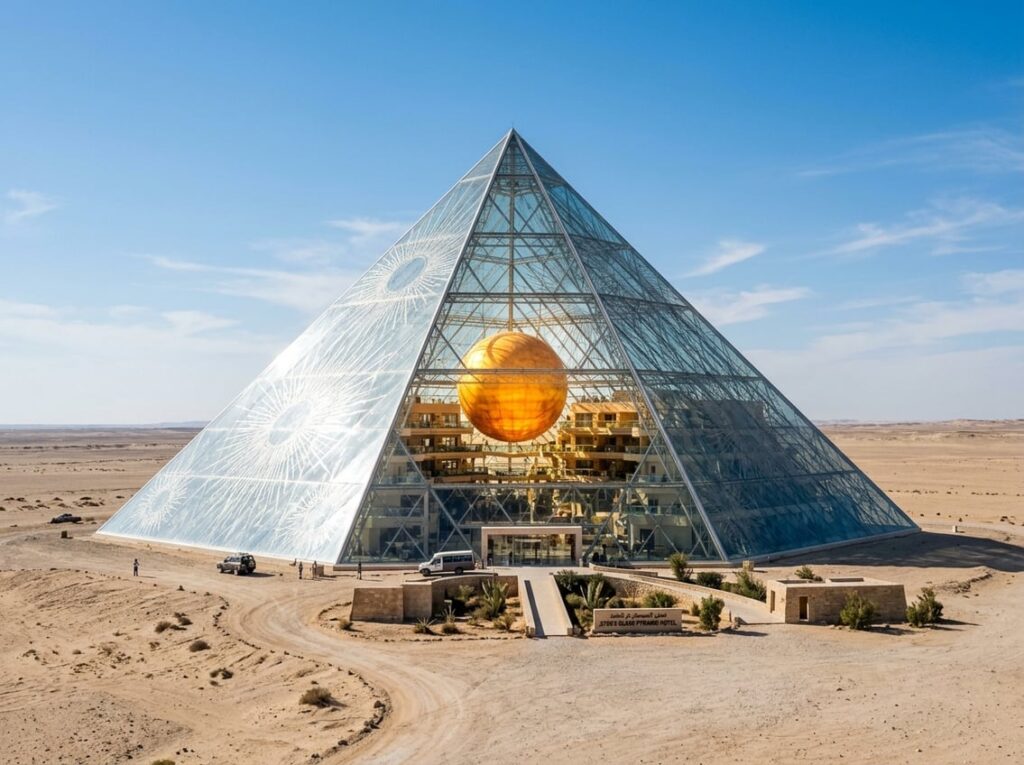
This place rises from the pale desert—a pure geometric pyramid, each transparent face carved with sun patterns that catch the light all day. Sleep in a suite with floor-to-ceiling glass walls framing endless sand and sky. At night, the stars feel impossibly close through the crystal-clear panels above your bed.
Every room faces the central atrium, where a massive golden sphere hangs suspended, glowing from within and lighting up the balconies and walkways. Have breakfast on your terrace as the real sun rises outside and the golden sun lights the atrium inside. The rooftop deck at the apex gives you a full 360-degree view of the desert, nothing but horizon in every direction.
The Queen’s Canopy
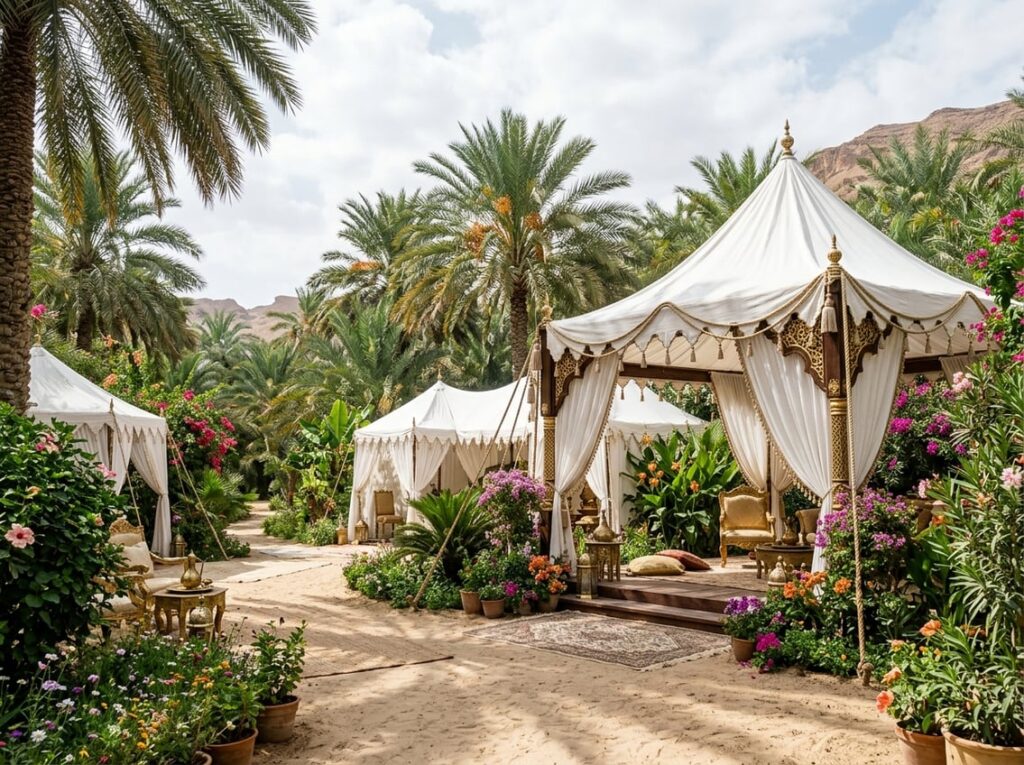
White linen pavilions rise in a palm grove, gilded cedar frames catching the afternoon sun. Step into what feels like an ancient royal camp, reimagined as a modern retreat at the edge of a flowering oasis. The canopies flutter overhead, scattering light and shadow across cushioned seats and low tables.
Each pavilion is its own little sanctuary under rippling fabric that somehow keeps things cool. Settle into a draped enclosure with nothing but birdsong and rustling palms, or wander along paths lined with blooming desert flowers. Soft gold leaf on the cedar frames glows at sunset, turning the whole grove into something ceremonial—yet deeply peaceful.
The Scarab Dune Hotel
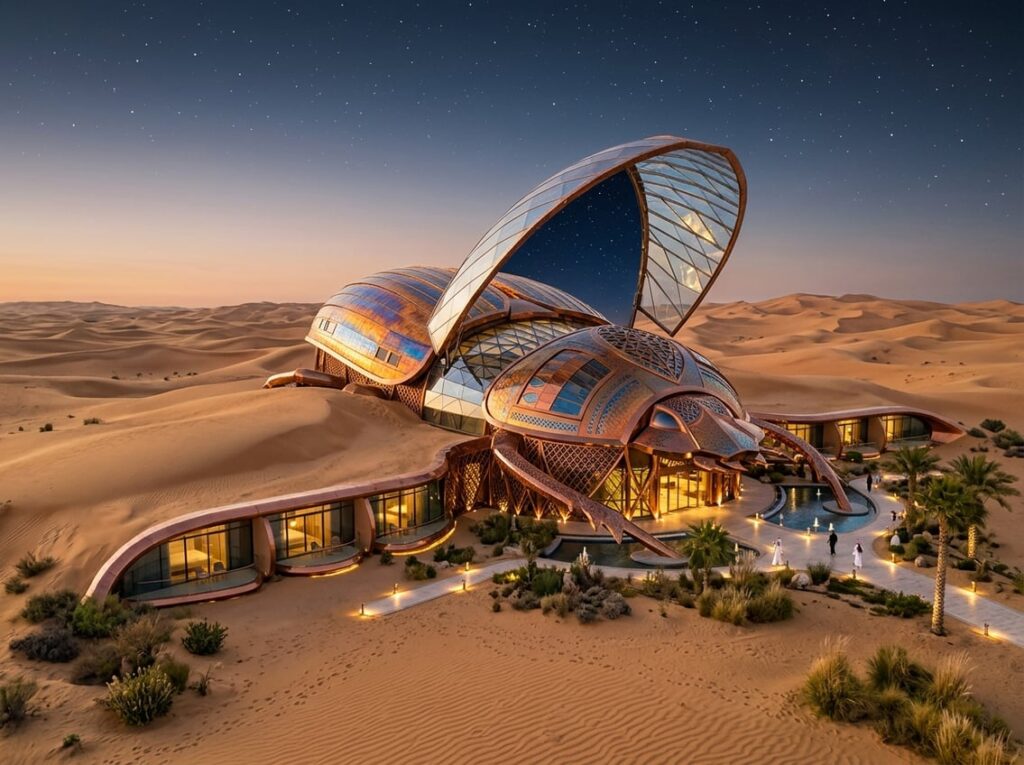
The exterior shimmers with copper panels that shift from bronze to green as the sun moves. This desert hotel looks like a giant jeweled beetle emerging from the dunes, its curved shell forming a dramatic roofline you can spot for miles. Guest suites spiral underground, cool and quiet, with walls that follow the scarab’s curves.
Your room opens onto rounded corridors winding like ancient tunnels. The main atrium features a huge skylight shaped like beetle wings, retracting after sunset to reveal the stars. Dine in restaurants built into the scarab’s “legs” or swim in pools that wrap around the base, where the building seems to burrow into the earth. The metallic shell reflects sunrises in amber and rose gold, making every photo a little different.
House of the Jackal Stars
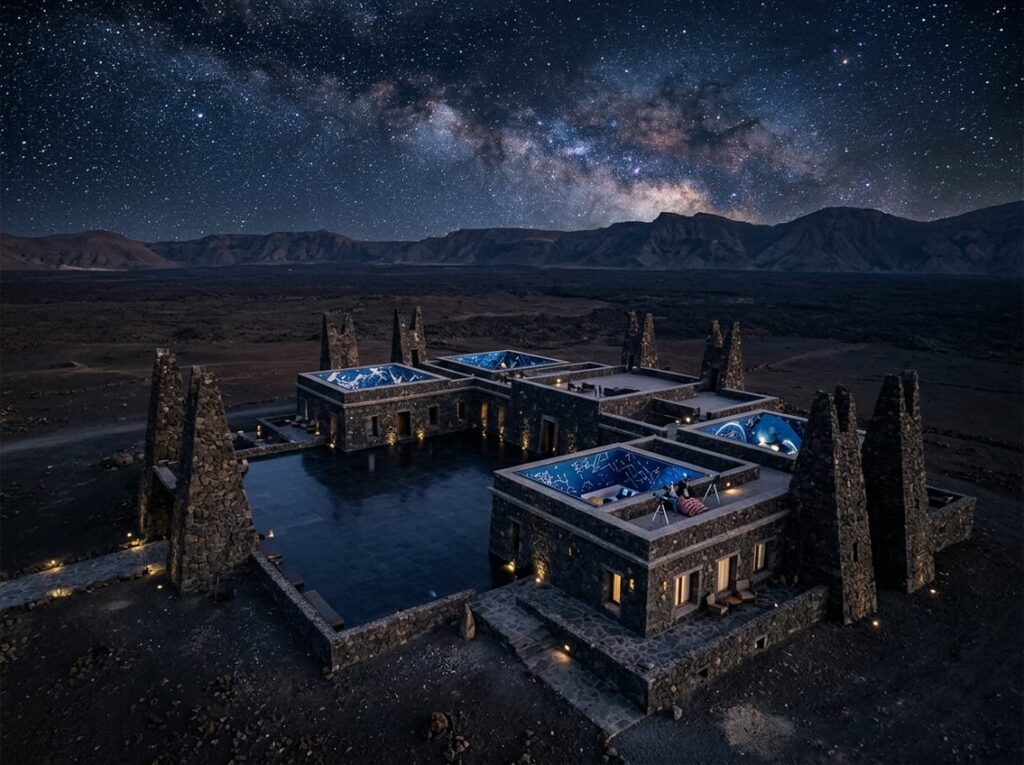
This place rises from a black volcanic plateau, nothing but sky all around. Stone pylons shaped like jackal ears frame the entrance, leading into courtyards paved in polished obsidian that mirrors the stars above. By day, the angular architecture nods to ancient guardian deities, but at night, the mood shifts completely.
Your sleeping chamber sits on the rooftop, open to the elements and lined up with specific constellations. Cobalt and silver paintings cover the ceiling, mapping the star patterns ancient priests once studied. Drift off watching meteor showers, wake before dawn as the Milky Way fades. The hotel leaves telescopes and star charts in every room, so you can trace Anubis and the other deities among the stars—just like the ancients did.
The Golden Cartouche
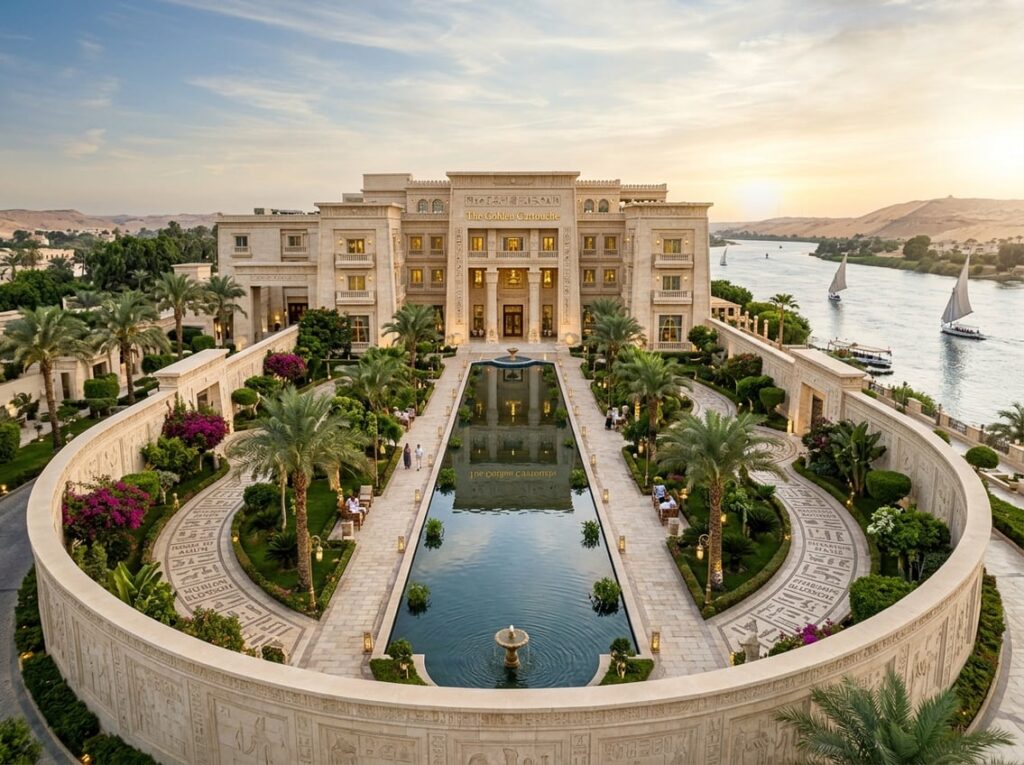
This riverside hotel borrows its shape from ancient royal insignia, wrapped by an oval wall that echoes the cartouches once used to protect pharaohs’ names. The cream limestone exterior glows in the morning, and garden pathways spell out fictional royal names in hieroglyphic paving stones. You can trace these symbols as you wander between date palms and papyrus beds.
A long reflecting canal slices through the property, offering mirror-like views of the palace-style buildings. You might spend afternoons on a shaded terrace above the water, watching sunlight ripple across the surface. The architecture nods to Old Kingdom design with clean horizontal lines and columned walkways framing glimpses of the river. Inside, guest rooms open onto private balconies overlooking either the canal or the Nile, depending on your wing.
The Alabaster Labyrinth
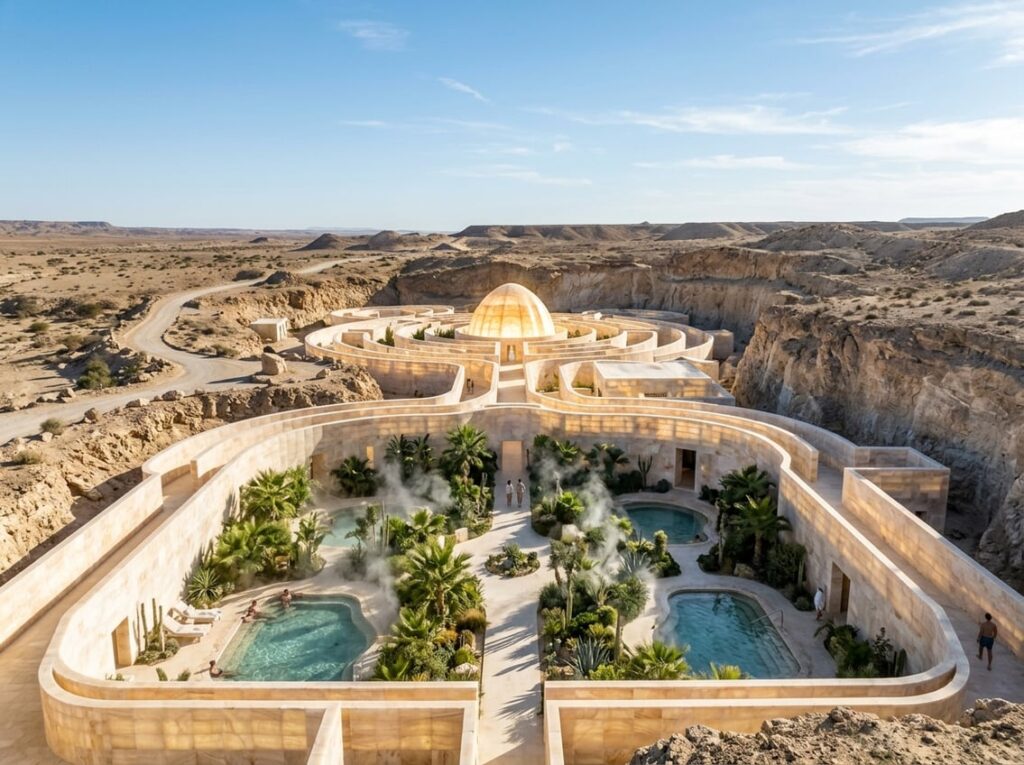
The quarry basin waits at the desert’s edge, with translucent alabaster walls winding in patterns that diffuse sunlight into a warm amber glow. You explore corridors that seem to shift at every turn, passing steam gardens where mineral vapors drift between pale stone columns. The maze slowly reveals its secrets—a sunken bath carved into the rock here, a contemplation chamber lit by skylights there.
At the heart of this spa hotel, you find a central sanctuary where alabaster panels tower overhead, filtering daylight into soft ribbons of gold and cream. The walls stay cool against your skin, even with the desert heat outside. Private treatment rooms branch off the main paths, each designed for silence and seclusion. Morning walks through the labyrinth become a ritual as you discover which passages lead to rooftop terraces overlooking the quarry and which open into quiet courtyards for stargazing soaks.
Hathor’s Music Court
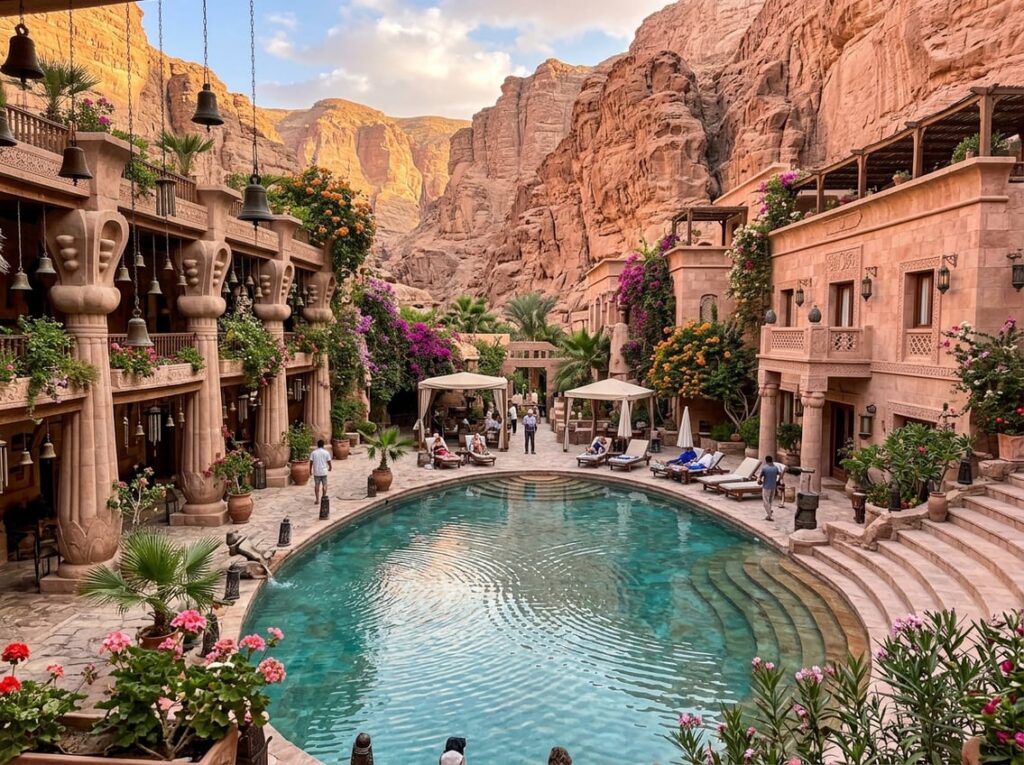
The hotel rises from a rose-colored canyon, with columns carved like ancient sistrums framing each archway and entrance. Bronze bells dangle from balconies, catching the breeze and creating soft chimes that echo off canyon walls. You can pick a room with a view of rock formations or one that looks over the central amphitheater pool.
The pool acts as the social center, with a curved stone stage at one end where musicians play in the evenings. Water features ripple across the surface, mirroring sound waves—especially striking when lit from below after sunset. Mornings might find you on your bell-adorned balcony with coffee, afternoons swimming, and evenings watching performances from poolside loungers. The canyon’s acoustics carry music and conversation in ways that make every gathering feel festive.
The Nile Star Observatory
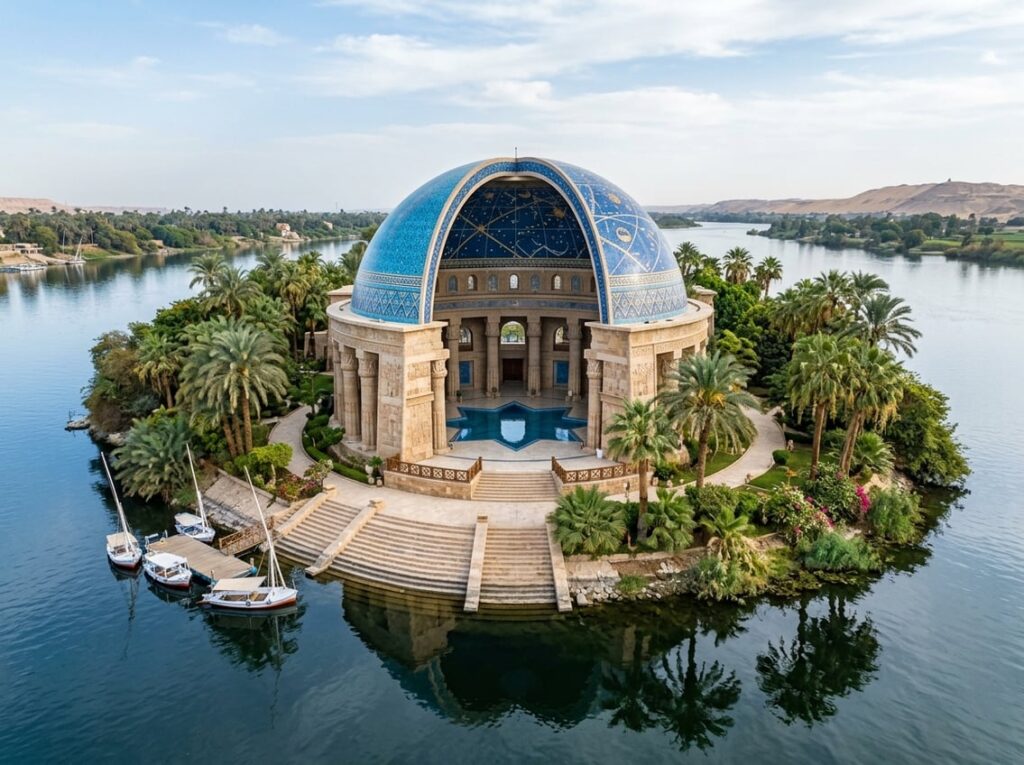
This domed retreat sits on a private river island, where ancient temple proportions meet celestial design. The building’s geometry follows sacred Egyptian ratios, while blue tilework on the exterior mimics constellations visible above the Nile. At the center, a circular lobby holds a rotating roof that opens after sunset, turning the space into an open-air observatory.
You’ll gather around the star-shaped pool as the dome retracts, watching the night sky reveal itself section by section until the stars stretch overhead. The pool mirrors the sky, so you see stars above and below. Guest rooms curve along the outer wall, each with windows angled to frame specific stellar alignments. The island’s isolation from city lights makes this one of the clearest viewing spots along the river; resident astronomers lead nightly sessions pointing out planets, galaxies, and the same constellations ancient Egyptians used for navigation.
Pylon House of Dawn
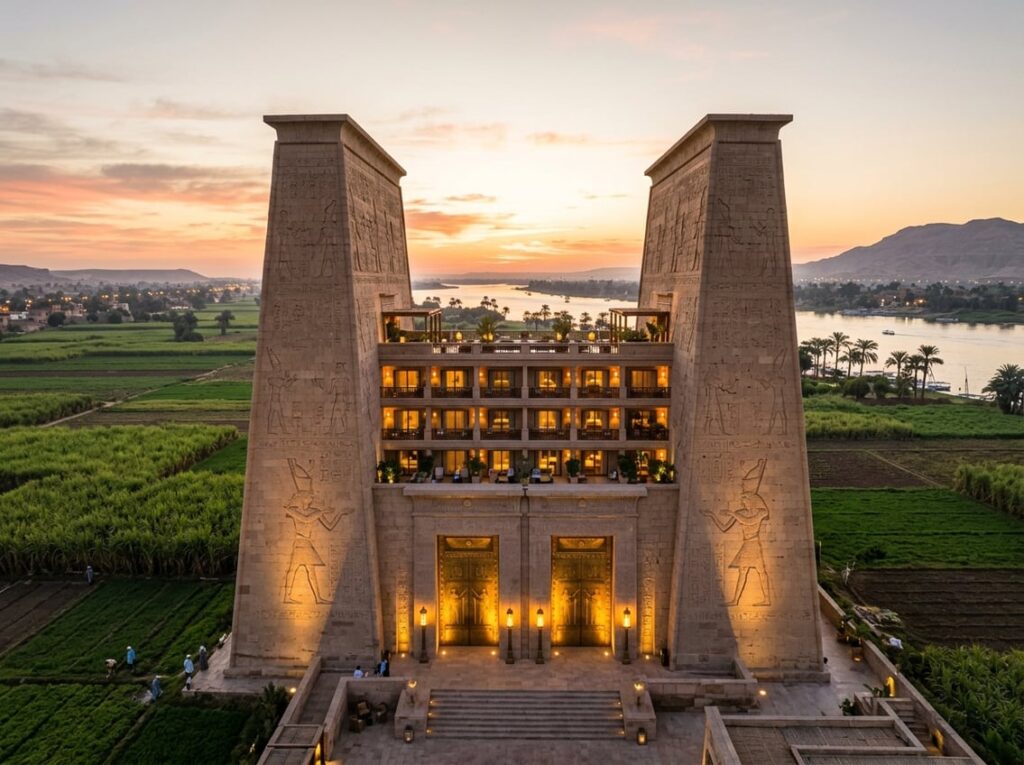
The hotel rises between two colossal sloped walls, framing the morning sky like a temple gateway. You stay in elevated suites designed to catch the first light as it sweeps across the Nile valley, turning your room into a glowing amber chamber. Golden doors mark the entrance to each level, their surfaces reflecting the changing sunrise by the hour.
The architecture throws dramatic shadow lines that shift throughout early morning, a daily show of light and geometry you can watch from your balcony. Beyond the pylons, cultivated fields stretch toward the river in neat parcels that recall ancient agricultural patterns. Mornings on the rooftop terrace reveal the full scale of the pylons and a view across farmland that still follows the rhythm of seasonal flooding and planting.
Ra’s Desert Clock
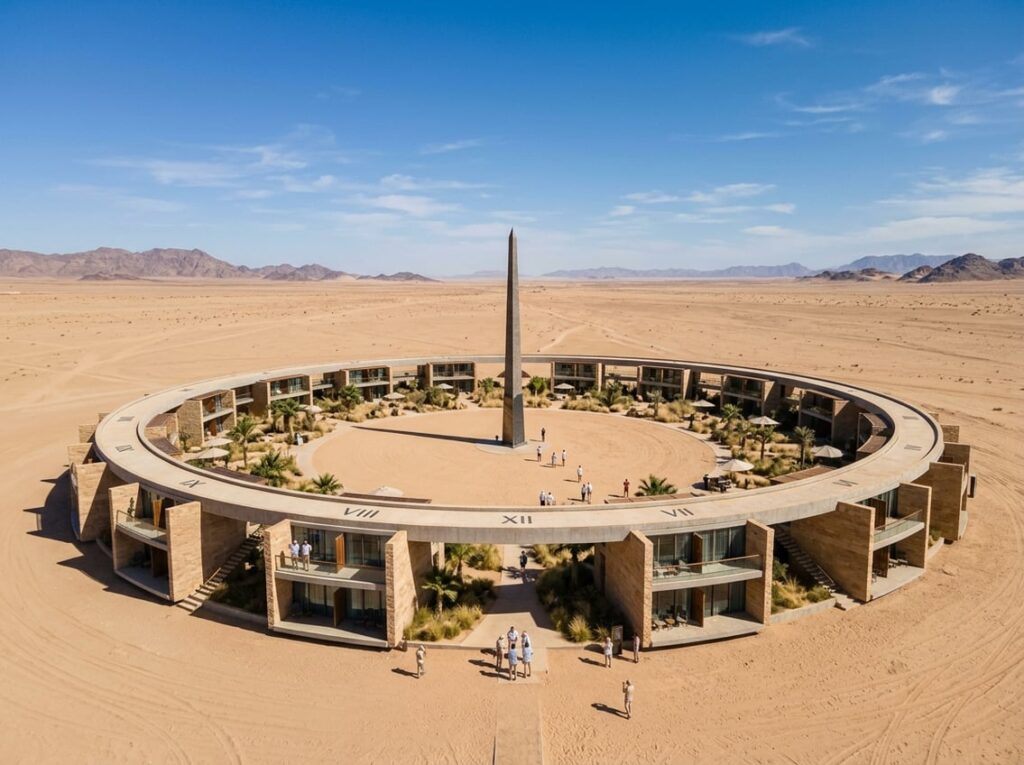
Suites ring the property like numbers on a timepiece, each at an hour mark around the sandy expanse. A slender obelisk rises from the center courtyard, its shadow sweeping the ground as the sun moves overhead. You can track the passing hours from your terrace, watching the dark line shift from suite to suite.
The architecture turns timekeeping into something you feel. Early risers gather in the eastern suites for breakfast, basking in morning light. By afternoon, guests migrate to the western side where shaded lounges offer relief from the heat. The obelisk’s shadow reaches your doorstep at a specific hour, a natural alarm clock connecting you to the ancient Egyptian reverence for solar cycles and astronomical observation.
The Serpent Causeway
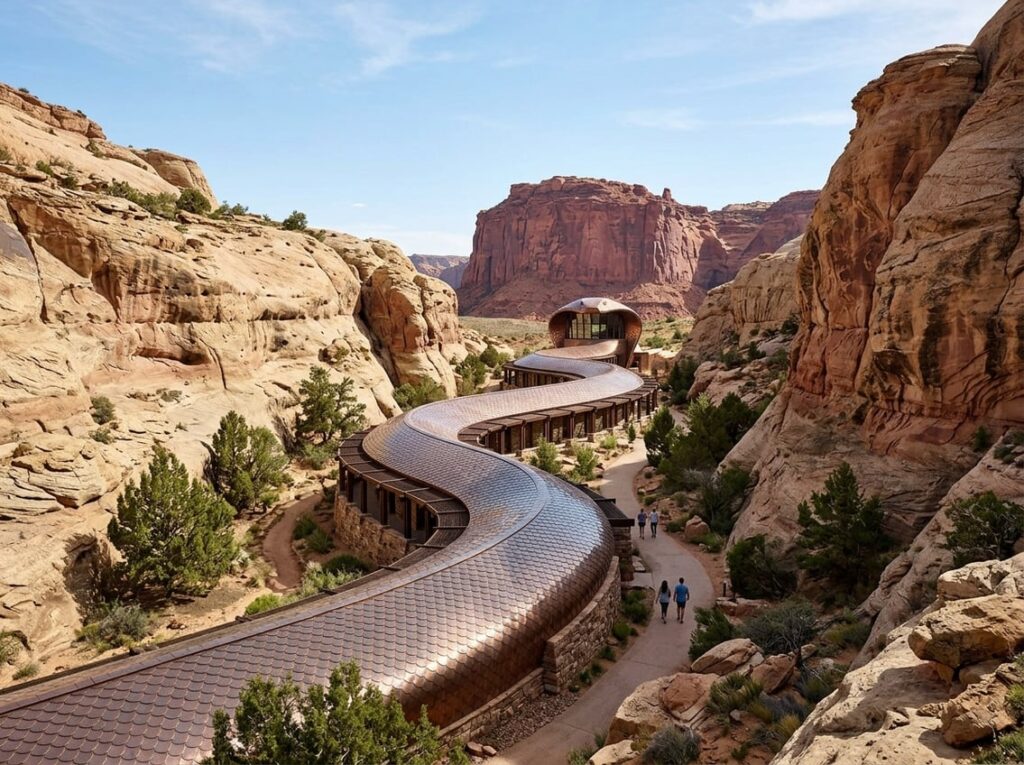
This narrow canyon hotel winds along the rocky floor, inspired by Egypt’s protective cobra deity. Copper panels shaped like serpent scales cover the roof, catching light and casting bronze reflections onto the stone walls. The structure hugs every curve of the canyon, creating a shaded gallery where you can walk in cool shadow even during the hottest hours.
At the canyon’s end, the main hall rises with dramatic walls that curve outward like a cobra’s flared hood. Floor-to-ceiling windows frame the red cliff face beyond, turning the rock into living artwork that shifts color as the sun moves. Evenings often find you in the stone galleries, with arched openings offering views of the canyon’s stratified walls and the serpentine copper roof stretching back toward the entrance.
The Royal Quarry Retreat
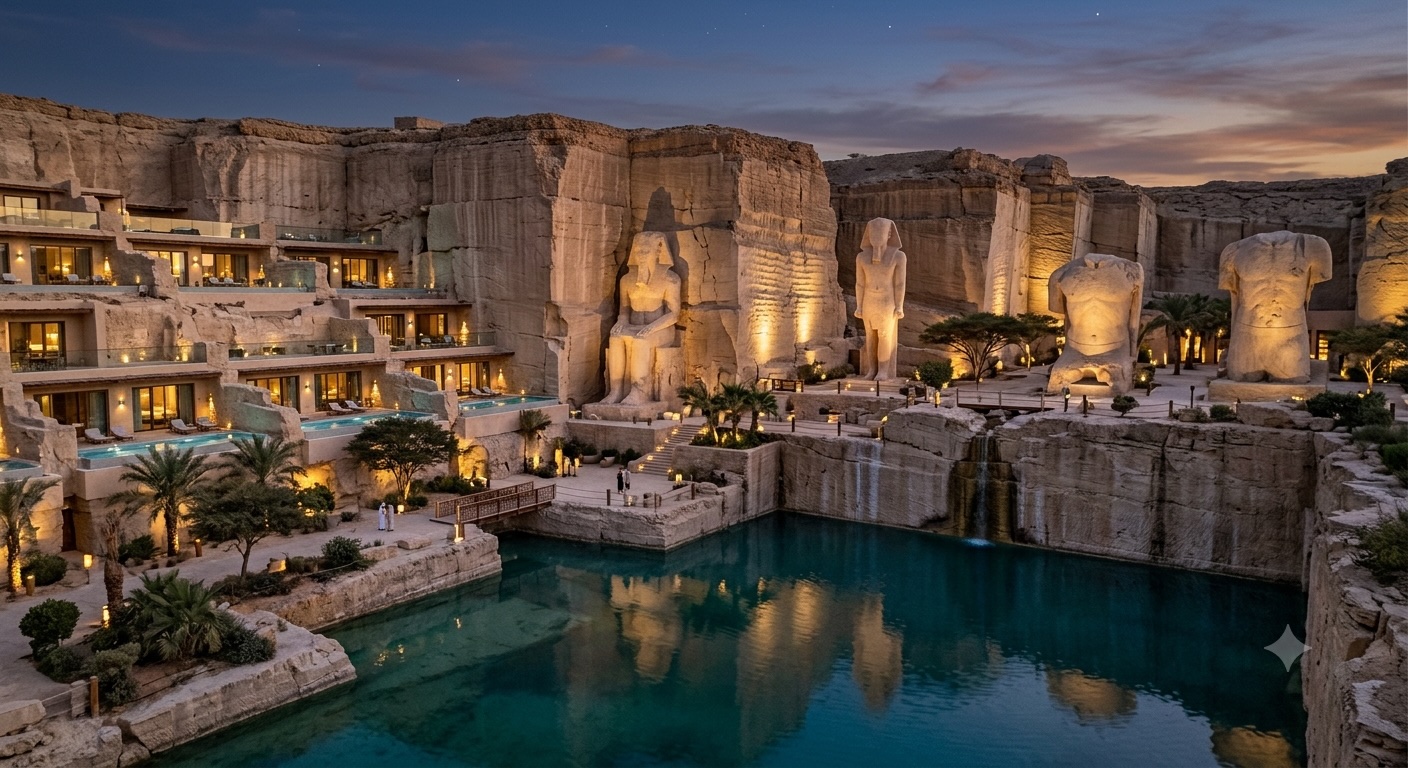
Limestone walls tower above your room, bearing the geometric cuts and chisel marks left by ancient workers who abandoned this quarry centuries ago. Half-carved statues emerge from the rock faces on various terraces, their forms suggesting pharaohs and deities that were never finished. Your accommodations use the natural cliff sides as interior walls, blending raw stone with modern comfort in unexpected ways.
The quarry floor holds a deep pool that mirrors the surrounding cliffs and unfinished monuments. You can explore winding paths past stone-cutting stations where massive blocks still rest at angles, frozen mid-extraction. As evening falls, dramatic lighting emphasizes the texture of tool marks across the rock, and the pool’s reflected glow creates shifting patterns on the quarry walls.
The Canopic Garden
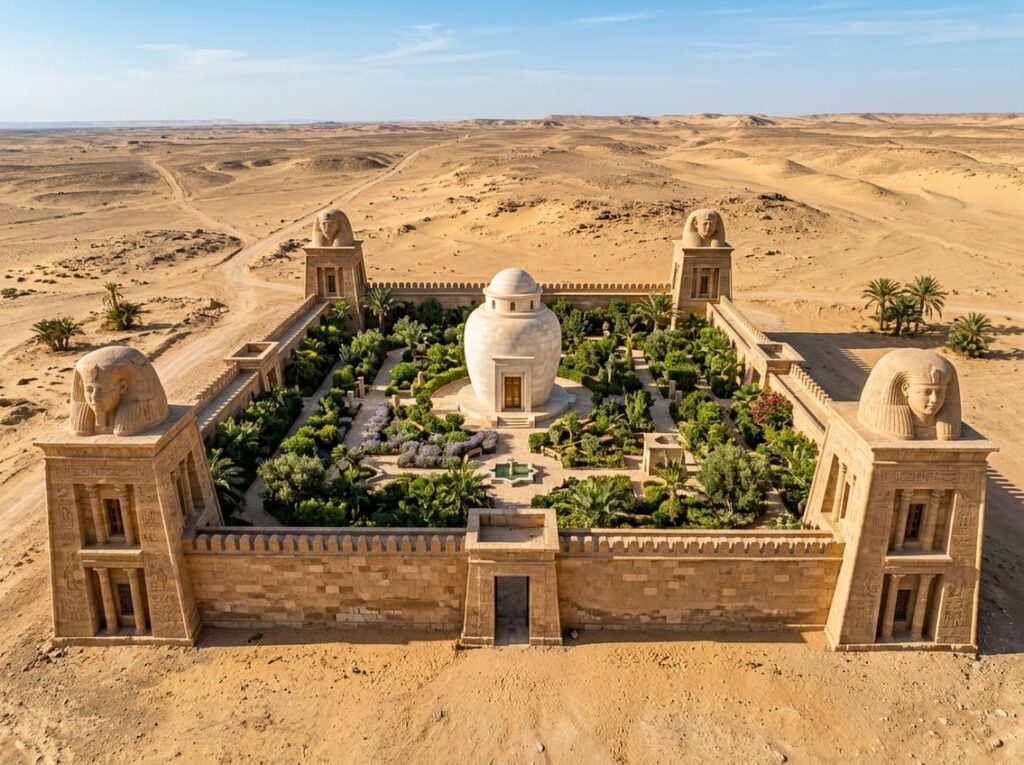
Four stone towers rise at the corners of this botanical retreat, each modeled after the protective deities that once guarded ancient burial vessels. The towers frame a sanctuary filled with lotus pools, papyrus groves, and rows of herbs that Egyptian healers relied on thousands of years ago. Your room sits within one of these guardian structures, offering views across fragrant gardens toward the desert.
At the center stands a pavilion shaped like a massive alabaster jar, its smooth curves glowing amber at sunset. You can take breakfast on its shaded terrace or spend afternoons wandering paths lined with blue water lilies and frankincense trees. The scent of cumin, coriander, and chamomile drifts through the air as you move between garden rooms, each dedicated to a different aspect of ancient Egyptian plant medicine. When night falls, oil lamps flicker along the pathways, and the towers stand watch like silent sentinels against the star-filled sky.
The Sand-Sail Citadel
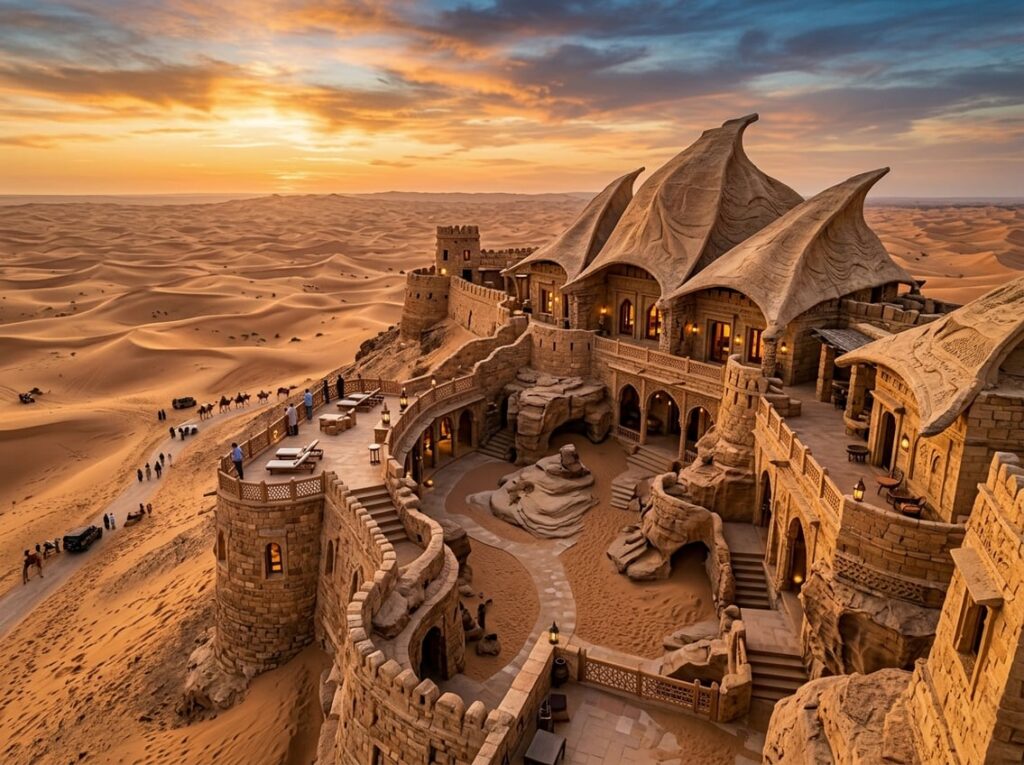
Perched on a towering dune ridge, this fortress hotel rises from the desert like an ancient military outpost reimagined for modern travelers. The rooflines billow in stone formations that echo sailing vessels, while wind carves natural patterns into the open-air courtyards below. Your room sits within thick walls that keep interiors cool, even when the midday heat settles over the sand.
Sunset terraces give you unobstructed views across miles of golden dunes that shift with each storm. You can watch shadows lengthen over the rippled landscape as the sky turns amber and rose. The design channels desert breezes through corridors and gathering spaces, creating natural ventilation that whistles softly past the sail-shaped architecture. At night, you’ll find the stargazing platform on the highest ridge, where the absence of light pollution reveals constellations that once guided caravans.
Osirian Greenhouse
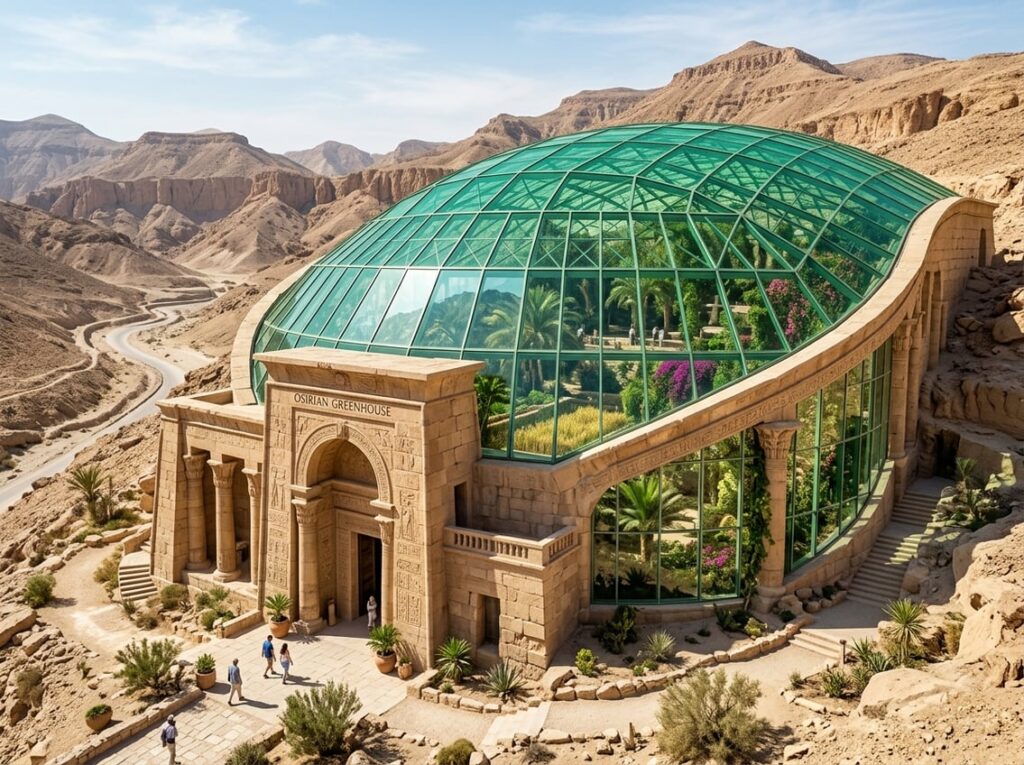
The hotel wraps around a vast indoor garden where ancient Egyptian agricultural symbolism meets modern climate control. You step through carved stone arches into a humid, green world where date palms reach for a translucent emerald ceiling, and terraced grain beds cascade down sculpted stone platforms. The glass-and-stone structure sits in an arid valley, making the lush interior feel even more dramatic.
Your room opens onto garden walkways lined with flowering vines and lotus pools. You can have breakfast beside ripening wheat beds or read beneath a pavilion shaded by persea trees, the sacred plants that once grew in temple gardens. At night, the emerald roof glows softly, casting everything in an otherworldly light that makes the space feel almost mythical. The air stays warm and fragrant, filled with the scent of wet stone and blooming plants year-round.
The Dendera Lanterns
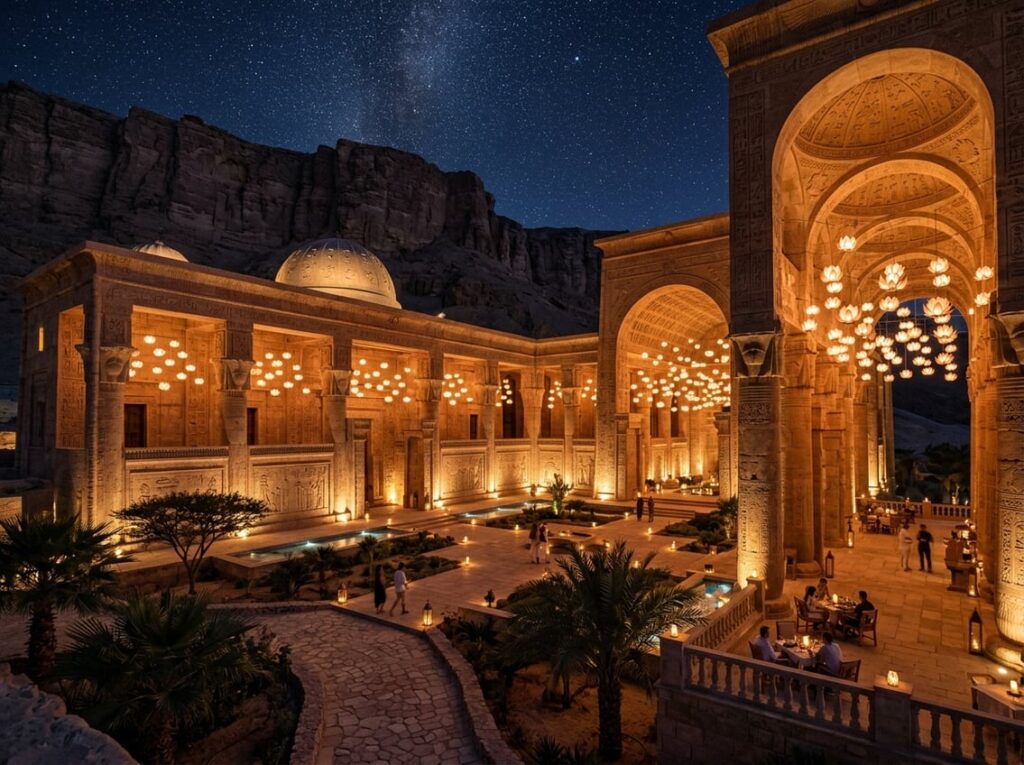
Carved sandstone courts rise around you at this boutique retreat, where ancient temple architecture meets the quiet drama of desert stargazing. Vaulted ceilings echo the geometry of Egypt’s celestial sanctuaries, and every archway frames the dark escarpment beyond. At sunset, staff light hundreds of lotus-shaped lanterns that float in shallow reflection pools and hang from copper chains above the corridors.
Your room opens onto a private terrace, letting you trace constellations without any light pollution getting in the way. The main courtyard turns into an outdoor lounge after dark, cushions scattered across stone platforms still warm from the day. Maybe you’ll head up to the observatory tower, where resident astronomers point out the same stars ancient priests once charted. Or just wander the lantern-lit passages, watching the glow soften as the night deepens.
The Red Crown Mesa
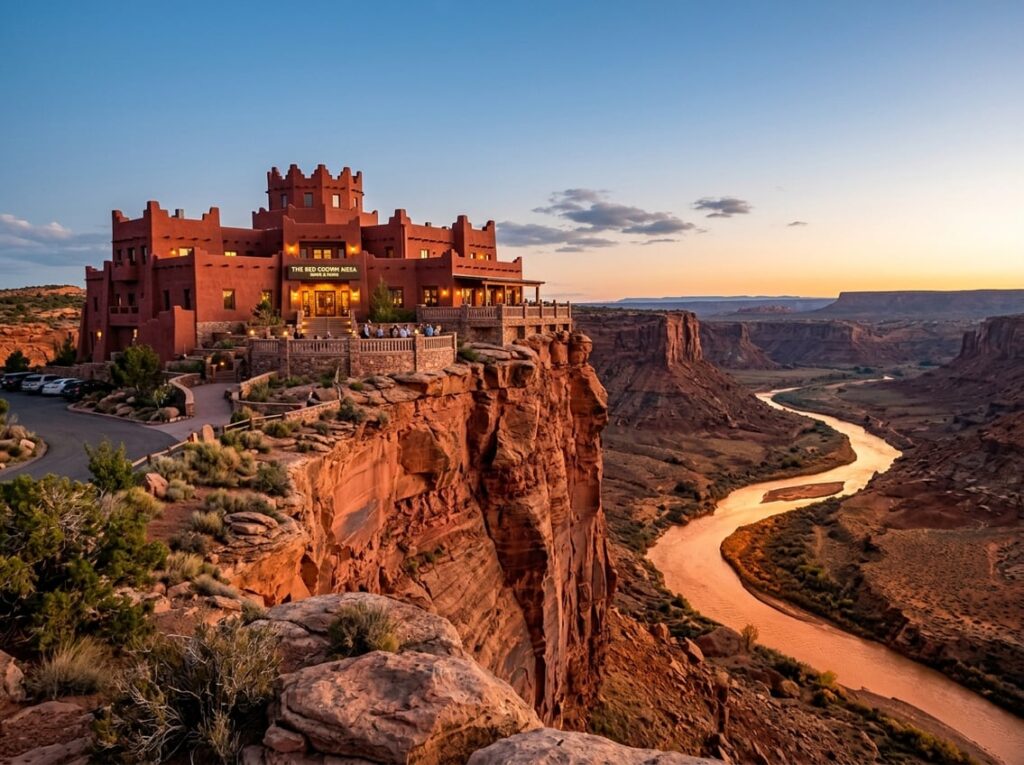
Perched high on a crimson cliff face, this hotel commands views over a dry riverbed that turns molten copper when the evening sun hits just right. The architecture borrows from ancient Egyptian fortifications—stepped red-plaster buildings and crown-shaped parapets catch the golden hour light. The staggered levels create natural terraces, perfect for watching the desert shift from burnt orange to deep burgundy as dusk settles in.
Your room opens straight onto one of these terraces, so you get a private front-row seat to the spectacle below. The rooftop observation deck sits at the highest point, where the crown motif feels especially bold in the design. Sunrise here? Stunning. The mesa glows pink, and the riverbed below almost goes violet in the early light.
The Whispering Reed Palace
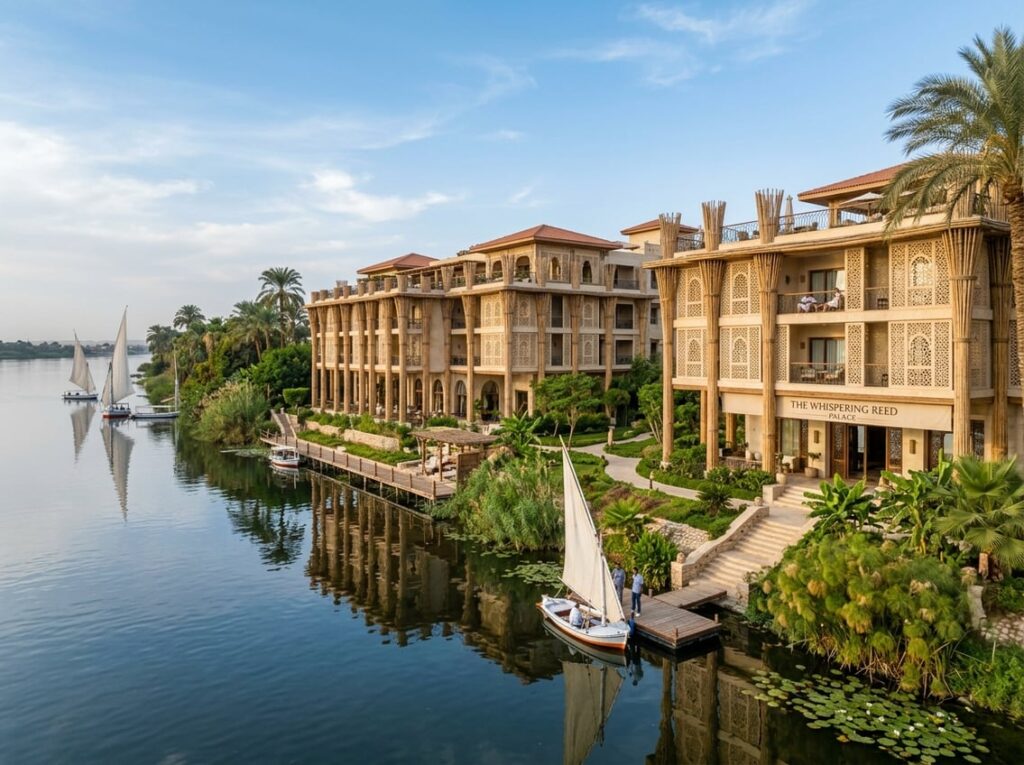
Slender columns rise along the riverbank, designed to echo the papyrus plants that once lined ancient waterways. The architecture centers on hollow reed-like structures that catch the breeze and turn it into soft, constant music. Limestone screens scatter daylight into shifting patterns across the terraces. You could easily spend hours watching the Nile’s current while listening to the wind play through the building itself.
Your room opens right onto these musical columns, and the air creates different tones depending on the time of day. The sound’s gentle, more background melody than anything else—easy to forget your phone exists. Guests gather on the waterside platforms at dusk, when the temperature drops and the reeds sing their clearest notes. The hotel’s restaurant sits inside a grove of these columns, so every meal comes with its own natural soundtrack.
The Sunken Alexandria Dream
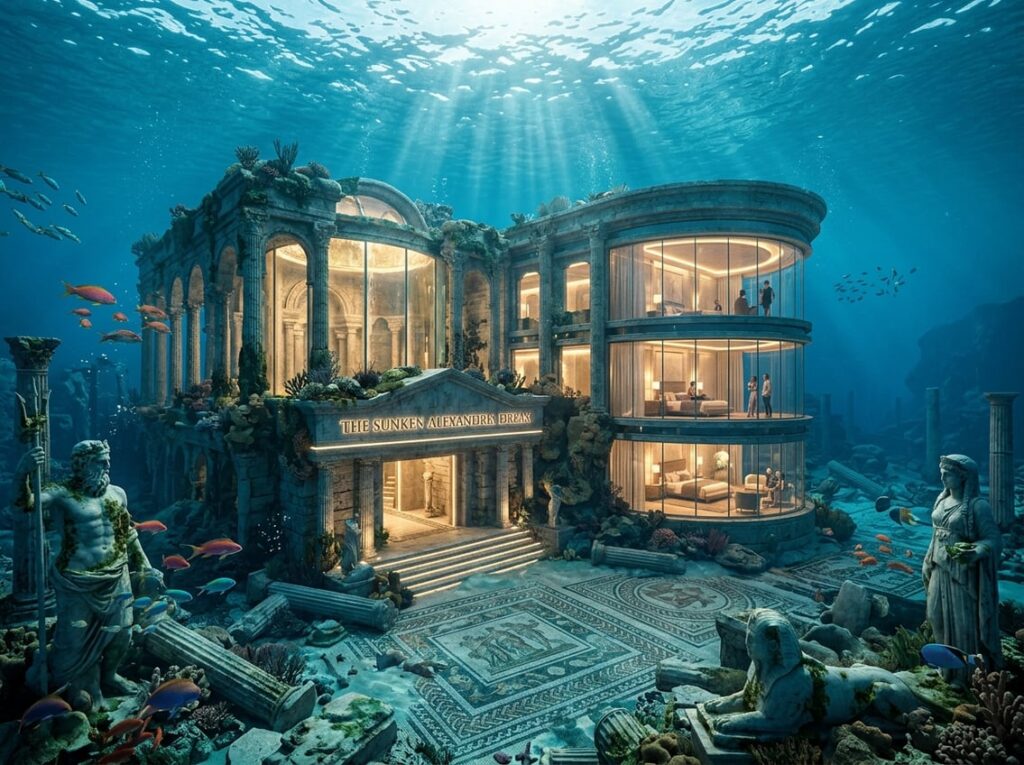
Glass walls curve around your suite as schools of fish drift past columns that once stood in an ancient harbor. This underwater hotel puts you inside a submerged world where Roman-era statues rest on mosaic floors and shafts of sunlight slice through the water above. Your room feels like a private observatory into another time, where history and marine life share the same space.
Column halls stretch out beyond your window, their capitals still decorated with lotus and papyrus carvings despite centuries beneath the waves. You can trace the patterns in the mosaics from your bed, watching rays and groupers investigate the stonework. At night, external lighting brings the statues to life in surprising ways, casting shadows that shift with the current. Morning brings the best visibility, when dawn light penetrates deepest and turns everything a soft azure blue.
The Granite Ram Court
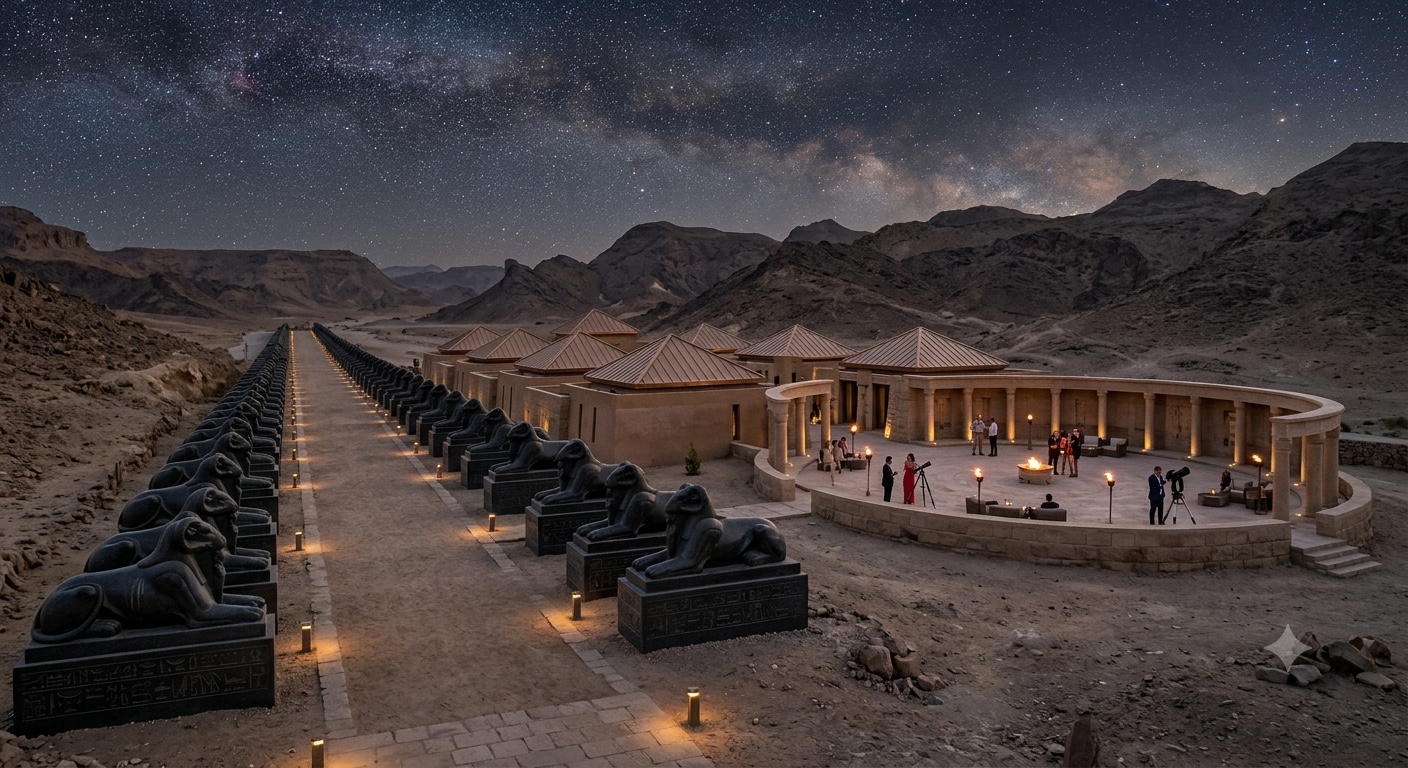
You’ll follow a striking avenue lined with towering black granite ram statues, their polished surfaces catching the harsh sunlight as you approach the main complex. The procession builds anticipation before you reach the low-slung bronze-roofed suites that seem to rise naturally from the valley floor. Floor-to-ceiling windows in your suite frame the desert landscape, pulling you right into the dramatic surroundings.
The open-air court at the heart of the property draws guests together after sunset. With no light pollution for miles, you get one of the clearest night skies imaginable—perfect for stargazing from cushioned loungers scattered across the space. The same ram statues that greeted you now stand as silent sentinels around the perimeter, their dark forms cutting dramatic silhouettes against the star-filled sky. The setting blends ancient Egyptian imagery with the raw beauty of complete desert isolation.
The Feather of Ma’at
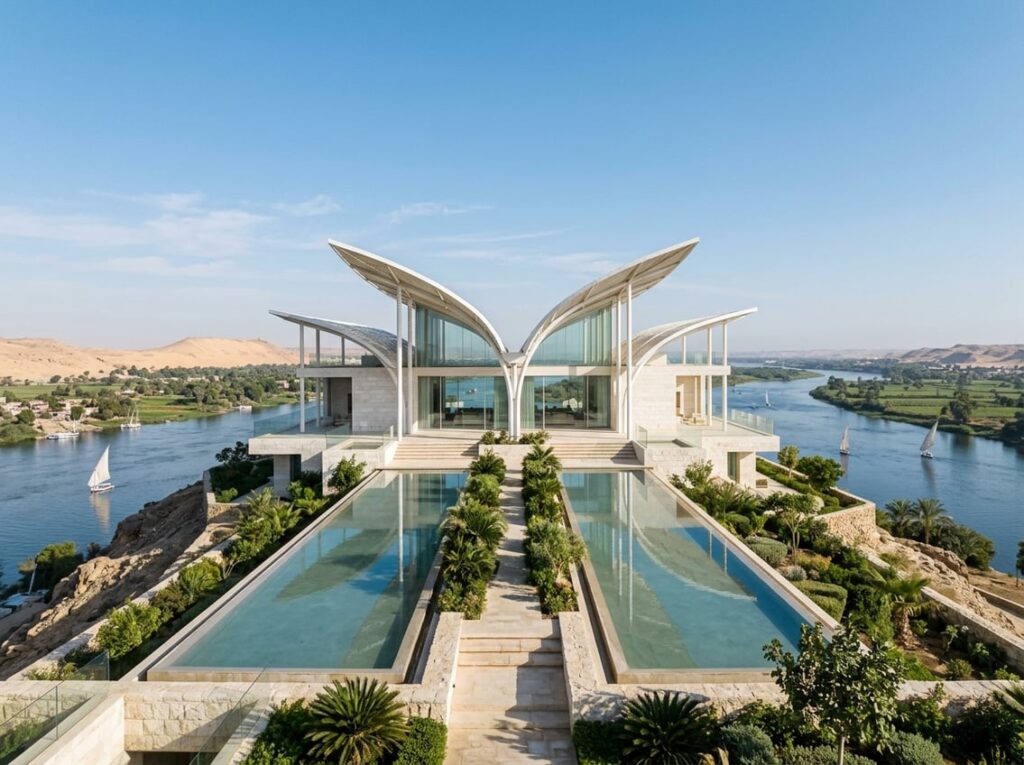
White stone rises from a narrow ridge high above the Nile, creating a retreat where ancient balance meets modern simplicity. The architecture follows Ma’at’s principle of harmony, with perfectly symmetrical design—twin reflecting basins on either side of the central hall, delicate shade roofs curving overhead in feather-like forms that filter sunlight into soft patterns across the limestone floors.
You’ll spend mornings in the central hall, where floor-to-ceiling windows dissolve the boundary between inside and sky, making the whole structure feel suspended in air. The narrow ridge means you’re surrounded by views—the Nile curves below on one side, desert valleys stretch endlessly on the other. Each guest room opens to its own section of the reflecting basins, so you can watch the water’s surface catch the changing light all day. The weightless quality of the space stands out at sunset, when the white stone glows amber and the feathered rooflines cast intricate shadows that shift like hieroglyphs across the ground.
The Hyena Valley Caravanserai
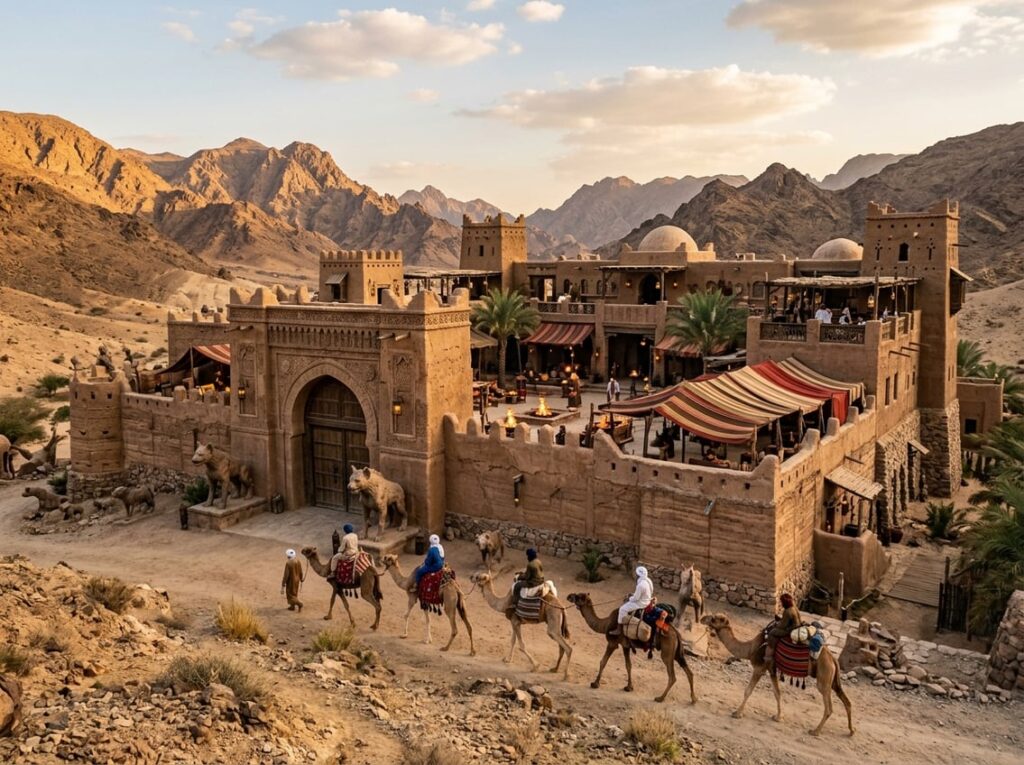
The desert pass opens to reveal mudbrick towers rising from rust-colored stone, their walls draped with striped fabric awnings that snap and billow in the wind. You arrive like travelers have for centuries, though your accommodations blend ancient caravanserai traditions with modern luxury that would probably leave those early merchants speechless.
Firelit courtyards become gathering spots after sunset, with sculpted animal guardians carved from sandstone standing watch at each corner. Your room occupies one of the fortified towers, thick walls keeping the desert heat at bay and windows framing the jagged valley beyond. Morning light catches dust motes drifting through shaded archways as you sip coffee near the central fountain, watching new arrivals finish their journey along the camel trail winding through the pass.
The Pyramid Orchard
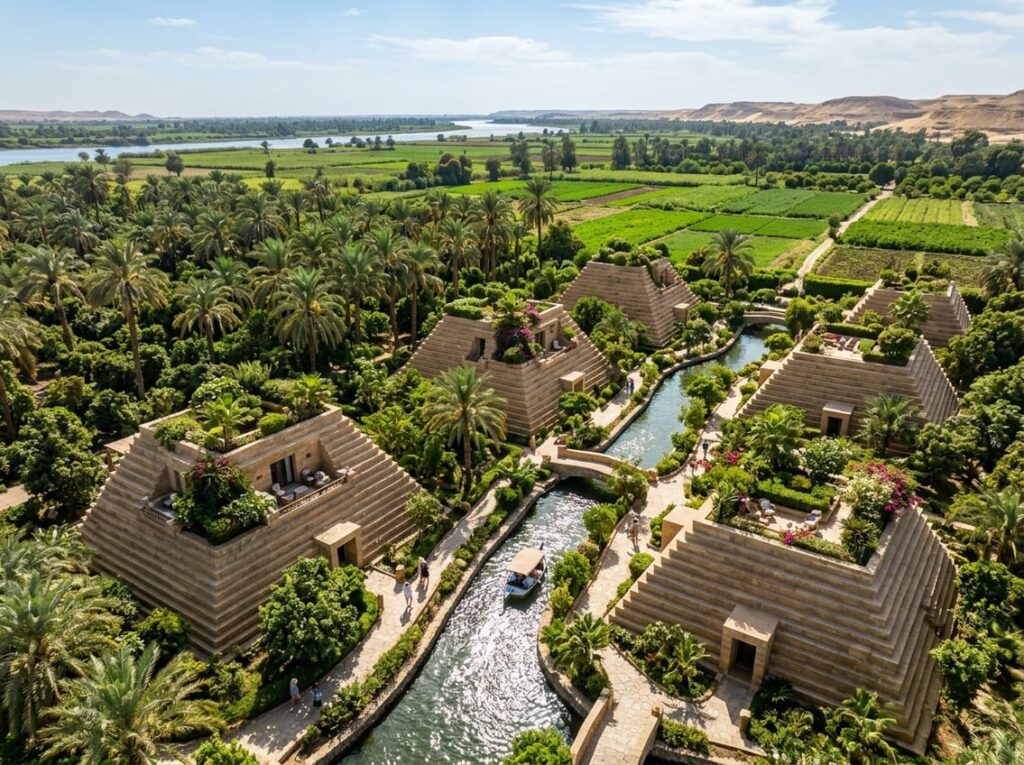
Terraced stone pyramids rise between rows of date palms and ancient fig trees, their stepped facades holding guest suites on multiple levels. You stay inside one of these geometric structures, with a private rooftop terrace overlooking irrigation canals that wind through the property like they did thousands of years ago. The green floodplain stretches beyond the cultivated grounds, offering views that shift between agricultural abundance and desert horizon.
Each morning, you can stroll along the canal paths connecting the pyramids, passing through groves where workers harvest dates by hand. Your suite opens onto gardens where pomegranates and figs grow in raised beds, and the rooftop space becomes your personal observatory at night. The resort runs as a working farm, so you might watch oxen pulling plows in demonstration fields or join bread-making sessions using grain milled on-site. The sound of water moving through ancient-style irrigation channels drifts through most outdoor moments here.
The Golden Mask Atrium
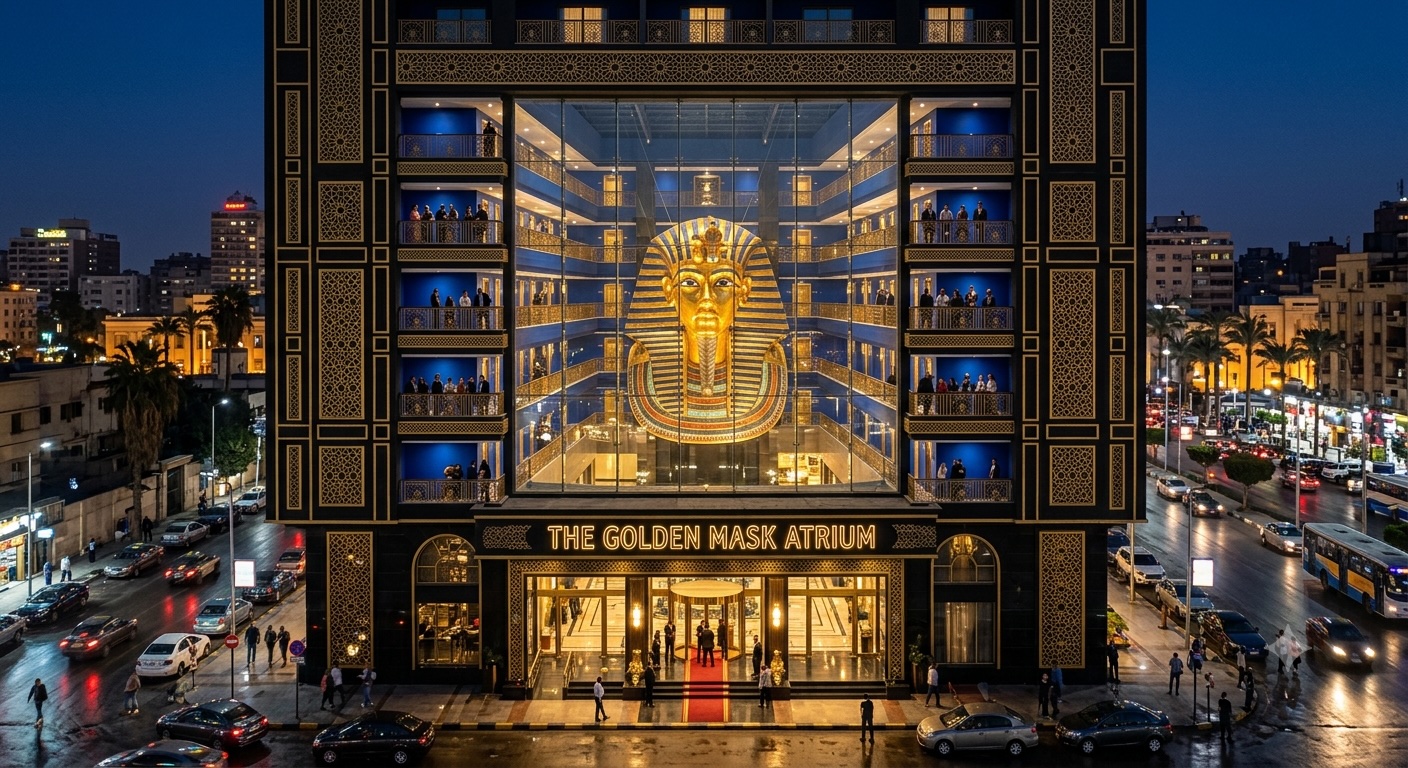
A colossal gilded mask floats at the center of this urban hotel, stretching through five floors of open space and tossing warm reflections across every surface. You walk into the lobby and—bam—there it is: an ancient pharaoh’s face in gleaming gold, suspended by nearly invisible cables, quietly watching everyone who enters. The walls show off bold black-and-gold geometric patterns that echo the mask’s sharp features, and royal-blue carpeting snakes down corridors wrapping around each level.
Your room’s balcony opens right onto the atrium, so you can stand there with your morning coffee and stare straight into those timeless eyes. At night, spotlights sweep across the mask’s contours, throwing shadows that make it seem almost alive. Riding the glass elevator becomes a little ritual—you glide past the mask’s forehead, then its cheekbones, noticing how the metalwork grabs the light in a new way on each floor. You might spot other guests lingering on their own balconies across the void, everyone caught up in this odd, theatrical view of a face that’s somehow both monument and centerpiece.