
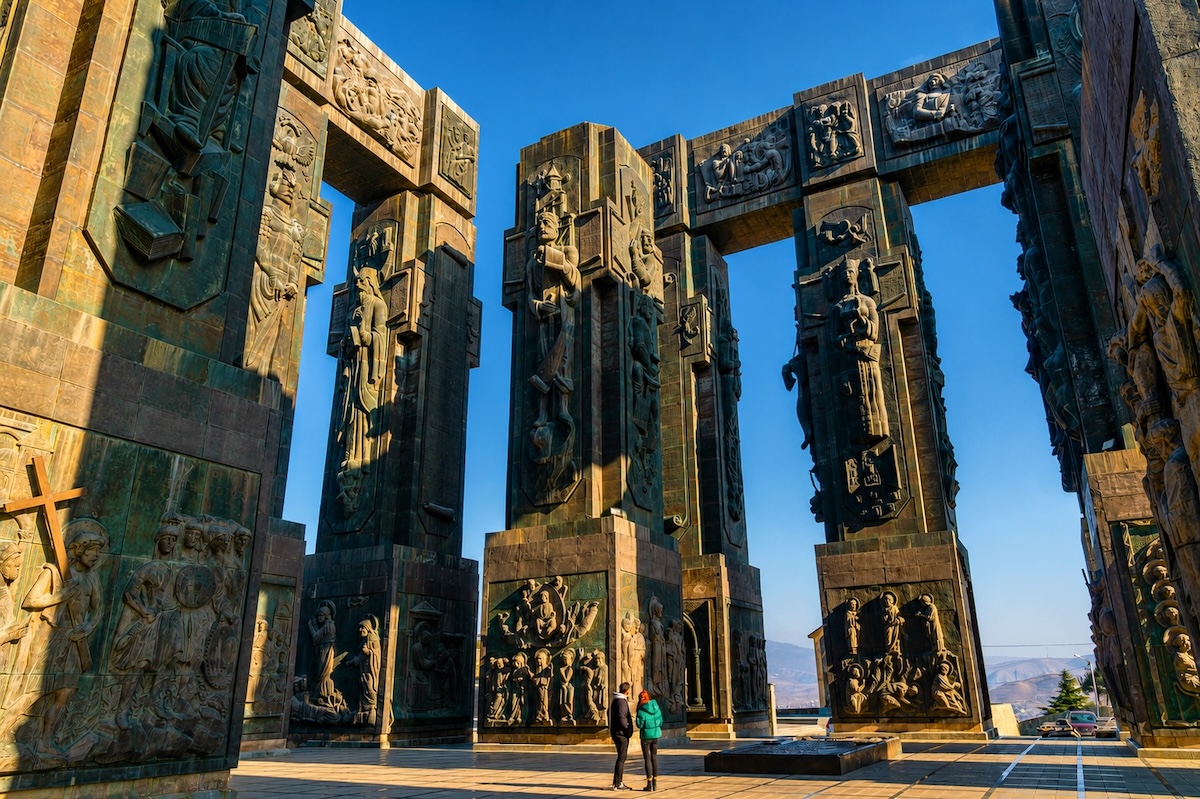
Standing on a bare hilltop at the northern edge of a forgotten capital, sixteen stone pillars rise more than 30 meters into open sky. There aren’t any ticket booths or crowds—no gift shops either. Just this huge, quiet monument looking out over a reservoir, surrounded by old Soviet apartment blocks and dry grass. If you’ve spent your time wandering the cobbled streets of Old Town, coming here feels like you’ve landed in a completely different city.
The Chronicle of Georgia tends to catch people by surprise. It’s far enough from central Tbilisi that most visitors don’t even know it’s there, but it’s honestly one of the most visually jaw-dropping things you’ll see in Georgia. The carved bronze panels, the sheer size of those columns, and the views over Tbilisi Sea—yeah, it’s worth the extra effort. The trick is just knowing it’s out there, and figuring out how to get up the hill.
What The Monument Is
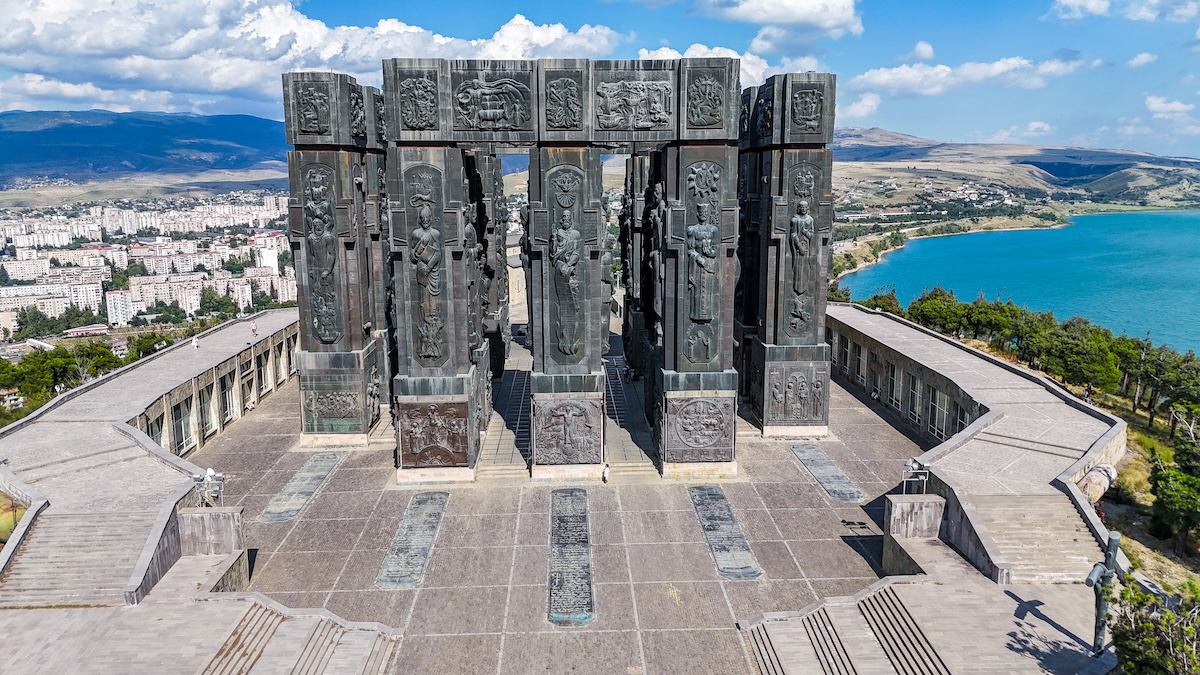
The Chronicle of Georgia is a massive sculpture complex on Mount Keeni, about 15 kilometers north of downtown. It overlooks Tbilisi Sea, the city’s biggest artificial reservoir, from a windswept hilltop with almost no tree cover or shade. Some people call it the History Memorial of Georgia, or more casually, the Georgian Stonehenge.
Georgian-Russian sculptor Zurab Tsereteli came up with the design, and workers started building it in 1985. They never actually finished it, which explains the raw, unfinished vibe. You’ll spot bare stone surfaces and parts of the base that look like they were waiting for something more. That roughness? It kind of adds to the mood, honestly.
Sixteen massive pillars stand in a loose grouping, each covered in big bronze bas-relief panels. A wide staircase leads up from the hill’s base, and there’s a small church nearby. From up top, you’ll get a sweeping panorama of the reservoir, the rolling hills, and the boxy residential blocks below.
You can reach it by taking Bus 360 from near Ghrmaghele metro station. Hop off one stop past Tbilisi Sea, then walk about 15 minutes uphill. A Bolt or taxi from the center costs around 10-15 GEL and saves some time. Plan to spend anywhere from half an hour to an hour wandering around.
Design And Symbolism
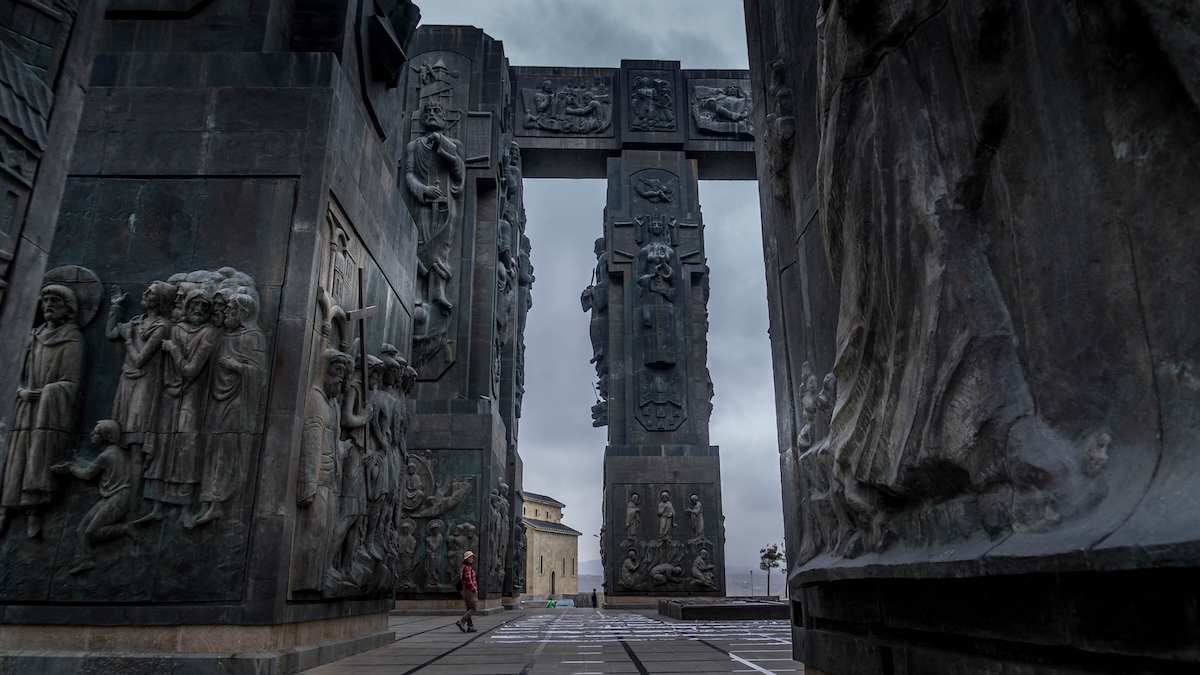
Each of the 16 pillars splits into visual zones. Up top, you’ll spot Georgian kings, queens, and all sorts of historical figures spanning nearly three thousand years. Armored warriors and robed rulers march across the bronze, their forms blocky and bold—very much in that heavy, oversized Soviet monumental style. It’s clearly meant to be seen from afar, not squinted at up close.
Lower down, things turn religious. Scenes from Christ’s life and Georgia’s early Christian history dominate, with crosses, biblical faces, and twisting vine patterns popping up everywhere. The contrast feels deliberate: secular rulers above, sacred stories below. It’s a vertical timeline, blending political and spiritual identity right on each column.
Get closer and you’ll notice the bronze has picked up a greenish patina after years in the elements. If you run your hand along the figures, the detail is impressive for something so massive. Some spots have softened with age, while others look almost fresh. The columns themselves are stone and concrete, rough to the touch, with visible seams where materials were joined.
The hilltop location really sets the mood. There’s nothing else around, no buildings, no city noise. On a clear day, the pillars cut sharply against the sky and the flat blue of the reservoir. The silence and scale hit you at once. Standing at the base, you can’t help but feel tiny—and that could well be the whole idea.