
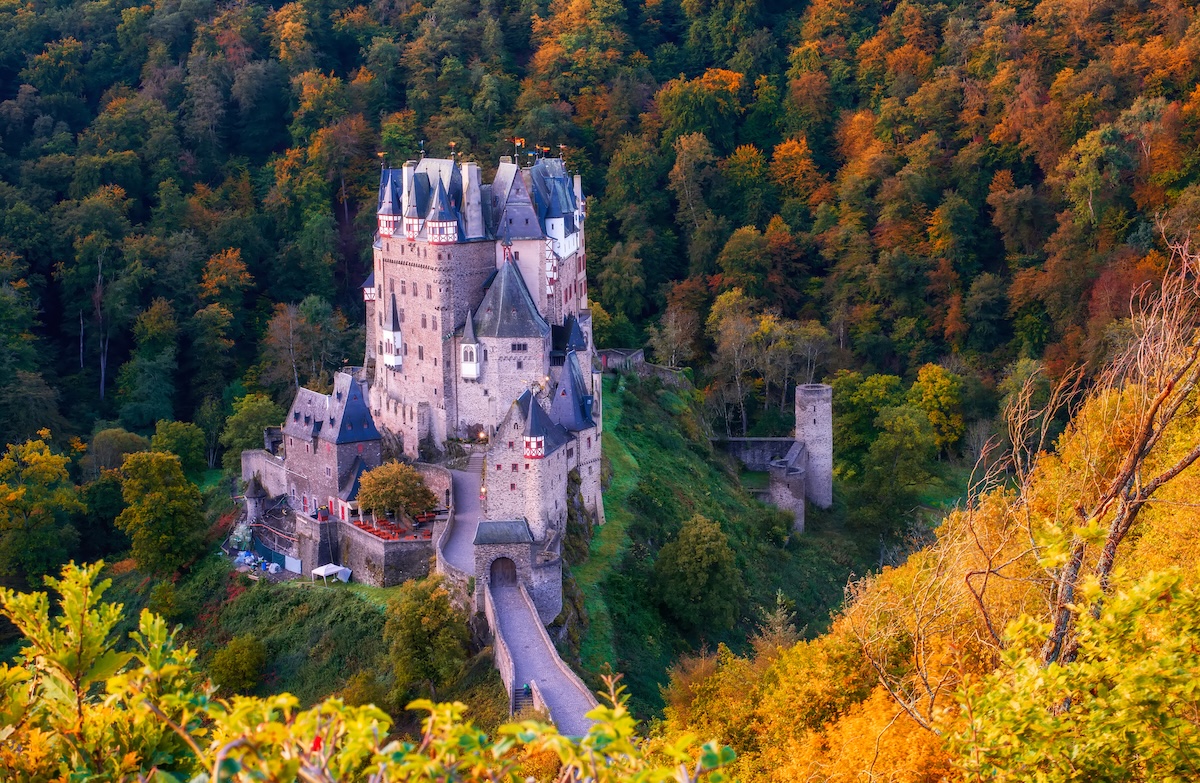
Somewhere in the western hills of Germany, tucked deep in a forested valley with no town anywhere close, a medieval castle still stands right where builders placed it more than 850 years ago. No ruin, no theme-park makeover, nothing fake. Burg Eltz is that rare European castle that actually looks the way you hope castles will look, and it’s earned that reputation the hard way.
Sitting on a rocky spur above the Elzbach stream between Koblenz and Trier in Rhineland-Palatinate, Burg Eltz has stayed in the same family since the 12th century. Thirty-three generations of the Eltz family have kept the property, and remarkably, war or fire has never destroyed the castle. That kind of continuity makes a visit here feel different from most German castle stops. You’re not wandering through a careful restoration or a hollow shell packed with museum signs. You’re standing in rooms that people actually lived in and furnished for centuries.
If you’re planning a trip through the Moselle Valley or just wondering if Burg Eltz is worth a detour, the short answer’s yes. The longer answer? It’s a walk through old-growth forest, eight stone towers—some rising up to 35 meters—and a treasury full of gold and silver that’s never left the building. Can you really pass that up?
Medieval Character Without Heavy Reconstruction
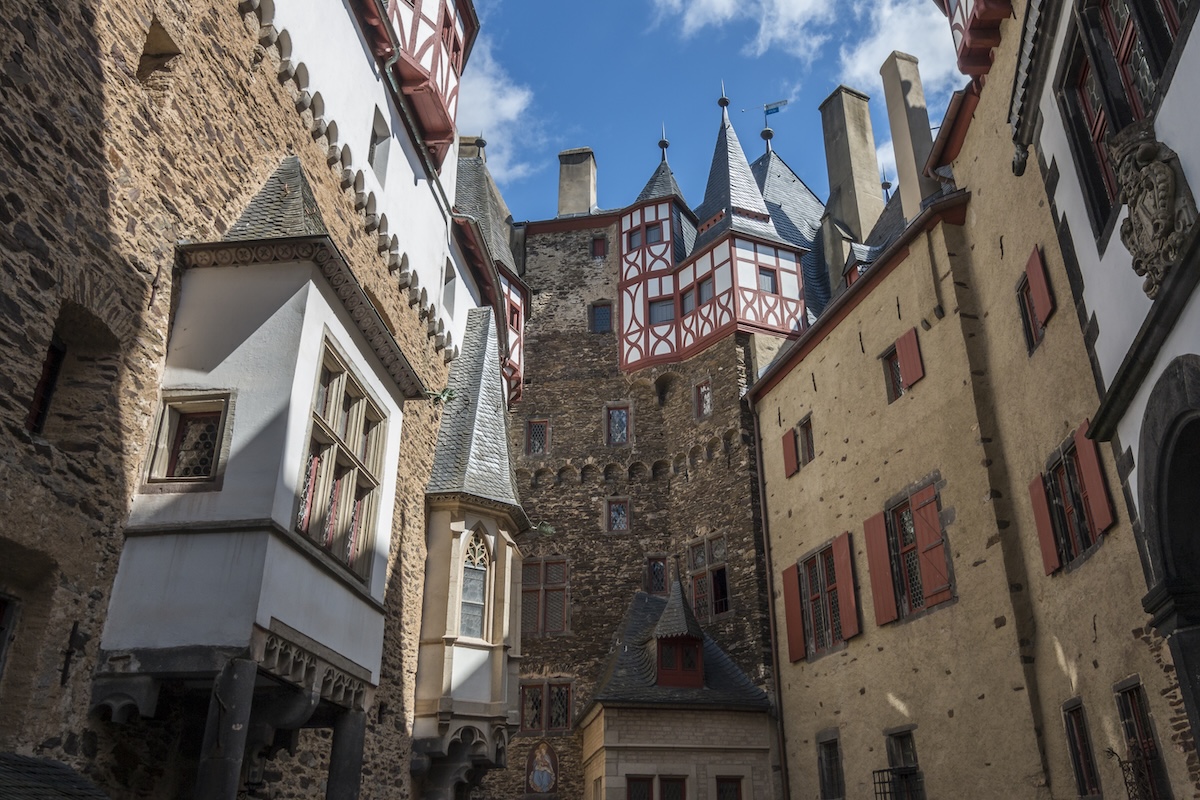
Most of Germany’s famous castles didn’t make it through the centuries unscathed—flattened in the Thirty Years’ War, torched by the French, or rebuilt in the 19th century to fit Romantic tastes. Burg Eltz dodged all that. The Eltz family survived centuries of regional conflict by relying on diplomacy instead of siege warfare, so the castle stayed intact while neighboring fortresses crumbled.
Today, you get a blend of Romanesque, Gothic, and Baroque details layered over about 500 years of construction and slow change. Timber-framed oriels stick out from stone walls, slate roofs tilt at odd angles, and the rooms inside curve along the rock beneath, making the layout feel handmade—never cookie-cutter.
Guided tours lead you through rooms filled with tapestries, painted ceilings, period furniture, and kitchenware that’s been there for generations. The Craftsmen’s House section was rebuilt in the 19th century using a 1680 painting as a guide, but even that was about accuracy, not spectacle. Downstairs, the treasury still displays centuries-old gold and silver in the same castle where the family collected it.
You won’t find velvet ropes or dramatic lighting here. The interiors feel genuinely residential, not staged. That’s what really sets Burg Eltz apart from slicker sites like Neuschwanstein. Nothing here was designed to impress visitors. People built it to live in, and you can still feel that when you walk through.
Setting In The Eltz Forest
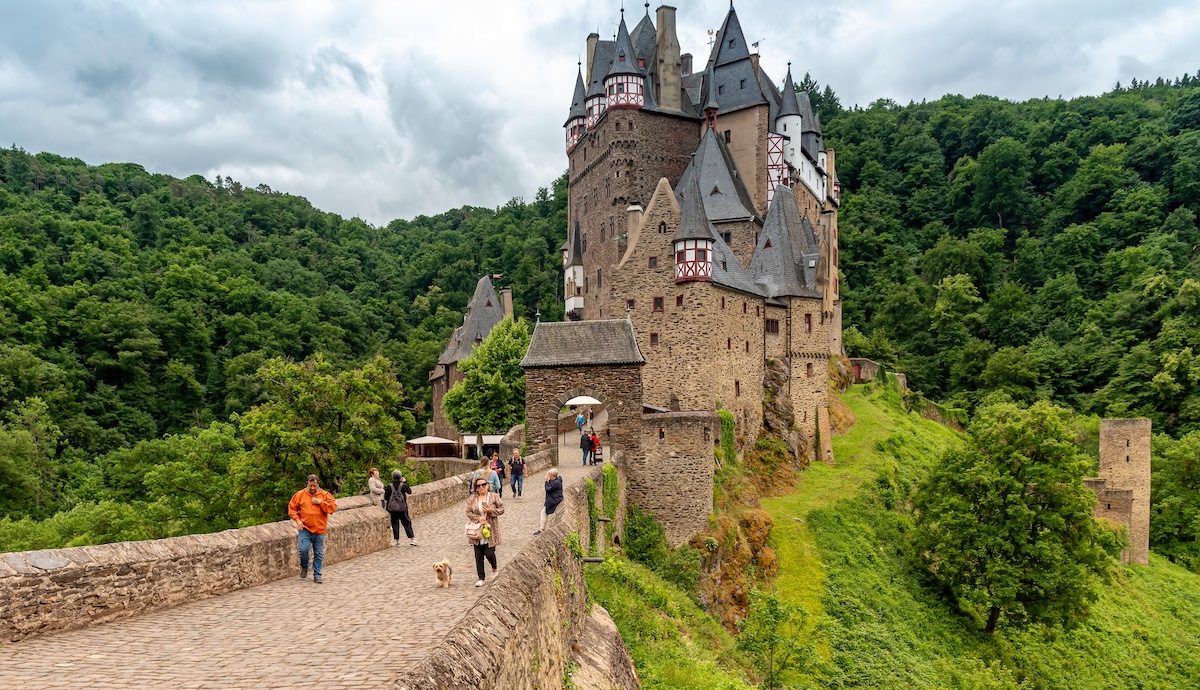
The approach to Burg Eltz is half the fun. You won’t spot the castle from a highway or some big parking lot overlook. Instead, you start from the nearest village—Münstermaifeld—or maybe the trailhead near Moselkern, and you follow a winding path into the Eltz Forest. This place is a protected nature reserve, over 300 hectares, all wrapped up in the Natura 2000 network.
Most people take the walking route from Moselkern train station. It’s about 4.5 kilometers and usually takes an hour or so if you don’t rush. The trail drops gently alongside the Elzbach stream, weaving through thick woods, over little bridges, and past mossy rocks that look like something out of a storybook. You hear the water before you even glimpse the castle. And then, suddenly, Burg Eltz just appears through the trees—eight towers perched on a narrow rock, the stream curling around three sides.
From the castle grounds, you can’t see any modern development. No tacky gift shops, no hotels crowding the view, not even a stray power line. That kind of isolation is rare for a major European landmark. It really does feel more 12th century than 21st, at least for a moment.
If you’re driving, there’s a shuttle from the upper parking lot down to the entrance. Still, if your legs and timing are up for it, the walk through the forest is just better. It gives you a chance to shake off the highway and settle into a slower, quieter world.