
Soaring wooden roofs, intricate carvings, and centuries of history give these remarkable buildings an almost fairytale-like appearance. Among the most distinctive medieval structures in Europe, they offer a fascinating glimpse into a world where craftsmanship and faith shaped entire communities.
Built primarily between the 12th and 13th centuries, stave churches are medieval wooden churches characterized by their unique timber-frame construction. While examples once stood across much of Northern Europe, the finest and best-preserved survive today in Norway, where they remain among the country’s most treasured historic landmarks.
From remote mountain valleys to picturesque rural villages, these architectural masterpieces continue to captivate visitors with their age, artistry, and extraordinary resilience. Their blend of Christian symbolism, Viking influences, and medieval craftsmanship makes them unlike any other churches in the world.
10. Flesberg Stave Church

The Flesberg Stave Church is located in Buskerud County, and it was constructed toward the end of the 12th century. The church was renovated in a significant way in the middle of the 18th century. As a result, little of the structure is entirely original. What makes Flesberg Stave Church particularly interesting is the slate fence surrounding the building, which has iron rings attached to it. Historically, each ring belonged to a local farmer and was where he would tie his horse when in church.
9. Gol Stave Church

As the name suggests, the Gol Stave Church was originally located in Gol. Today, however, this stave church is found at the Norwegian Museum of Cultural History in Oslo. The entire structure was to be replaced a century ago to make way for a new church, but King Oscar II decided to preserve it. The unusual design, with multiple pitched roofs, is so impressive that multiple replicas have been made. There is even one found in North Dakota, America!
8. Undredal Stave Church

In the year 1147, the Undredal Stave Church was constructed in the small village of Undredal, which is situated right on the banks of the Aurlandsfjorden. This church is one of the smallest of its kind still operating in Norway. It has just 40 seats, and the floor plan of the building is a scant 4 by 12 meters (13 by 39 feet). Like many of the medieval stave churches, Undredal has been relocated several times, often with minor changes made along the way.
7. Roldal Stave Church

Røldal Stave Church is unique in that today, it serves as both as museum and a functioning church. On two Sundays each month, parishioners gather in Røldal Stave Church for services. The rest of the time, the 13th century structure is open to the public and preserved as a museum. Inside the church, wooden sculptures dating to the 13th century depict biblical stories like the Virgin Mary with child and the Archangel Michael visiting Earth.
6. Kaupanger Stave Church

The 12th century Kaupanger Stave Church has been in continuous use for more than 800 years, which makes it a great example of local culture, history and heritage. It has a large number of staves, or weight-bearing columns, which sets it apart from other older churches in Norway. In the 19th century, there were drastic renovations to the Kaupanger Stave Church. Thankfully, however, most of these unattractive changes were undone in the 1960s, creating an image of the church that more accurately reflects its medieval origin.
5. Reinli Stave Church

The 12th century Reinli Stave Church in Oppland County is likely the third structure to have stood in that exact spot. While that isn’t unusual, what is definitely uncommon is that the previous structure was a pagan building. The Reinli Stave Church looks more traditional than some other stave churches in Norway, but it is still a wonderful glimpse into the past. In the 20th century, some renovations updated the building, adding in things like electricity, lights and heating.
4. Hopperstad Stave Church

Outside the tiny village of Vikøyri, there is the Hopperstad Stave Church. Constructed in the beginning of the 12th century, the structure is one of the oldest stave churches in Norway. By the 19th century, however, the church was abandoned. Even some of the wood siding was removed from the building. Thankfully, the church was purchased and restored. The triple nave is still an important feature, as is the altar dedicated to the Virgin Mary.
3. Urnes Stave Church

Surrounded by picturesque beauty, including fjords and lush green fields, stands the 12th century Urnes Stave Church. Since it is one of the earliest stave churches, it serves as a link between the Viking religions and a more Western Christianity. There is a lot of animal imagery, some of which comes from the Bible and some of which comes from Norse mythology. The church is not used for regular services, but locals still have weddings and baptisms in the unique structure.
2. Borgund Stave Church

Arguably one of the best preserved stave churches in Norway is Borgund Stave Church. Built roughly between 1180 and 1250, Borgund Stave Church has what is known as a basilica layout, and it has several tiered, overhanging roofs. Since the late 19th century, the church hasn’t been used for religious purposes, but it is now run as a museum for the public. Of particular note for visitors are the inscriptions found on the wall, which are believed to date back to the 13th century.
1. Heddal Stave Church
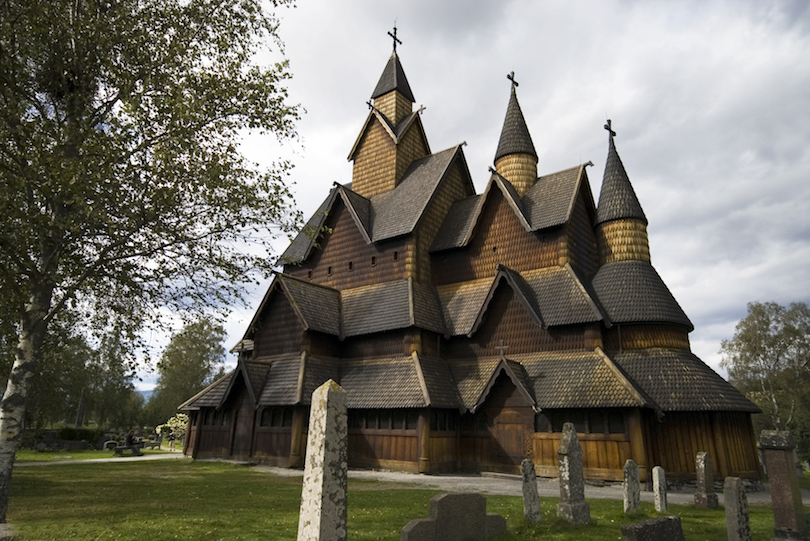
The largest of all stave churches in Norway is Heddal Stave Church. Heddal was constructed in the beginning of the 13th century, and its origins have some unusual roots. Legend says that the entire church, an enormous structure by stave standards, was built in just three days by five local farmers. Whether or not that is true, it adds intrigue to the church. Heddal’s exterior was restored in the 19th and 20th centuries, and its interior had serious changes under Lutheran control in the 16th century.